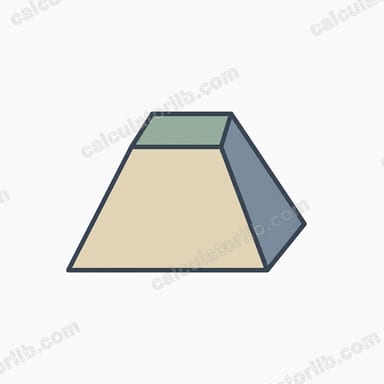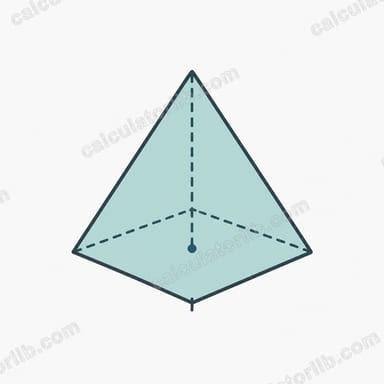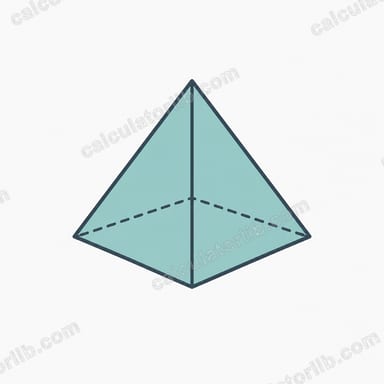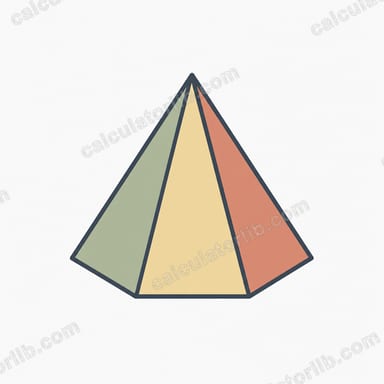

What is a Hexagonal Pyramid?
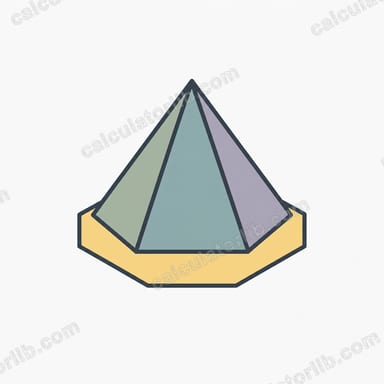
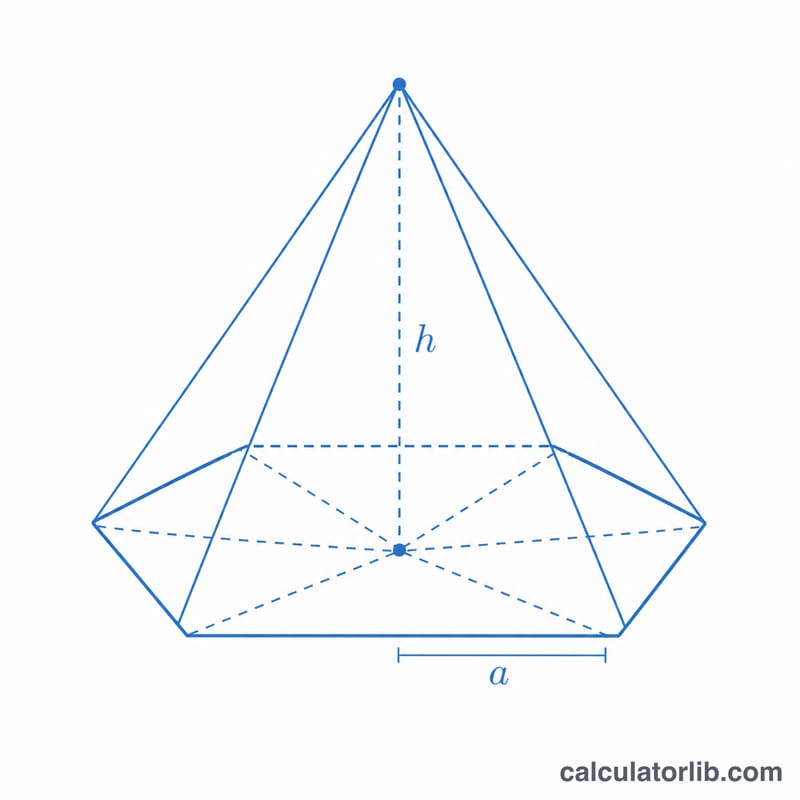
A hexagonal pyramid is a three-dimensional solid with a six-sided (hexagonal) base and six triangular faces that meet at a single point called the apex. When the base is a regular hexagon — all six edges equal — and the apex sits directly above the center of the base, the shape is a regular hexagonal pyramid. This calculator finds its volume from just two measurements: the base edge length and the perpendicular height.
How to Use This Calculator
Enter the length of one side of the hexagonal base (a) and the vertical height of the pyramid (h) measured from the base to the apex. Both values must be in the same unit (for example centimeters). The result is returned in cubic units, along with the area of the hexagonal base for reference.
The Formula Explained
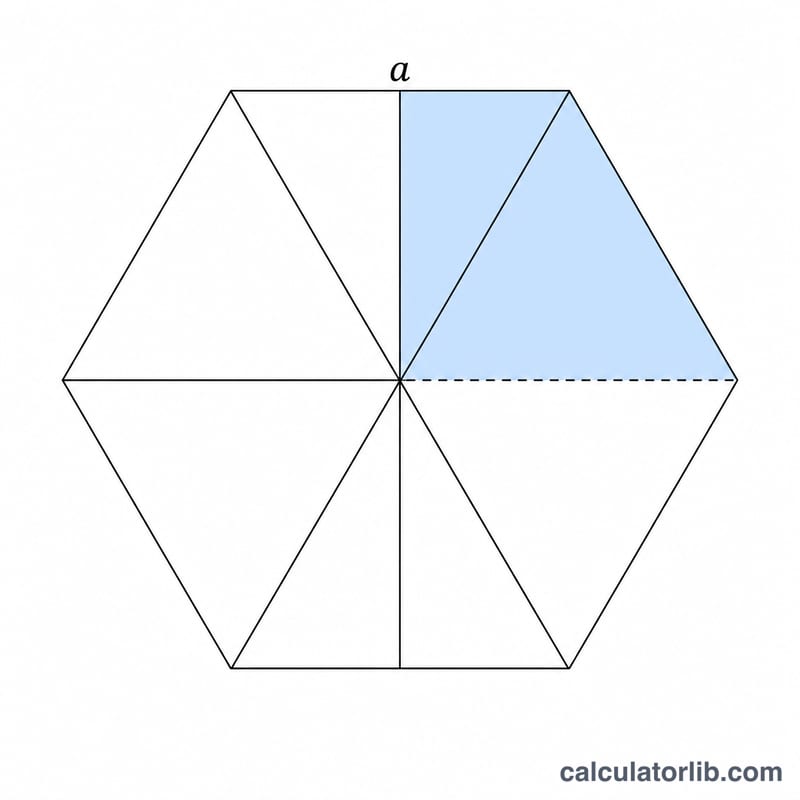
The volume of any pyramid is one-third of its base area times its height: \(V = \frac{1}{3} \cdot A \cdot h\). For a regular hexagon, the base area is \(A = \frac{3\sqrt{3}}{2} \cdot a^{2}\). Substituting gives:
$$V = \frac{1}{3} \cdot \frac{3\sqrt{3}}{2} \cdot a^{2} \cdot h = \frac{\sqrt{3}}{2} \cdot a^{2} \cdot h$$
The \(\sqrt{3}\) appears because a regular hexagon can be split into six equilateral triangles, each with area \(\frac{\sqrt{3}}{4} \cdot a^{2}\).
Worked Example
Suppose a hexagonal pyramid has a base edge a = 5 and height h = 10. The base area is $$\frac{3\sqrt{3}}{2} \cdot 5^{2} = 2.598 \times 25 = 64.95.$$ The volume is $$\frac{1}{3} \cdot 64.95 \cdot 10 = 216.51 \text{ cubic units}.$$ Using the compact form: $$\frac{\sqrt{3}}{2} \cdot 25 \cdot 10 = 0.866 \times 250 = 216.51.$$
FAQ
Does this work for irregular hexagonal pyramids? No — it assumes a regular hexagon base with all edges equal. For an irregular base, compute the base area separately and use \(V = \frac{1}{3} \cdot A \cdot h\).
What is the difference between height and slant height? Height (h) is the perpendicular distance from the base to the apex. Slant height runs along a triangular face. This calculator uses the perpendicular height.
What units does the result use? Whatever length unit you enter, the volume comes out in that unit cubed (e.g. cm → cm³).