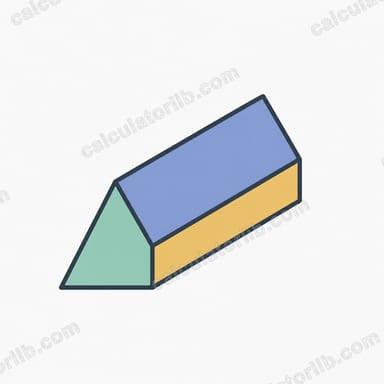

What is a triangular prism volume calculator?
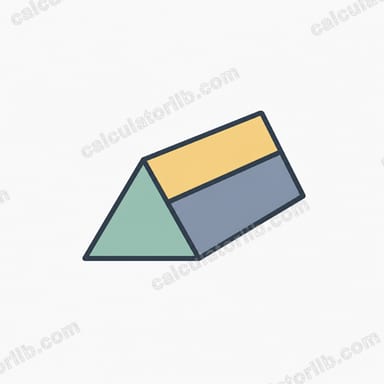
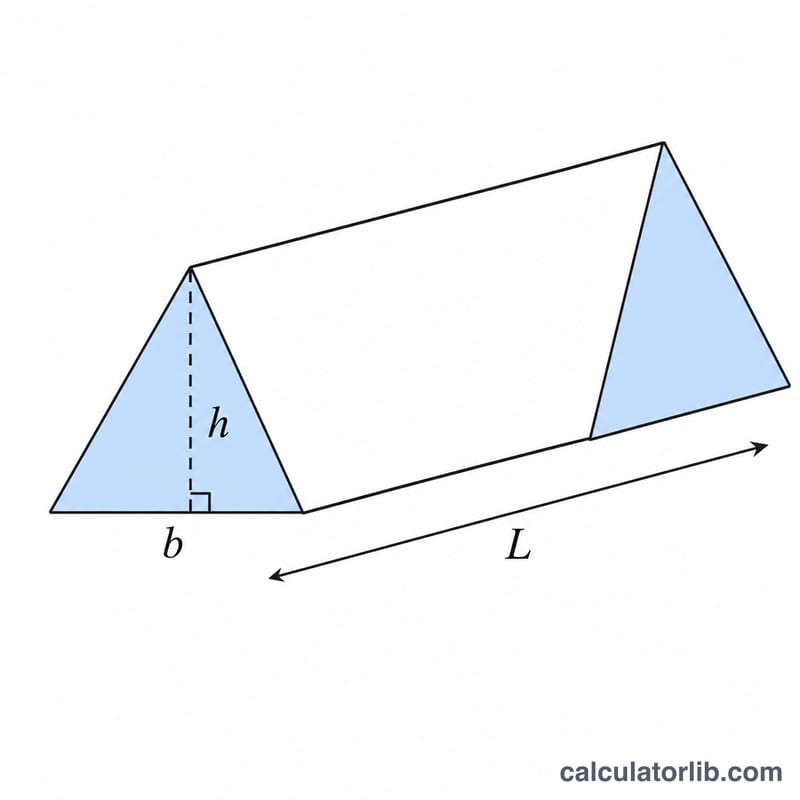
A triangular prism is a three-dimensional solid with two identical triangular ends connected by three rectangular faces. This calculator finds the volume of any such prism using only three measurements: the base of the triangle (b), the perpendicular height of the triangle (h), and the length of the prism (L). It works with any consistent units — centimeters, meters, inches — and returns the volume in the matching cubic units.
How to use it
Enter the triangle base and the triangle height (these define the triangular cross-section), then enter the length of the prism (the distance between the two triangular faces). Press calculate. The tool shows both the triangular cross-sectional area and the final volume.
The formula explained
The volume of any prism equals the area of its cross-section multiplied by its length. For a triangle, the area is \(\frac{1}{2} \cdot \text{base} \cdot \text{height}\). Combining these gives:
$$V = \frac{1}{2} \cdot b \cdot h \cdot L$$
The first step, \(\frac{1}{2} \cdot b \cdot h\), computes the area of the triangular face. Multiplying by \(L\) "extrudes" that face along the length of the prism to produce the solid's volume.
Worked example
Suppose a triangular prism has a triangle base of 6 cm, a triangle height of 4 cm, and a prism length of 10 cm. The cross-sectional area is $$\frac{1}{2} \cdot 6 \cdot 4 = 12 \text{ cm}^2.$$ The volume is $$12 \cdot 10 = 120 \text{ cm}^3.$$
FAQ
Does the triangle have to be right-angled? No. The height \(h\) is the perpendicular distance from the base to the opposite vertex, regardless of triangle shape, so the formula works for any triangle.
What units does the result use? Whatever units you input. If all lengths are in meters, the volume is in cubic meters.
Is the prism length the same as height? Not necessarily. Here "height" (\(h\)) refers to the triangle's height, while "length" (\(L\)) is how far the prism extends. Keep them distinct.