
What is a circular segment?
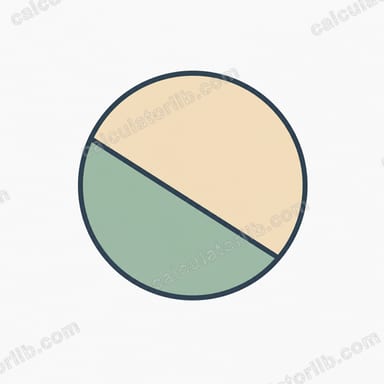
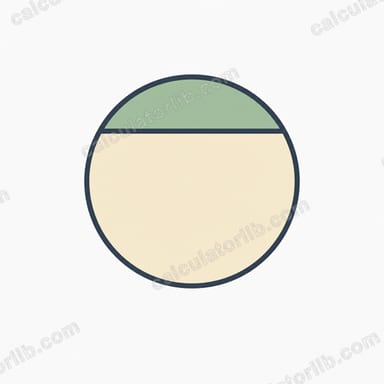
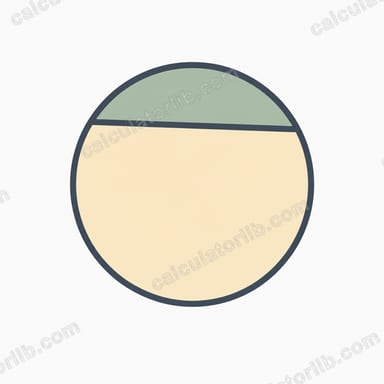
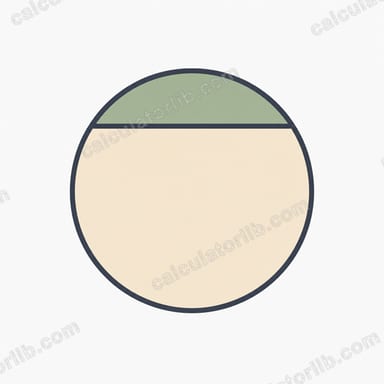
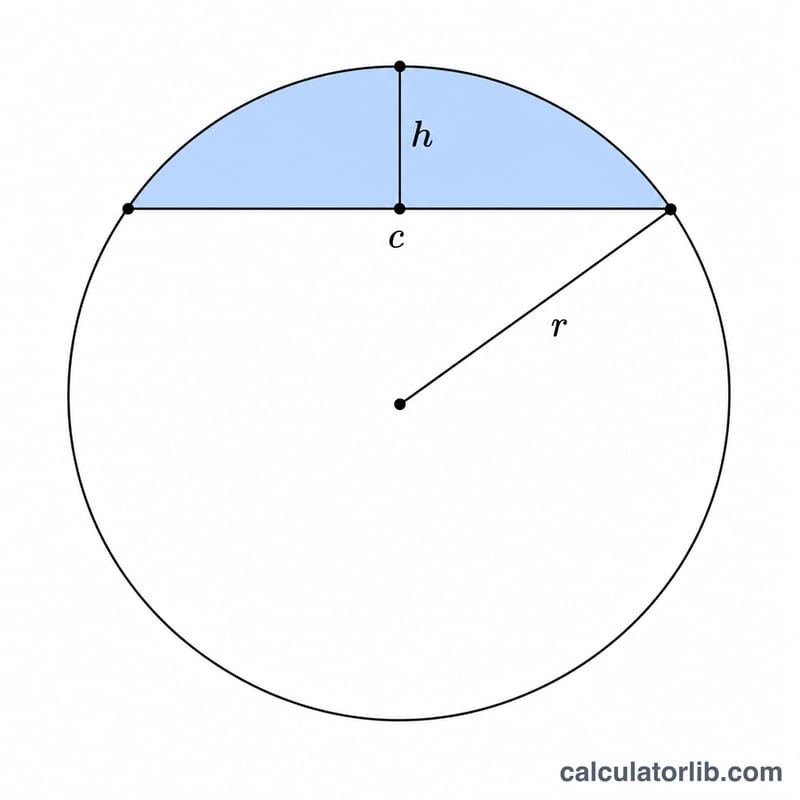
A circular segment is the region of a circle "cut off" by a straight line (a chord) — the curved, arch-like area between the chord and the arc above it. The most natural way to describe such a segment is by the circle's radius r and the segment height h (also called the sagitta), which is the maximum distance from the chord up to the arc. This is pure geometry and works in any units; just keep r and h in the same length unit and the area comes out in that unit squared.
How to use this calculator
Enter the radius r and the segment height h. The height must satisfy \(0 < h \le 2r\): when \(h = r\) you have a semicircle, and when \(h = 2r\) the segment is the whole circle. Pick the number of significant digits you want shown (this only affects the display, not the math). The tool returns the segment area S, the central angle θ in both radians and degrees, the arc length L, and the chord length c.
The formulas explained
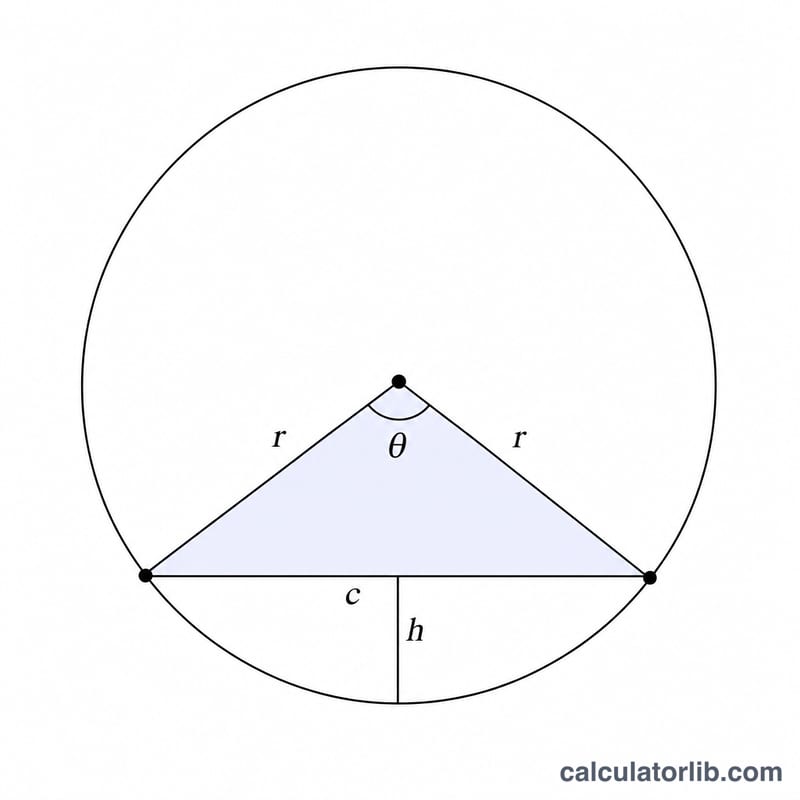
First the central angle is found from the height:
$$\theta = 2\cdot\arccos\!\left(1 - \frac{h}{r}\right).$$The arc length is
$$L = r\cdot\theta,$$and the chord is
$$c = 2\cdot\sqrt{h(2r - h)}.$$The area combines a circular-sector term with a triangle correction:
$$S = \frac{\theta}{2}\cdot r^{2} - (r - h)\cdot\sqrt{h(2r - h)}.$$When \(h > r\) the term \((r - h)\) becomes negative, which correctly adds area beyond the semicircle.
Worked example
Take \(r = 1\) and \(h = 0.5\). Then \(1 - h/r = 0.5\), so
$$\theta = 2\cdot\arccos(0.5) = 2.0943951 \text{ rad} = 120^{\circ}.$$The arc length
$$L = 1 \times 2.0943951 = 2.0943951.$$With \(h(2r - h) = 0.75\), \(\sqrt{0.75} = 0.8660254\), so \(c = 1.7320508\). Finally
$$S = 1.0471976 - 0.5\cdot 0.8660254 = 0.6141848.$$FAQ
What is the sagitta? It is the segment height \(h\) — the perpendicular distance from the midpoint of the chord to the arc.
What if h equals 2r? The segment becomes the entire circle: \(\theta = 2\pi\), the chord length \(c = 0\), and \(S = \pi r^{2}\).
Can the area exceed a semicircle? Yes. When \(h > r\) the segment is bigger than half the circle, and the formula accounts for this automatically.