
What Is the Radius from Area Calculator?
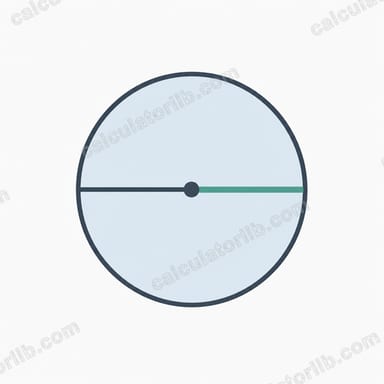
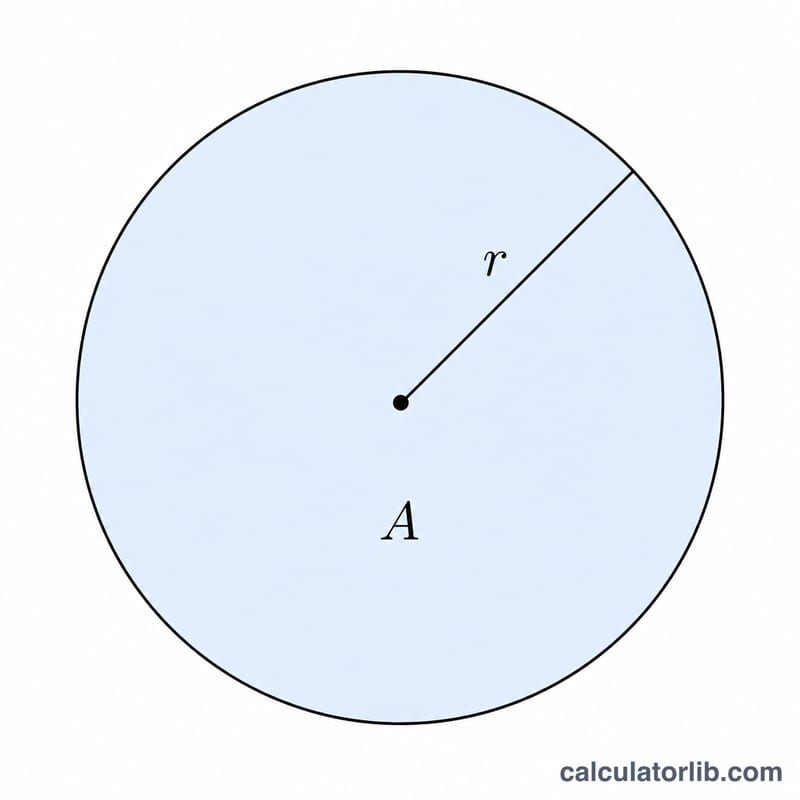
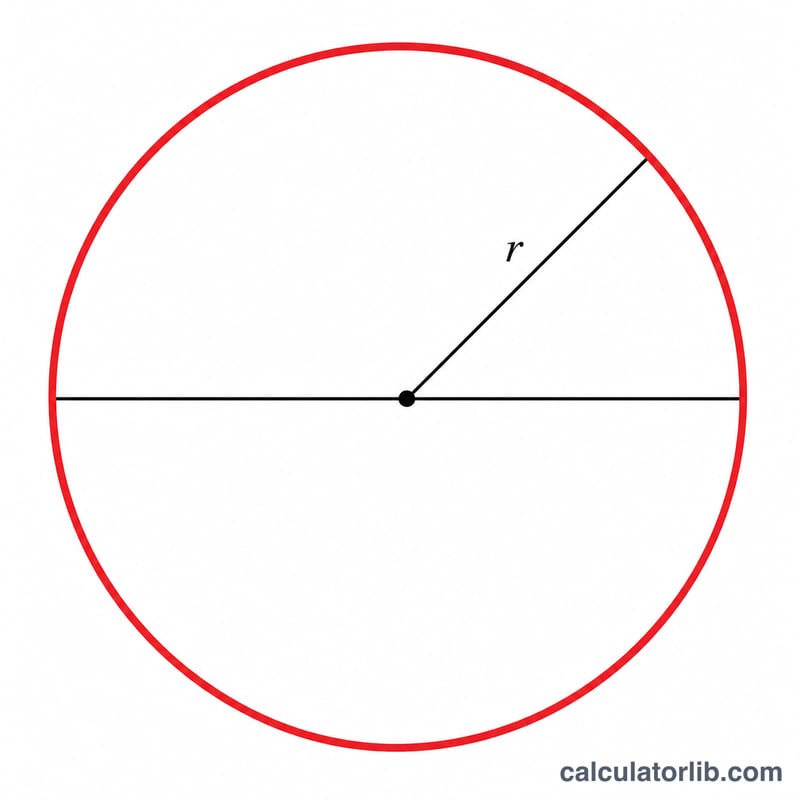
This tool works backwards from the familiar circle-area formula. Normally you compute area from radius using \(A = \pi r^2\). When you already know the area but need the radius, you rearrange the equation to get \(r = \sqrt{A/\pi}\). This calculator does that instantly and also reports the diameter and circumference of the same circle.
How to Use It
Enter the area of the circle in any unit you like (square centimeters, square inches, square meters, etc.). The radius, diameter, and circumference are returned in the matching linear unit. For example, if you enter an area measured in square meters, the radius will be in meters.
The Formula Explained
Start from the area of a circle: \(A = \pi r^2\). To isolate \(r\), divide both sides by \(\pi\) to get \(r^2 = A/\pi\), then take the square root of both sides:
$$r = \sqrt{\dfrac{A}{\pi}}$$Pi (\(\pi \approx 3.14159\)) is the constant ratio of a circle's circumference to its diameter.
Worked Example
Suppose a circle has an area of 78.54 square units. Divide by \(\pi\):
$$\frac{78.54}{3.14159} \approx 25.0$$The square root of 25 is 5, so the radius is 5 units. The diameter is \(2 \times 5 = 10\) units, and the circumference is \(2 \times \pi \times 5 \approx 31.42\) units.
FAQ
What units does it use? Any consistent unit. If the area is in square feet, the radius comes back in feet.
Can the area be zero or negative? No. Area must be a positive number for a real circle to exist; zero or negative inputs return zero.
How accurate is the result? It uses the full-precision value of \(\pi\), so results are accurate to many decimal places before display rounding.