
What is a circular segment?
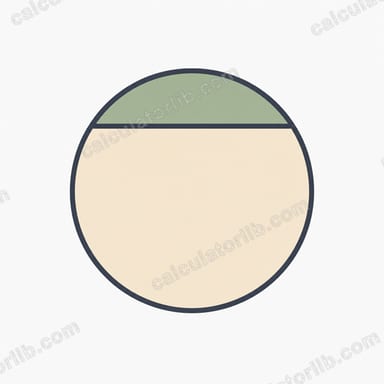
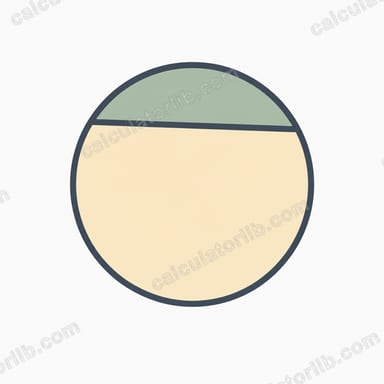
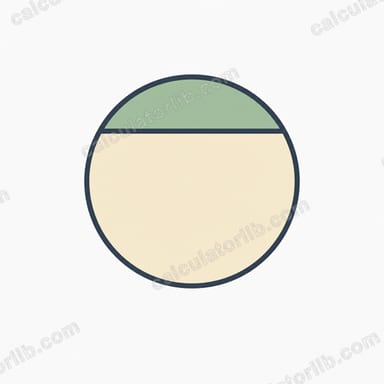
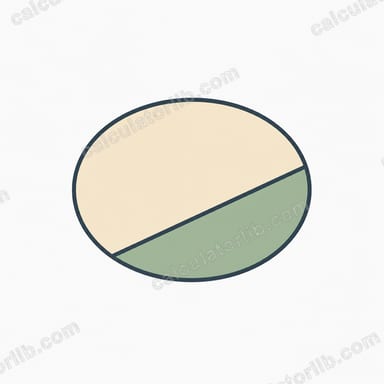
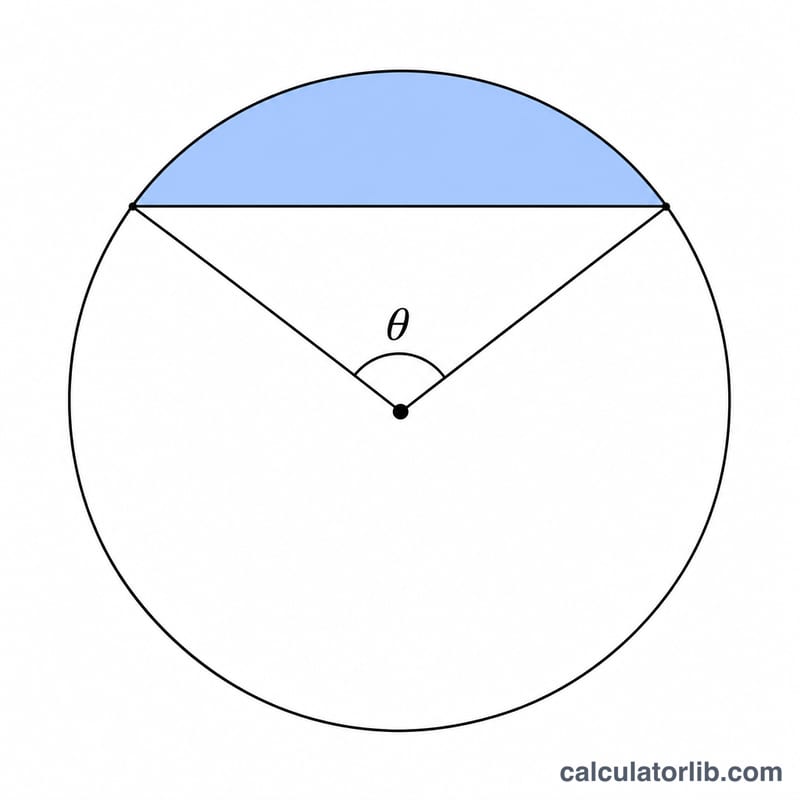
A circular segment is the region of a circle bounded by a chord and the arc it subtends. Picture slicing a circle with a straight line: the smaller piece cut off (between the line and the curved edge) is a segment. This calculator works out three key measurements from just the radius and the central angle: the segment area S, the arc length L, and the chord length c. It is pure geometry and applies universally, in any unit of length you choose.
How to use it
Enter the radius r and the central angle \(\theta\). Choose whether the angle is given in degrees or radians using the unit selector. The tool converts the angle to radians internally, then evaluates every formula. Results are shown to high precision. The angle should be in the range 0 to 360 degrees (0 to \(2\pi\) radians); at the full circle the segment becomes the whole disk.
The formulas explained
With \(\theta\) expressed in radians and r the radius:
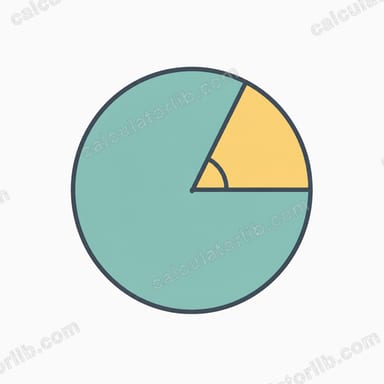
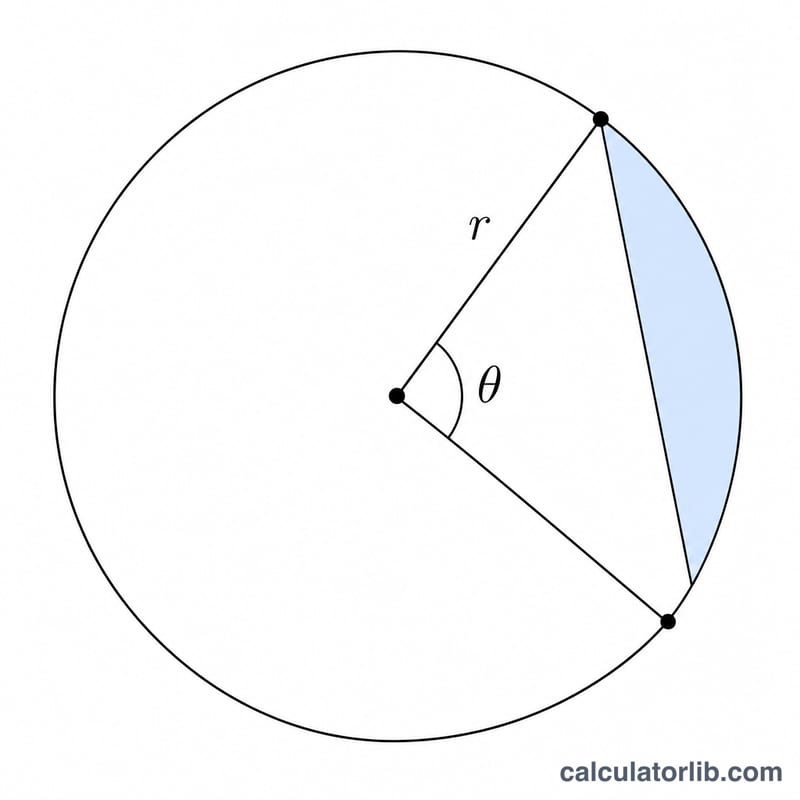
Area: $$S = \tfrac{1}{2}\,r^{2}\left(\theta - \sin\theta\right).$$ This is the sector area \(\tfrac{1}{2}\,r^{2}\theta\) minus the triangle area \(\tfrac{1}{2}\,r^{2}\sin\theta\).
Arc length: $$L = r\theta.$$ Note this is r times theta, not \(2r\theta\).
Chord length: $$c = 2r\cdot\sin(\theta/2).$$ The sine always takes the radian value of the angle.
Worked example
Take r = 1 and \(\theta\) = 120 degrees. Convert: $$\theta = 120 \times \frac{\pi}{180} = \frac{2\pi}{3} \approx 2.0943951.$$ Then \(\sin\theta = \frac{\sqrt{3}}{2} \approx 0.8660254\). Area $$S = 0.5 \times 1 \times (2.0943951 - 0.8660254) = 0.6141848.$$ Arc length $$L = 1 \times 2.0943951 = 2.0943951.$$ Chord $$c = 2 \times \sin(60°) = 1.7320508$$ (which is \(\sqrt{3}\)).
FAQ
Is the arc length \(2r\theta\)? No. The correct arc length is \(L = r\theta\) with \(\theta\) in radians.
What if the radius is zero? A zero radius is a degenerate point, so all outputs are zero.
Can the angle exceed 180 degrees? Yes. Up to 360 degrees the formula still gives the area of the larger segment; at exactly 360 degrees you get the full disk area \(\pi r^{2}\).