
What this calculator does
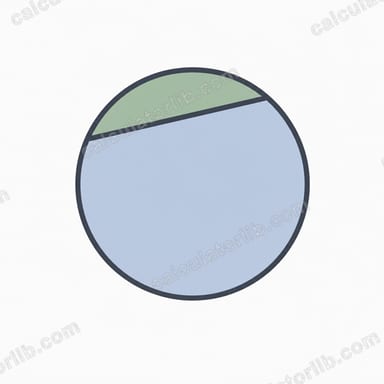
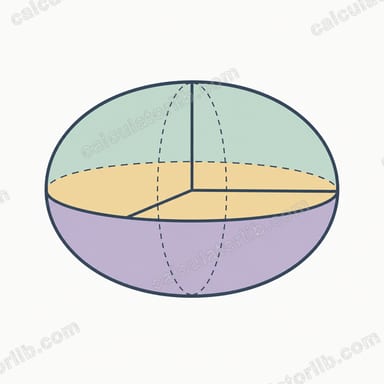
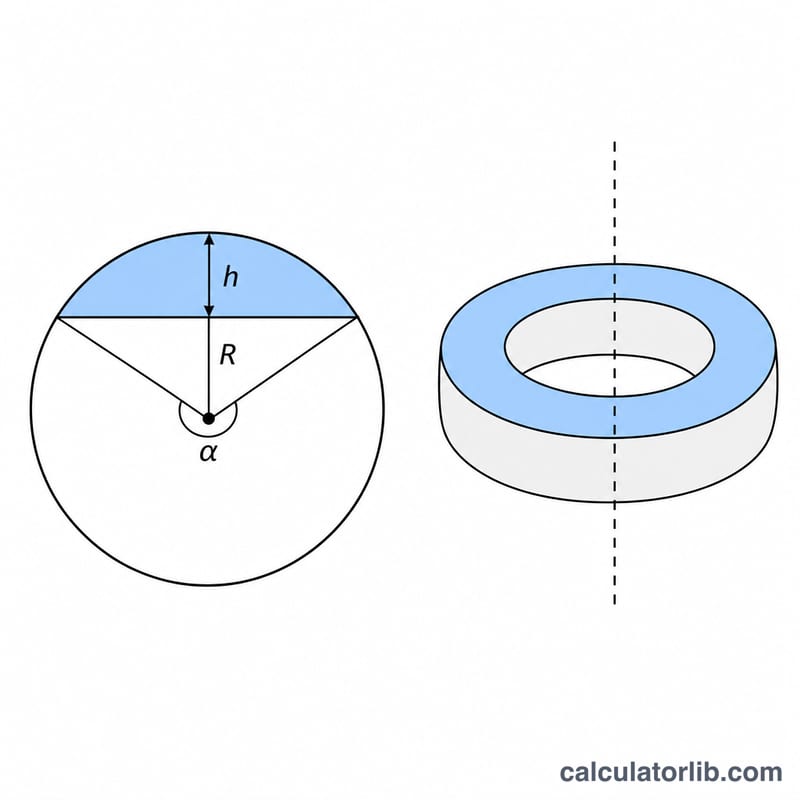
This tool computes the volume and outer surface area of a solid of revolution generated by sweeping a circular segment (the region of a circle cut off by a chord, sometimes called a bow or sagitta shape) about an axis parallel to its chord. You can sweep a full 360 degrees or any partial angle, and when the sweep is partial the body is truncated by two flat segment cap faces. It is a pure geometry/calculus tool and works identically anywhere in the world.
How to use it
Enter the arc radius R, the segment height h (the sagitta, the maximum distance from chord to arc), the distance d from the chord to the rotation axis, and the sweep angle. Pick a length unit (mm, cm, m or inch) and an angle unit (degrees or radians). Results are reported in the cube and square of the chosen length unit, plus the chord length.
The formula
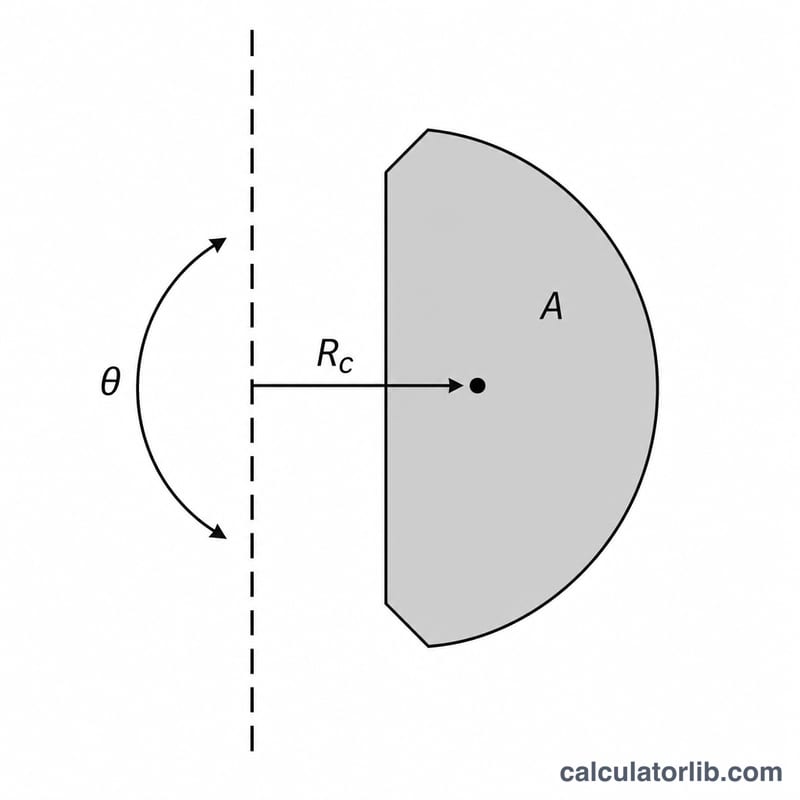
With central angle \(\alpha = 2\cdot\arccos\!\left(\frac{R-h}{R}\right)\), the segment area is \(A = \tfrac{1}{2}R^2(\alpha - \sin\alpha)\), the half-chord \(a = \sqrt{h(2R-h)}\), and chord \(c = 2a\). By Pappus's theorems the volume is $$V = \theta\cdot R_c\cdot A$$ where \(R_c\) is the distance from the axis to the segment's area centroid, and the lateral surface is $$S = \theta\cdot(R_{\text{arc}}\cdot L_{\text{arc}} + R_{\text{chord}}\cdot c).$$ For a partial sweep two flat caps of area \(A\) each are added.
Worked example
For \(R = 100\ \text{mm}\), \(h = 40\ \text{mm}\), \(d = 50\ \text{mm}\) and \(\theta = 360^\circ\): \(\alpha = 1.8546\ \text{rad}\), \(A = 4472.95\ \text{mm}^2\), chord \(c = 160\ \text{mm}\). The volume comes out to about $$V \approx 1.86\times 10^{6}\ \text{mm}^3\ (\approx 1864\ \text{cm}^3)$$ and the surface area about \(1.39\times 10^{5}\ \text{mm}^2\).
FAQ
What is the sagitta? It is the segment height \(h\), the perpendicular distance from the chord to the highest point of the arc. It must satisfy \(0 < h \le 2R\).
Why does a partial sweep add area? Cutting the ring at two angular positions exposes two flat planar faces, each equal to the segment area \(A\), so \(2A\) is added to the lateral surface.
Can the axis pass through the chord? Yes, set \(d = 0\). Negative \(d\) places the axis on the arc side; the centroid distance must stay positive for a physical body.