
What this calculator does
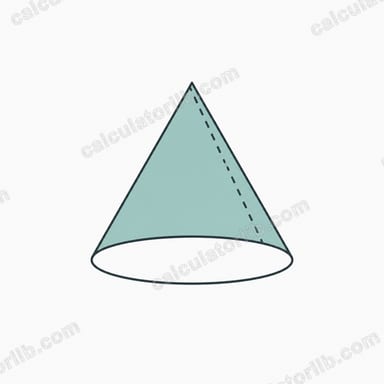
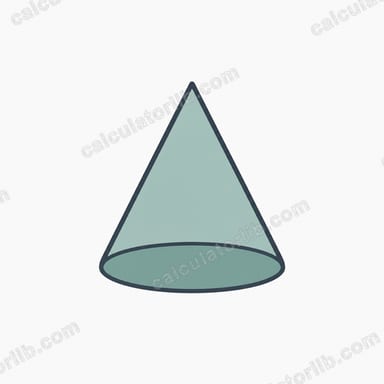
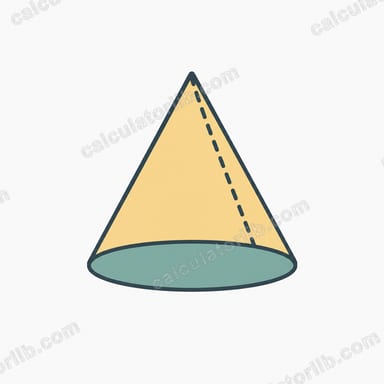
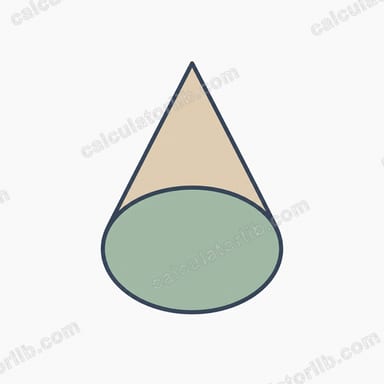
This tool computes the geometric properties of a right circular cone — a cone whose apex sits directly above the center of its circular base. From just the base radius (r) and the perpendicular height (h) it returns the volume, the lateral (side) surface area, the total surface area, and the slant height. All lengths use a single unit you choose; outputs scale accordingly (length, length squared for areas, length cubed for volume).
How to use it
Enter the base radius and the height, pick a length unit (m, cm, mm, km, in, ft), and submit. Both r and h must be positive — a zero or negative value produces a degenerate shape that is not a real cone, so it is rejected. The unit you select applies to both inputs; volume is reported in that unit cubed and areas in that unit squared.
The formulas explained
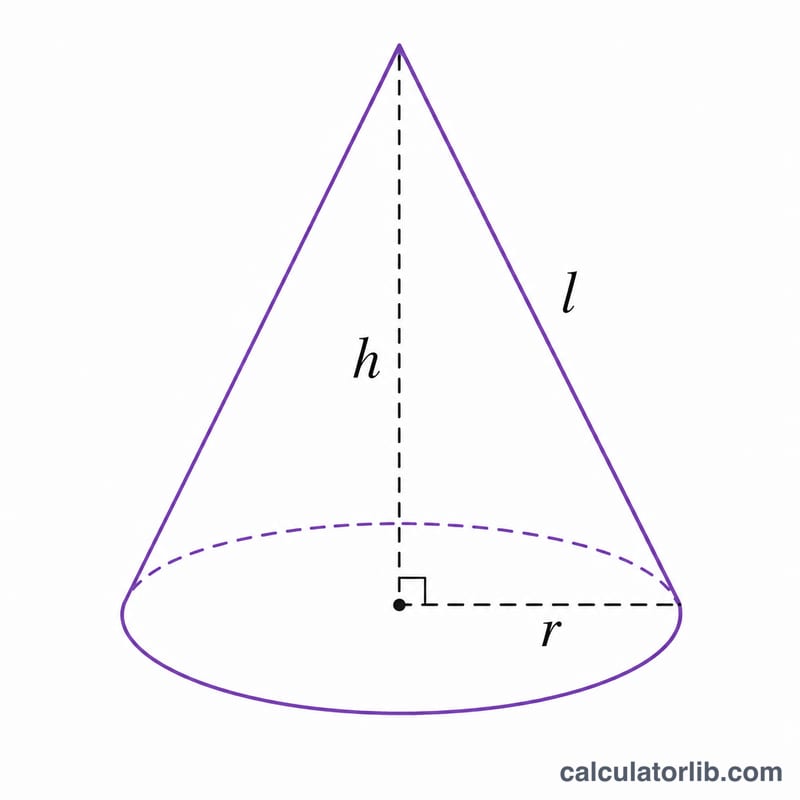
The slant height is the straight-line distance from the apex to the edge of the base, found with the Pythagorean theorem: \( \ell = \sqrt{\text{r}^{2} + \text{h}^{2}} \). The volume is one third of the base area times the height: \( V = \frac{1}{3}\pi\, \text{r}^{2}\, \text{h} \). The lateral surface (the curved side, unrolled into a sector) equals \( \pi\, \text{r}\, \ell \). Adding the base circle area \( \pi\, \text{r}^{2} \) gives the total surface: \( S = \pi\, \text{r}(\ell + \text{r}) \).
Worked example
For r = 3 and h = 4: slant height $$\ell = \sqrt{9 + 16} = \sqrt{25} = 5.$$ $$V = \frac{1}{3}\pi(9)(4) = 12\pi \approx 37.699.$$ $$A_{L} = \pi(3)(5) = 15\pi \approx 47.124.$$ Base area \( = 9\pi \approx 28.274 \). $$A_{T} = 15\pi + 9\pi = 24\pi \approx 75.398.$$
FAQ
Does this work for an oblique (slanted) cone? No. These formulas assume a right circular cone where the apex is centered over the base. Oblique cones share the same volume formula but have a different, more complex surface area.
What is slant height versus height? Height (h) is the perpendicular distance from base to apex; slant height (l) is measured along the sloping side and is always larger than both r and h.
Why must radius and height be positive? A zero radius or height collapses the cone to a line or disk with zero volume, so it is not a valid three-dimensional cone.