
What this calculator does
This tool converts a complex number written in polar form — a magnitude r (also called the modulus) and an angle θ (the argument) — into its rectangular or Cartesian form \(x + yi\). Polar form is often written as \(r\cdot e^{\theta i}\) or \(r\angle\theta\), and many engineering, physics and signal-processing problems require switching back to the familiar \(x + yi\) representation.
How to use it
Enter the magnitude r and the angle θ. Choose whether θ is given in radians (the default) or degrees. The calculator internally converts degrees to radians by multiplying by \(\pi/180\), then computes the real and imaginary components and assembles the full \(x + yi\) string.
The formula explained
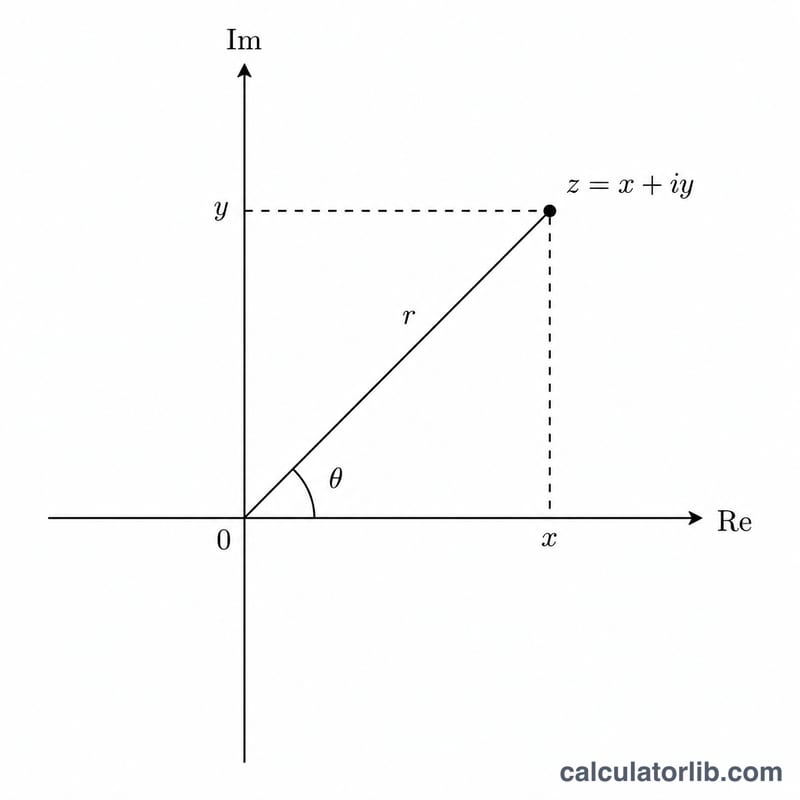
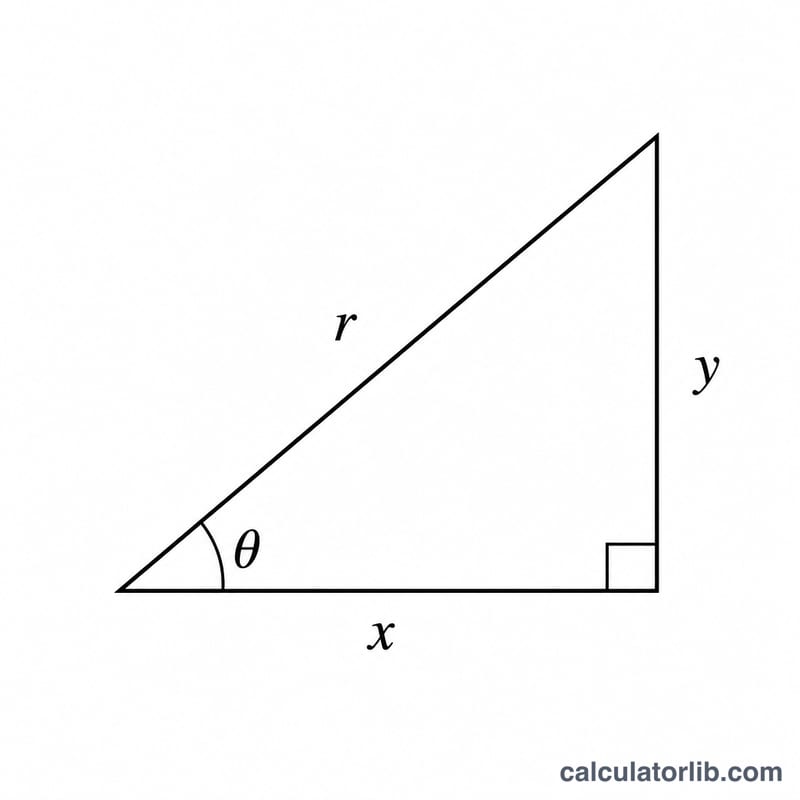
A point on the complex plane at distance r from the origin and angle θ from the positive real axis has coordinates:
$$x = r\cdot\cos\theta \quad \text{and} \quad y = r\cdot\sin\theta$$
The complex number is then \(z = x + y\cdot i\). The inverse relations (for reference only) are \(r = \sqrt{x^2 + y^2}\) and \(\theta = \arctan(y / x)\), but this tool performs only the forward polar → Cartesian direction.
Worked example
Take \(r = 2\) and \(\theta = \pi/3\) in radians. Then $$x = 2\cdot\cos(\pi/3) = 2\cdot 0.5 = 1$$ and $$y = 2\cdot\sin(\pi/3) = 2\cdot 0.8660254 = 1.7320508.$$ The result is \(1 + 1.7320508076\,i\).
In degrees: \(r = 5\), \(\theta = 30^\circ\). Convert: \(30\cdot\pi/180 = 0.5235988\) rad. Then \(x = 5\cdot\cos = 4.330127019\) and \(y = 5\cdot\sin = 2.5\), giving \(4.330127019 + 2.5\,i\).
FAQ
What happens if r = 0? The result is 0 (the origin) regardless of the angle, since both x and y become zero.
Can r be negative? Yes. A negative r is valid and simply reflects the point through the origin, equivalent to adding \(\pi\) to the angle.
Why must I pick radians or degrees? The trig functions operate in radians. Selecting "Degrees" multiplies your angle by \(\pi/180\) first so the answer is correct.