
这个计算器能做什么
本工具可将以极坐标形式表示的复数——即模 r(也称模长)和辐角 θ(即幅角)——换算为直角坐标形式(也叫笛卡尔坐标形式)\(x + yi\)。极坐标形式常写作 \(r\cdot e^{\theta i}\) 或 \(r\angle\theta\)。在工程、物理和信号处理等领域,许多问题都需要把它转换回我们熟悉的 \(x + yi\) 表示法。
使用方法
输入模 r 和辐角 θ,并选择 θ 采用弧度(默认)还是角度。计算器在内部会先把角度乘以 \(\pi/180\) 转换为弧度,再分别算出实部和虚部,最后拼出完整的 \(x + yi\) 表达式。
公式解析
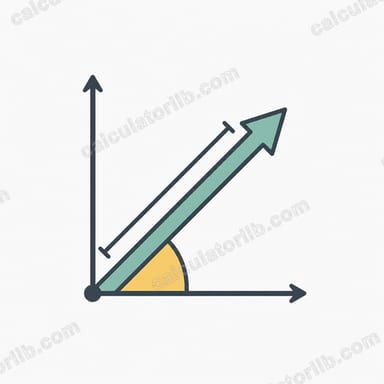
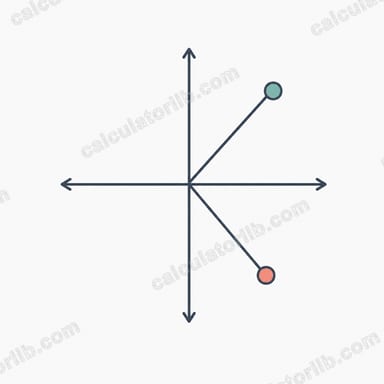
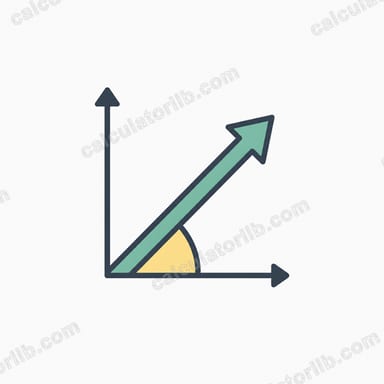
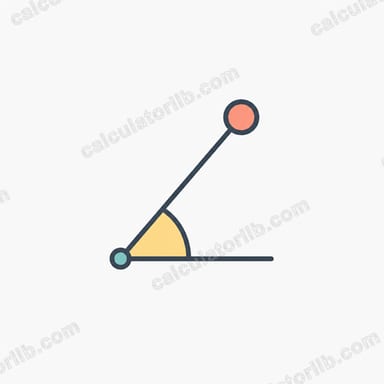
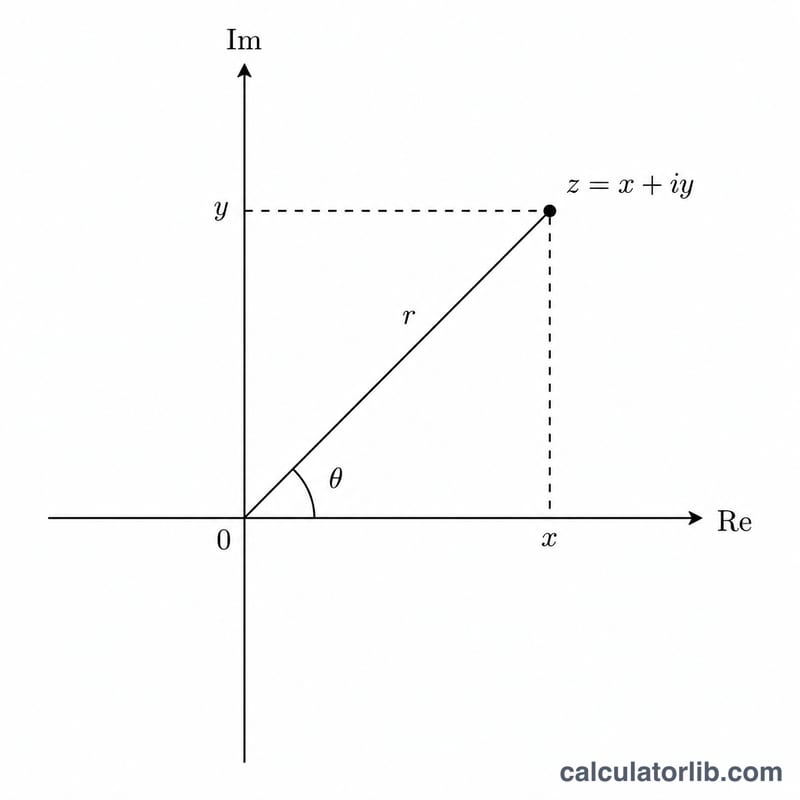
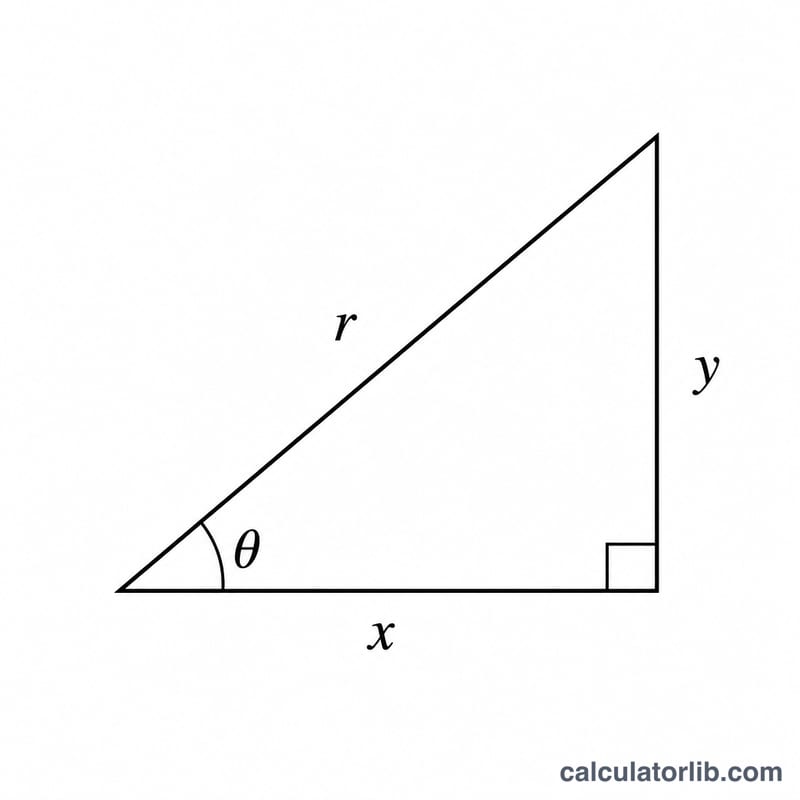
复平面上距原点为 r、与正实轴夹角为 θ 的点,其坐标为:
$$z = x + yi = \text{r}\cos\theta + \text{r}\sin\theta\,i$$
\(x = \text{r}\cdot\cos\theta\) 以及 \(y = \text{r}\cdot\sin\theta\)
对应的复数即 \(z = x + y\cdot i\)。反向换算关系(仅供参考)为 \(r = \sqrt{x^2 + y^2}\)、\(\theta = \arctan(y / x)\),但本工具只进行极坐标 → 直角坐标这一个方向的换算。
实例演算
设 \(r = 2\)、\(\theta = \pi/3\)(弧度)。则 \(x = 2\cdot\cos(\pi/3) = 2\cdot 0.5 = 1\),\(y = 2\cdot\sin(\pi/3) = 2\cdot 0.8660254 = 1.7320508\),结果为 1 + 1.7320508076 i。
若采用角度:\(r = 5\)、\(\theta = 30\degree\)。先换算:\(30\cdot\pi/180 = 0.5235988\) 弧度。则 \(x = 5\cdot\cos = 4.330127019\),\(y = 5\cdot\sin = 2.5\),得到 4.330127019 + 2.5 i。
常见问题
如果 r = 0 会怎样? 无论辐角取何值,结果都是 0(即原点),因为此时 x 和 y 都为零。
r 可以是负数吗? 可以。负的 r 是合法的,它相当于把该点关于原点作对称反射,效果等同于给辐角加上 \(\pi\)。
为什么必须选择弧度或角度? 三角函数以弧度为单位运算。选择"角度"后,系统会先把你输入的角度乘以 \(\pi/180\),从而保证结果正确。