
What this calculator does
This tool takes a single complex number z and returns two fundamental quantities: its complex conjugate and its modulus (absolute value). You can enter z either in rectangular form, such as 3+4i, -2-5i, 7, or 4i, or in polar/exponential form, such as 5e^(0.9273i), where the angle is given in radians.
How to use it
Type your complex number into the field and pick how many significant digits you want in the displayed answer (10 by default). The calculator parses the real part a and imaginary part b, then computes both results. The significant-digits setting only affects how the answer is shown, not the underlying calculation.
The formulas explained
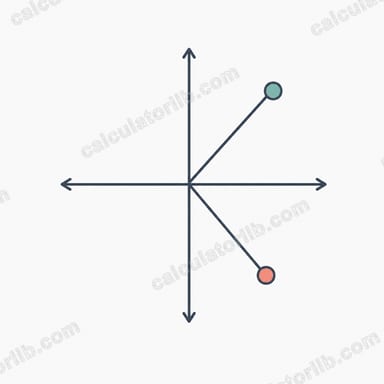
For \(z = a + bi\), the conjugate is obtained by changing the sign of the imaginary part: \(\text{conj}(z) = a - bi\). The modulus is the Pythagorean distance of the point \((a, b)\) from the origin: \(|z| = \sqrt{a^{2} + b^{2}}\). For a number in polar form \(r\cdot e^{\theta i}\), we first convert with \(a = r\cdot\cos(\theta)\) and \(b = r\cdot\sin(\theta)\).
$$\bar{z} = a - b\,i, \qquad |z| = \sqrt{a^{2} + b^{2}}$$ $$\text{where}\quad z = a + b\,i$$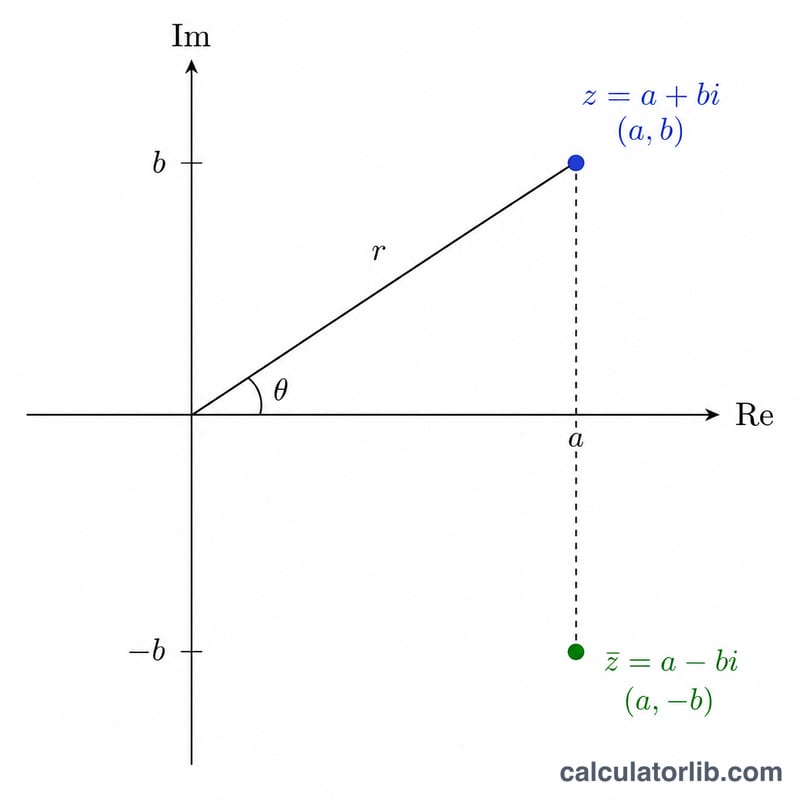
Worked example
Let \(z = 3 + 4i\), so \(a = 3\) and \(b = 4\). The conjugate flips the imaginary sign, giving \(3 - 4i\). The modulus is $$|z| = \sqrt{3^{2} + 4^{2}} = \sqrt{9 + 16} = \sqrt{25} = 5.$$ A polar input of \(5e^{0.9273i}\) yields the same point, because \(5\cdot\cos(0.9273) \approx 3\) and \(5\cdot\sin(0.9273) \approx 4\).
FAQ
Is the modulus ever negative? No. It is a distance, so it is always greater than or equal to zero.
What is the conjugate of a real number? Since \(b = 0\), the conjugate equals the number itself.
What angle units does polar form use? Radians. For example, \(e^{3.14159i}\) is roughly \(-1\).