
What this calculator does
This tool applies to Japan's NPB (Nippon Professional Baseball) postseason. It estimates two things from a single number — your team's chance of winning any one game (the "strength ratio"): the probability of an exact predicted series score, and the probability of winning the whole series. The series formats follow the Climax Series introduced in 2007: the First Stage is best-of-3 (first to 2 wins), the Second Stage is best-of-5 (first to 3 wins), and the Japan Series itself is best-of-7 (first to 4 wins).
How to use it
Pick a predicted result from the dropdown — this sets both the format and the exact final score (for example "4 wins, 2 losses"). Then enter the strength ratio as a percentage: 50% means two evenly matched teams, while a higher value reflects a stronger favourite. Read off the exact-result probability and the overall series win probability.
The formula explained
Let \(p\) be the per-game win probability and \(q = 1 - p\). If your team wins \(W\) games and loses \(L\), the deciding final game must be a win, so the first \((W + L - 1)\) games contain exactly \(L\) losses arranged freely: $$P = \binom{W+L-1}{L} \cdot p^{W} \cdot q^{L}.$$ To win the whole series you must reach \(C = W\) clinching wins before conceding \(C\) losses, summed over every possible loss count \(j\) from \(0\) to \(C-1\).
Worked example
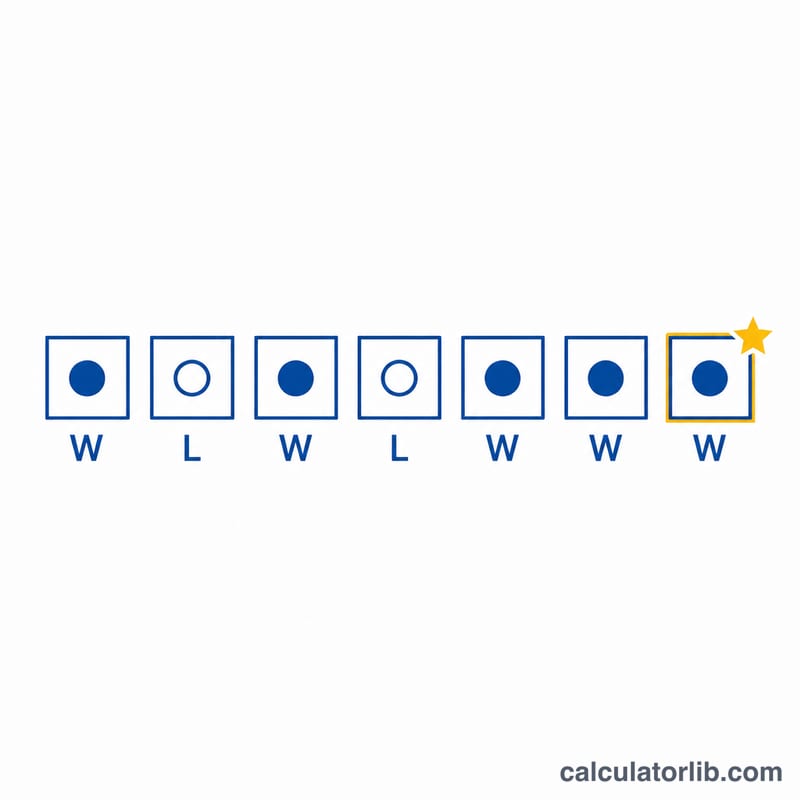
For the Japan Series with a 60% per-game edge, predicting a 4-2 win: $$P_{\text{exact}} = \binom{5}{2} \cdot 0.6^4 \cdot 0.4^2 = 10 \cdot 0.1296 \cdot 0.16 = 0.20736 \approx 20.74\%.$$ Summing all clinching scores gives an overall series win probability of about 71.02%.
FAQ
Why is the series win probability 50% for equal teams? Because a best-of-N series with \(p = 0.5\) is symmetric — each team is equally likely to clinch first.
Does the model assume independent games? Yes. It uses a constant single-game win probability and ignores home-field advantage, momentum and pitching rotations.
Can I model the First or Second Stage? Yes — choose a 2-win or 3-win option to switch to the best-of-3 or best-of-5 format.