
What Is the OR Probability Calculator?
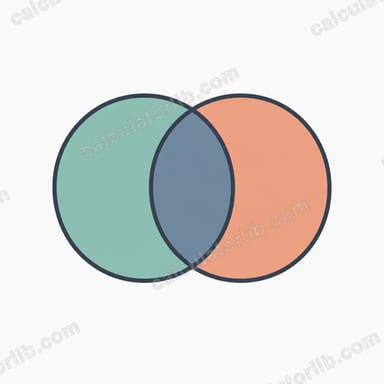
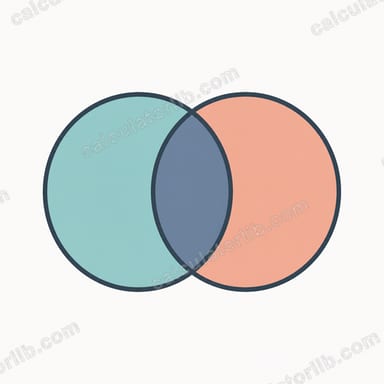
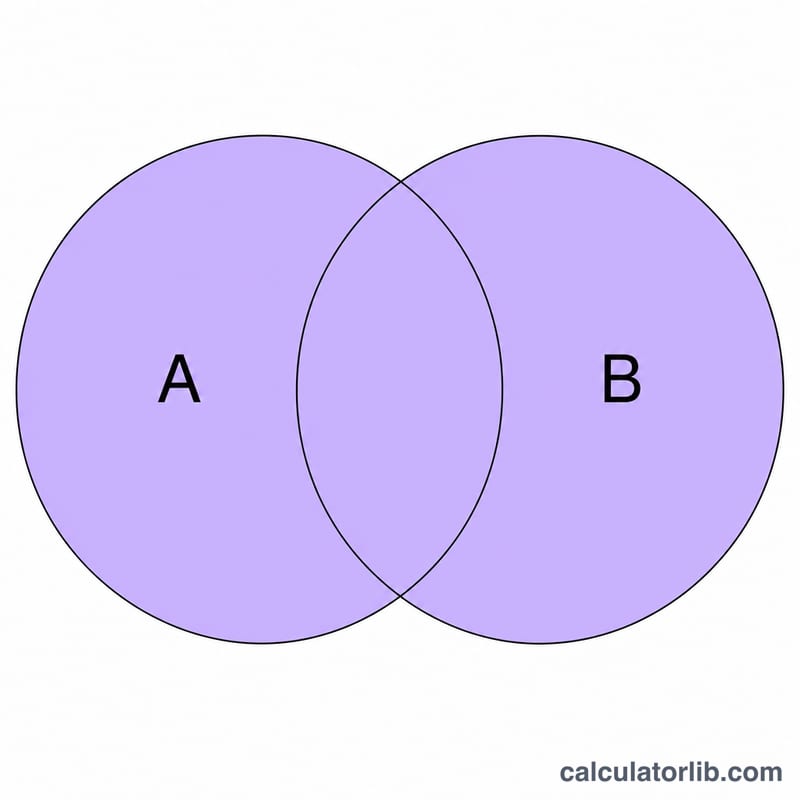
This calculator finds the probability that at least one of two events occurs — written P(A or B) or \(P(A \cup B)\). It applies the general addition rule of probability, which works whether or not the two events overlap. Enter the probability of each event and the probability that both happen together, and the tool returns the combined probability as both a decimal and a percentage.
How to Use It
Provide three values, each between 0 and 1: P(A), the probability of event A; P(B), the probability of event B; and P(A and B), the probability that both events occur simultaneously. If the two events are mutually exclusive (they cannot happen at the same time), set P(A and B) to 0. The result is automatically clamped to the valid 0–1 range.
The Formula Explained
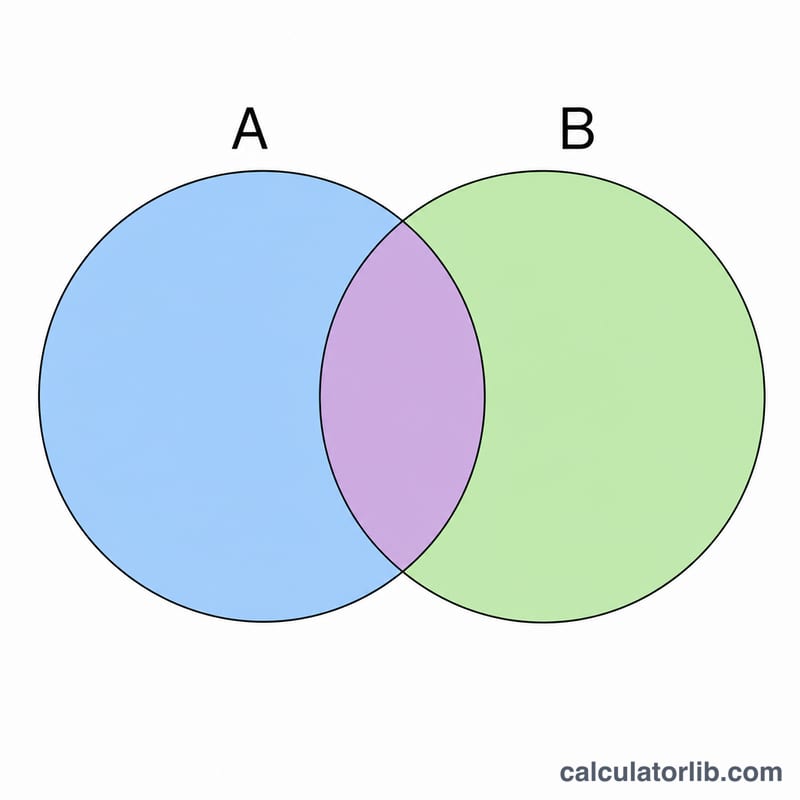
The addition rule states $$P(A \cup B) = \text{P(A)} + \text{P(B)} - \text{P(A and B)}$$ We subtract the intersection because events counted in both P(A) and P(B) would otherwise be counted twice. When events are mutually exclusive, \(P(A \cap B) = 0\) and the formula simplifies to \(P(A) + P(B)\).
Worked Example
Suppose you draw one card from a standard deck. Let A = "the card is a heart" with \(P(A) = 13/52 = 0.25\), and B = "the card is a king" with \(P(B) = 4/52 \approx 0.0769\). Both happen for the king of hearts, so \(P(A \text{ and } B) = 1/52 \approx 0.0192\). Then $$P(A \cup B) = 0.25 + 0.0769 - 0.0192 = 0.3077$$ or about 30.77%.
FAQ
What if the events are independent? If A and B are independent, \(P(A \text{ and } B) = P(A) \times P(B)\). Compute that product first and enter it as the intersection.
Can P(A or B) exceed 1? No. A valid probability never exceeds 1; if your inputs produce a value above 1, your inputs are inconsistent and the result is capped at 1.
What does mutually exclusive mean? Two events are mutually exclusive when they cannot both occur — like flipping heads and tails on a single coin toss. Their intersection is 0.