
What is the return period?
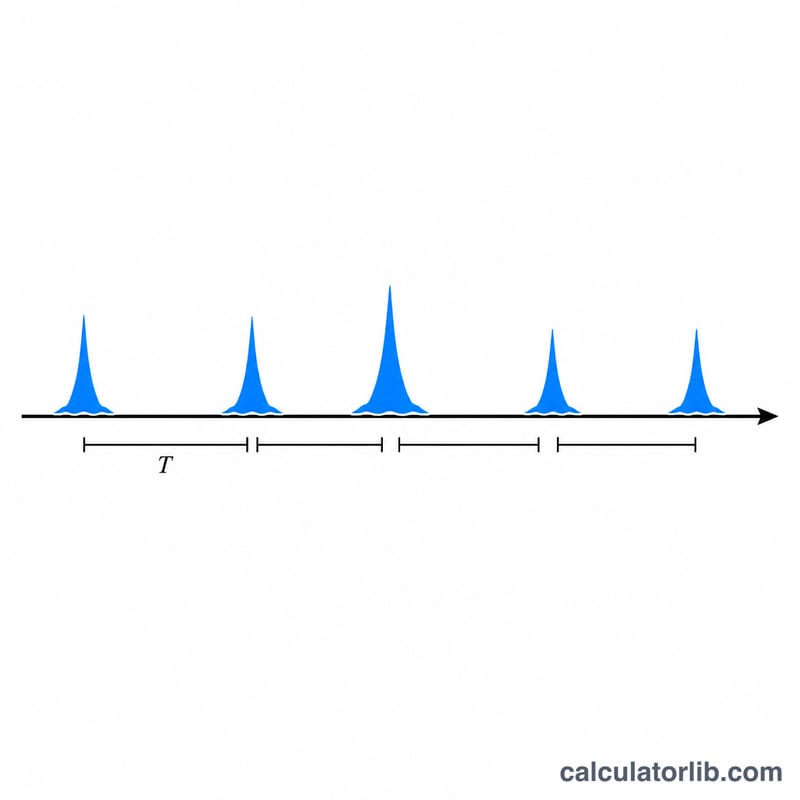
The return period (or recurrence interval) \(T\) is the average number of years between events of a given magnitude — a "100-year flood" has a return period of 100 years. This does not mean it happens exactly once a century. Instead, it has a \(1/T\) probability of occurring in any single year. This calculator converts a return period into the more decision-relevant exceedance probability: the chance the event happens at least once over a planning horizon of \(n\) years.
How to use it
Enter the return period \(T\) (e.g. 100 years) and the planning period \(n\) (e.g. the 30-year life of a building or mortgage). The calculator returns the probability that the design event is equalled or exceeded at least once during those years, plus the annual probability and the probability of no exceedance.
The formula
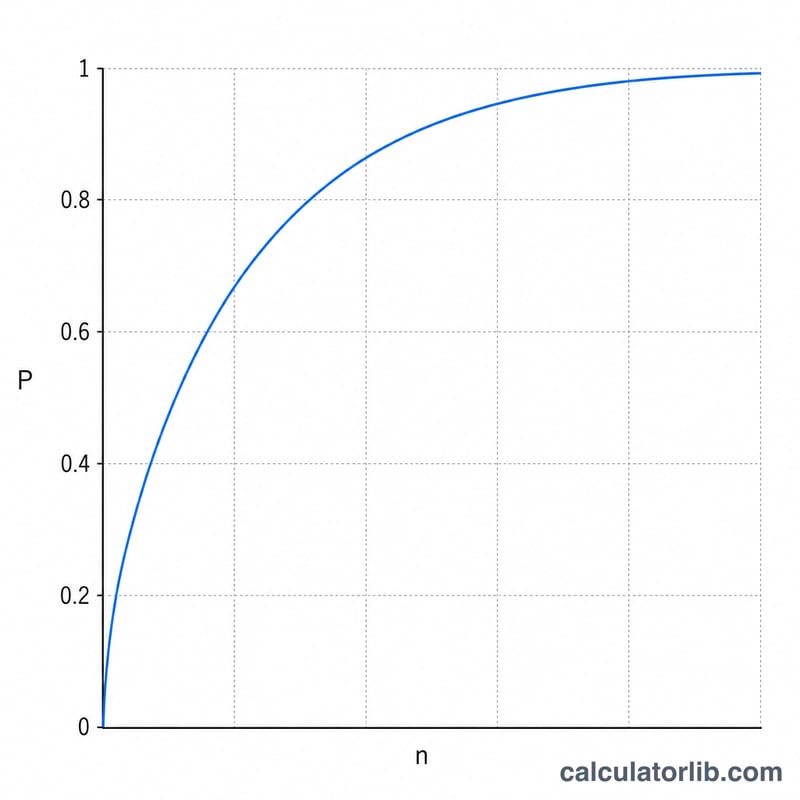
Assuming events are independent from year to year, the chance of no exceedance in one year is \((1 - 1/T)\). Over \(n\) years that becomes \((1 - 1/T)^{n}\). The chance of at least one exceedance is therefore:
$$P = 1 - \left(1 - \frac{1}{T}\right)^{n}$$
Worked example
For a 100-year storm (\(T = 100\)) over a 30-year horizon (\(n = 30\)): the annual probability is \(1/100 = 1\%\). The probability of no exceedance is \(0.99^{30} \approx 0.7397\), so the exceedance probability is $$1 - 0.7397 = 26.0\%.$$ There is roughly a 1-in-4 chance the "100-year" event strikes within 30 years.
FAQ
Does a 100-year event happen once every 100 years? No — it has a 1% chance each year, and can occur in consecutive years or not for centuries.
Why is the 30-year risk so high? Small annual probabilities accumulate; over many years the combined chance grows substantially.
What assumption does this make? It assumes a stationary climate and statistically independent years. Climate change can alter the underlying return period over time.