
What Is Implied Probability?
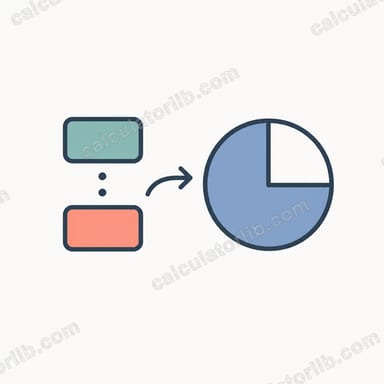
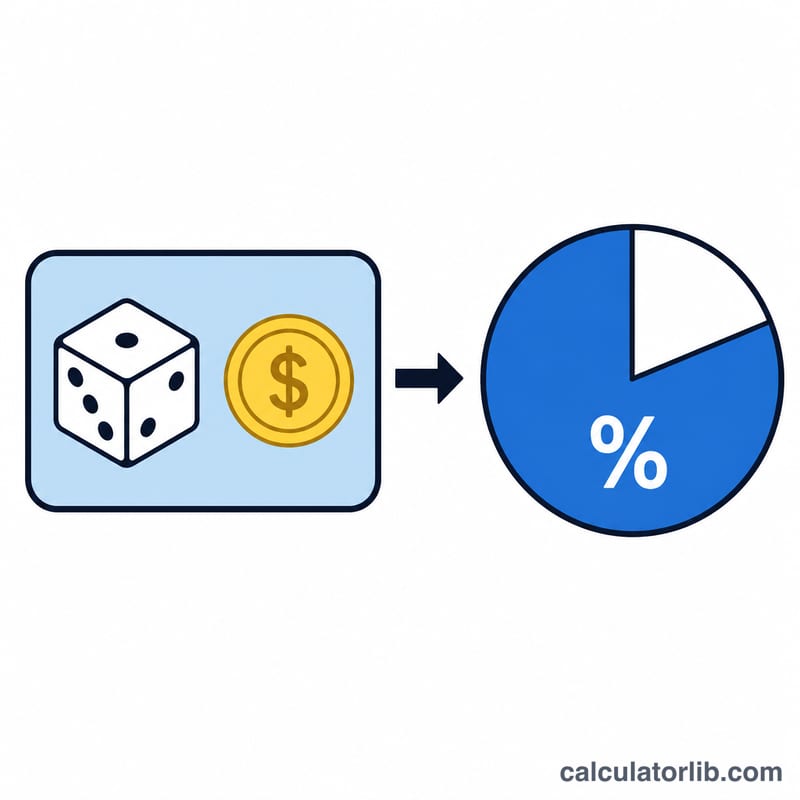
Implied probability is the percentage chance of an outcome that is "baked into" a set of betting odds. Bookmakers and traders quote odds, but odds are just another way of expressing a probability (plus a margin). Converting odds back into a probability lets you compare quotes, spot value, and understand exactly what the market thinks is likely to happen.
How to Use This Calculator
Pick your odds format — Decimal (common in Europe and Australia, e.g. 2.50) or American/Moneyline (e.g. +150 or -200) — then enter the odds and read off the implied probability percentage. The tool also shows the equivalent decimal odds so you can cross-check different formats.
The Formula Explained
For decimal odds the math is simple: divide one by the odds.
$$P = \frac{1}{\text{Odds}} \times 100\%$$Odds of 2.00 give \(1 \div 2.00 = 0.50 = 50\%\). For American odds the calculation depends on the sign. Positive odds (underdogs) use:
$$P = \frac{100}{\text{Odds} + 100} \times 100\%$$Negative odds (favorites) use \((-\text{odds}) \div (-\text{odds} + 100)\), where \(-\text{odds}\) is the absolute value of the negative number:
$$P = \frac{\left|\text{Odds}\right|}{\left|\text{Odds}\right| + 100} \times 100\%$$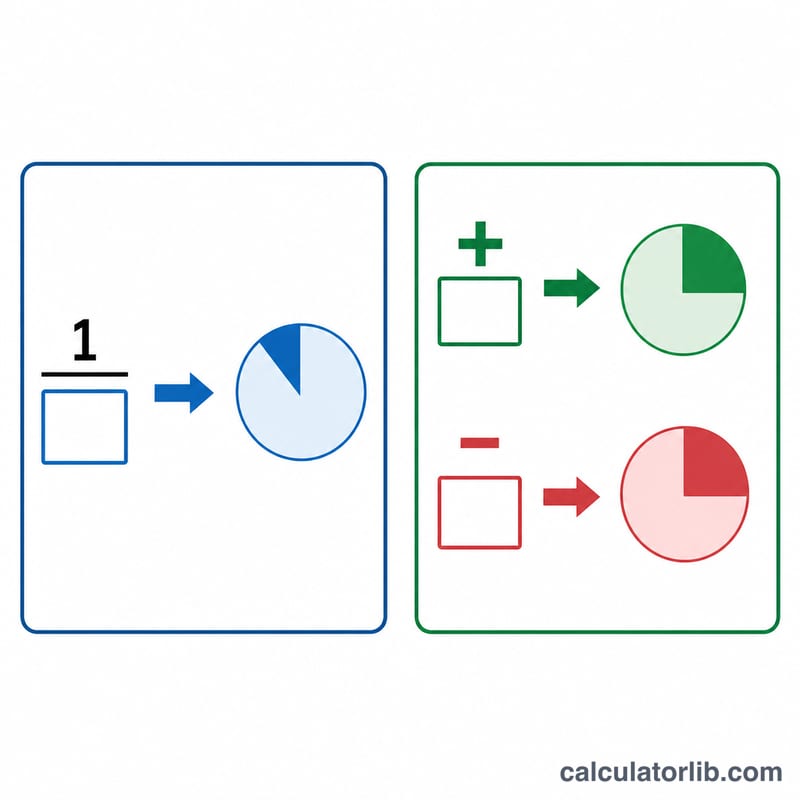
Worked Example
Suppose a team is priced at American +150. Because the number is positive, implied probability:
$$P = \frac{100}{150 + 100} = \frac{100}{250} = 0.40 = \textbf{40\%}$$The equivalent decimal odds are \(1 \div 0.40 = 2.50\). A bettor would judge whether the true chance is higher than 40% before placing the bet.
FAQ
Why do all outcomes add up to more than 100%? The extra percentage above 100% is the bookmaker's margin (the "vig" or "overround"), which is how they build in profit.
Does this remove the margin? No — it shows the raw implied probability from the quoted odds. To find a fair, margin-free probability you would normalize all outcomes so they sum to 100%.
What is the difference between +150 and -150? +150 means a $100 stake wins $150 (40% implied). -150 means you must stake $150 to win $100 (60% implied), reflecting a favorite.