
What is the Dice Probability Calculator?
This tool computes the exact probability of rolling a chosen total when you throw several dice at once. You choose how many dice (\(n\)), how many sides each die has (\(s\)), and the target sum you want. The calculator counts every combination of faces that adds up to that target and divides it by all possible outcomes, giving you the probability, the percentage, and the odds against.
How to use it
Enter the number of dice, the sides per die (6 for standard dice, but any value from 2 to 100 works), and your target sum. Press calculate to see the favorable outcomes, total outcomes, decimal probability, percentage chance, and the odds. The valid sum range (\(n\) to \(n \times s\)) is shown so you know which targets are even possible.
The formula explained
For \(n\) dice with \(s\) sides, there are \(s^{n}\) equally likely ordered outcomes. The probability of a given sum is the number of those outcomes that hit the sum, divided by \(s^{n}\). The probability of a given sum is given by:
$$P(\text{sum}=T) = \frac{N(T)}{s^{n}}$$where
$$\left\{ \begin{aligned} n &= \text{Number of dice} \\ s &= \text{Sides per die} \\ T &= \text{Target sum} \\ N(T) &= \text{ways to roll sum } T \text{ with } n \text{ dice} \end{aligned} \right.$$The calculator counts the favorable outcomes using dynamic programming — building up the number of ways to reach each running total one die at a time — which is exact even for many dice.
Worked example
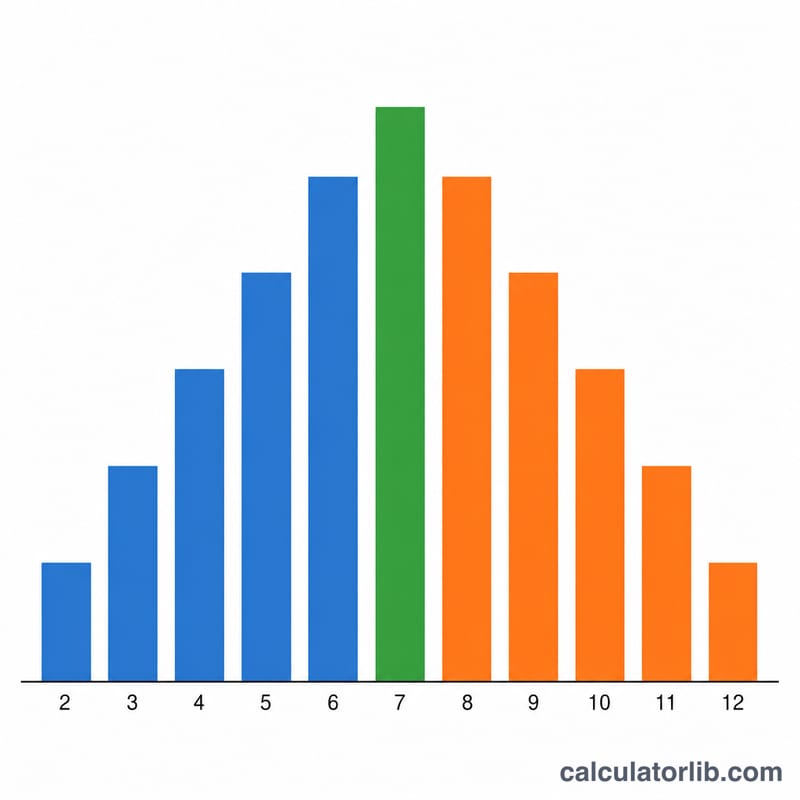
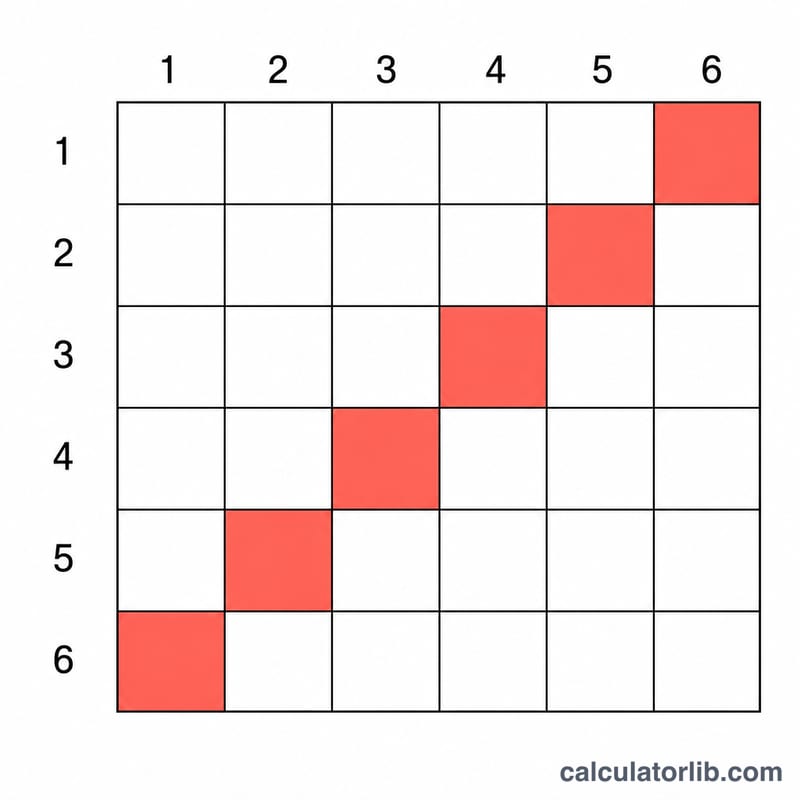
Roll two standard six-sided dice (\(n = 2\), \(s = 6\)) and aim for a sum of 7. The combinations are (1,6),(2,5),(3,4),(4,3),(5,2),(6,1) = 6 ways. Total outcomes = \(6^{2} = 36\). So $$P = \frac{6}{36} = 0.1667,$$ or 16.67% — the most likely single total when rolling 2d6.
FAQ
Why is 7 the most common total on 2d6? Because more face combinations add up to 7 than any other sum, it sits at the peak of the bell-shaped distribution.
What does "odds against" mean? It is the ratio of unfavorable outcomes to favorable ones. Odds of 5:1 means five losing outcomes for every winning one.
Can sums outside the range happen? No. With \(n\) dice you cannot roll less than \(n\) or more than \(n \times s\), so any target outside that range has probability 0.