What is the Two Dice Probability Calculator?
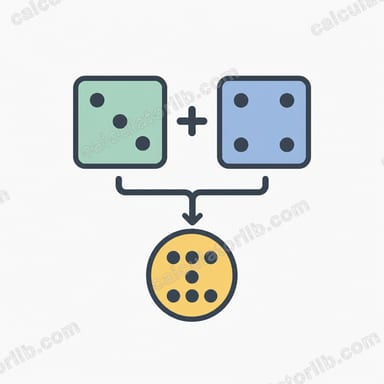
When you roll two fair six-sided dice, there are \(6 \times 6 = 36\) equally likely ordered outcomes. This calculator counts how many of those outcomes match the condition you choose — equal to, less than, or greater than a target sum — and divides by 36 to give the exact probability. It works for any sum from 2 to 12.
How to use it
Enter a target sum between 2 and 12, pick a condition (exactly equal, less than, less than or equal, greater than, or greater than or equal), and read off the probability as a percentage, a decimal, and as odds against. The favorable and total outcome counts are shown so you can verify the result yourself.

The formula explained
The probability of a sum s is simply the number of ways to roll s divided by 36:
$$P = \frac{\left|\left\{(a,b) : a+b = \text{Target}\right\}\right|}{36}$$The number of ways peaks at 7 (six combinations: 1-6, 2-5, 3-4, 4-3, 5-2, 6-1) and decreases symmetrically toward the extremes 2 and 12, which each have only one way. Order matters in the count, so 2-5 and 5-2 are treated as distinct outcomes.
Worked example
What is the chance of rolling a sum of 7? There are 6 favorable outcomes out of 36, so
$$P = 6 / 36 = 0.1667 \approx 16.67\%$$The odds against are \((36 - 6) / 6 = 5 : 1\).

Two Dice Sum Probability Table (2–12)
Two fair six-sided dice give 6 × 6 = 36 equally likely ordered outcomes. The table shows how many of those outcomes produce each sum, the exact probability, and the cumulative count for \(P(\text{sum} \le s)\).
| Sum | Combinations | Probability (fraction) | Probability (%) | Cumulative P(sum ≤ s) |
|---|---|---|---|---|
| 2 | 1 | 1/36 | 2.78% | 1/36 |
| 3 | 2 | 2/36 | 5.56% | 3/36 |
| 4 | 3 | 3/36 | 8.33% | 6/36 |
| 5 | 4 | 4/36 | 11.11% | 10/36 |
| 6 | 5 | 5/36 | 13.89% | 15/36 |
| 7 | 6 | 6/36 | 16.67% | 21/36 |
| 8 | 5 | 5/36 | 13.89% | 26/36 |
| 9 | 4 | 4/36 | 11.11% | 30/36 |
| 10 | 3 | 3/36 | 8.33% | 33/36 |
| 11 | 2 | 2/36 | 5.56% | 35/36 |
| 12 | 1 | 1/36 | 2.78% | 36/36 |
The combination counts total 36. Seven is the most likely sum because it has the most ordered pairs: (1,6), (2,5), (3,4), (4,3), (5,2), (6,1). Percentages are rounded to two decimals.
Comparing Conditions: Equal, Less Than and Greater Than
The table shows favorable outcomes out of 36 (and the probability) for each comparison mode, for three sample targets.
| Condition | Target 4 | Target 7 | Target 10 |
|---|---|---|---|
| = target | 3/36 (8.33%) | 6/36 (16.67%) | 3/36 (8.33%) |
| < target | 3/36 (8.33%) | 15/36 (41.67%) | 30/36 (83.33%) |
| ≤ target | 6/36 (16.67%) | 21/36 (58.33%) | 33/36 (91.67%) |
| > target | 30/36 (83.33%) | 15/36 (41.67%) | 3/36 (8.33%) |
| ≥ target | 33/36 (91.67%) | 21/36 (58.33%) | 6/36 (16.67%) |
The conditions are linked by simple complements: \(P(>s) = 1 - P(\le s)\) and \(P(\ge s) = 1 - P(<s)\). For example, with target 7: \(P(>7) = 1 - \frac{21}{36} = \frac{15}{36}\). Also, \(P(\le s) = P(<s) + P(=s)\), so for target 4: 3/36 + 3/36 = 6/36.
Because the distribution is symmetric around 7, the probability of a sum below 7 equals the probability of a sum above 7 (both 15/36).
FAQ
Why 36 outcomes and not 21? Each die is independent, so ordered pairs (1,2) and (2,1) are separate equally likely results. Using 36 keeps every outcome equally probable.
What sum is most likely? A sum of 7 is the most probable at \(6/36 \approx 16.67\%\), because it has the most combinations.
Does this assume fair dice? Yes — it assumes two standard, fair, six-sided dice with each face equally likely.