
What is the 6-Sided Dice Probability Calculator?
This tool computes the exact probability of rolling a specific total (sum) when throwing one or more standard six-sided dice (d6). It counts every combination of faces that produces your target sum and divides by the total number of possible outcomes, giving you the chance as a percentage, a decimal probability, and the odds against.
How to use it
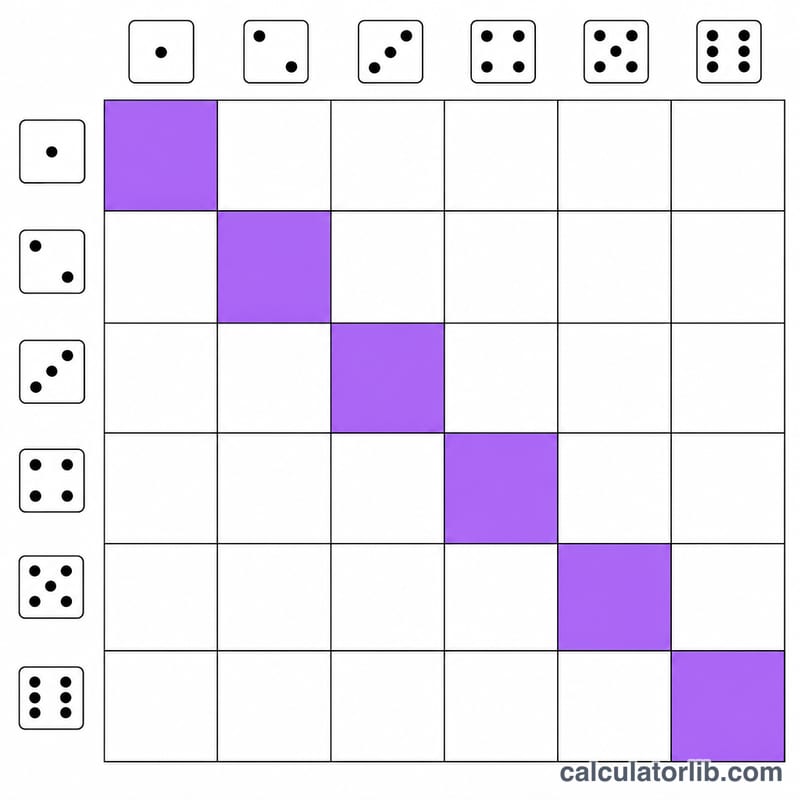
Enter the number of dice you are rolling and the target sum you want to evaluate. Press calculate to see the favorable outcomes, the total outcomes (6 to the power of the number of dice), and the resulting probability. For example, with 2 dice the possible sums range from 2 to 12, and 7 is the most likely total.
The formula explained
For n dice the total number of equally likely outcomes is \(6^{n}\). The calculator uses a convolution (dynamic programming) method to count how many of those outcomes add up to the target sum — call that the favorable outcomes. The probability is then:
$$P(\text{sum}) = \dfrac{\text{favorable outcomes}}{6^{n}}$$
For a single die, every face is equally likely, so any one face has probability \(\frac{1}{6} \approx 16.67\%\).
Worked example
Roll 2 dice and ask for a sum of 7. The combinations are (1,6), (2,5), (3,4), (4,3), (5,2), (6,1) — that is 6 favorable outcomes. Total outcomes = \(6^{2} = 36\). So $$P = \frac{6}{36} = 0.1667 = 16.67\%,$$ with odds of 5 to 1 against.
Key Terms
- Favorable outcomes
- The number of distinct ordered dice combinations that produce the target sum. For two dice, a sum of 5 has 4 favorable outcomes: (1,4), (2,3), (3,2) and (4,1). This is the numerator \(N(\text{dice},\,\text{target})\) in the probability formula.
- Total outcomes (sample space)
- Every equally likely result of rolling the dice. With \(d\) dice each having 6 faces, the sample space has \(6^{d}\) outcomes — 36 for two dice, 216 for three. This is the denominator of the probability.
- Probability
- The chance that the target sum occurs, expressed as favorable outcomes divided by total outcomes: \(P = N / 6^{d}\). It ranges from 0 (impossible) to 1 (certain) and is often shown as a percent.
- Odds against
- The ratio of unfavorable outcomes to favorable outcomes. For a sum of 7 with two dice, the odds against are \((36-6):6 = 30:6 = 5:1\), meaning five non-7 results are expected for every 7.
- Convolution / distribution
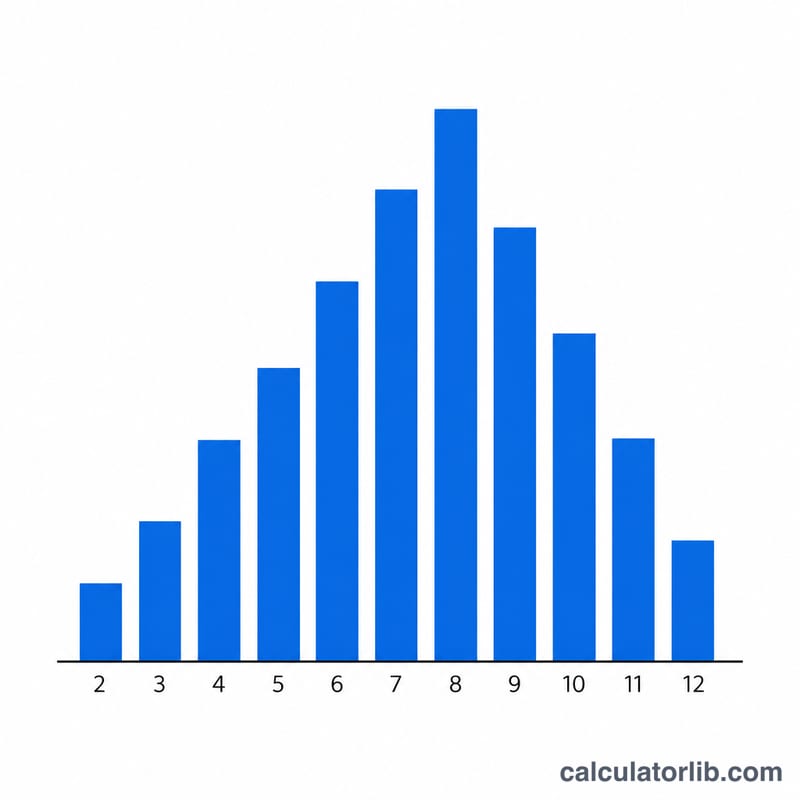
- The full set of probabilities across all possible sums. Adding a die convolves (overlaps and combines) the single-die distribution with the running total, which is why the two-dice distribution forms a triangular shape peaking at 7.
- Target sum
- The specific total you want to evaluate, entered as the target field. It must lie between the minimum (number of dice × 1) and maximum (number of dice × 6); sums outside that range have zero favorable outcomes.
FAQ
Why is 7 the most common sum with two dice? Because more combinations add up to 7 (six of them) than to any other total, making it the peak of the bell-shaped distribution.
Can I use this for more than two dice? Yes. The calculator supports up to 20 dice and counts all combinations exactly.
What does "odds against" mean? It compares unfavorable to favorable outcomes. Odds of 5 to 1 means 5 ways to fail for every 1 way to succeed.