What is a D20 Dice Roller?
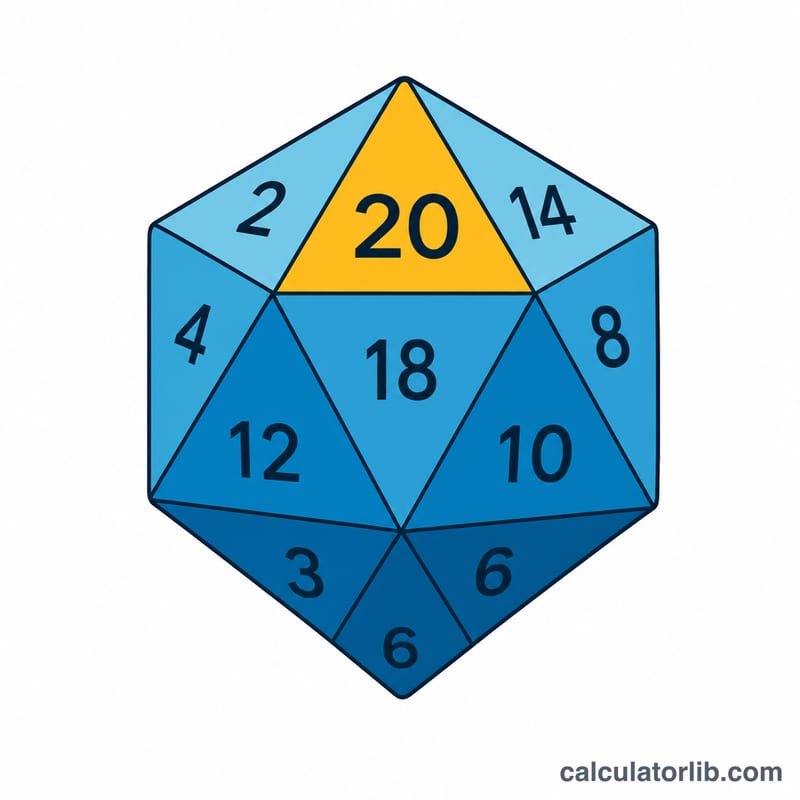
A d20 is a twenty-sided die, the iconic die of Dungeons & Dragons and countless other tabletop role-playing games. This calculator simulates rolling one or more virtual d20 dice and adds an optional modifier to the total — perfect for attack rolls, ability checks, and saving throws when you don't have physical dice on hand.
How to use it
Enter how many d20 dice you want to roll (1 to 100) and an optional modifier such as +5 or -2. Press calculate and you'll get the combined total, the raw dice subtotal, the modifier applied, plus the highest and lowest single roll in the batch. Refresh or re-submit to roll again.
The formula explained
Each die uses roll = floor(random() × 20) + 1. A random fraction between 0 and 1 is scaled to the range 0–19.999, floored to a whole number 0–19, then shifted by 1 to give an integer from 1 to 20 with equal probability. The grand total is the sum of every die plus your modifier.
$$\text{Total} = \sum_{i=1}^{\text{Number of d20}} \left(\lfloor \text{rand} \times 20 \rfloor + 1\right) + \text{Modifier}$$
Worked example
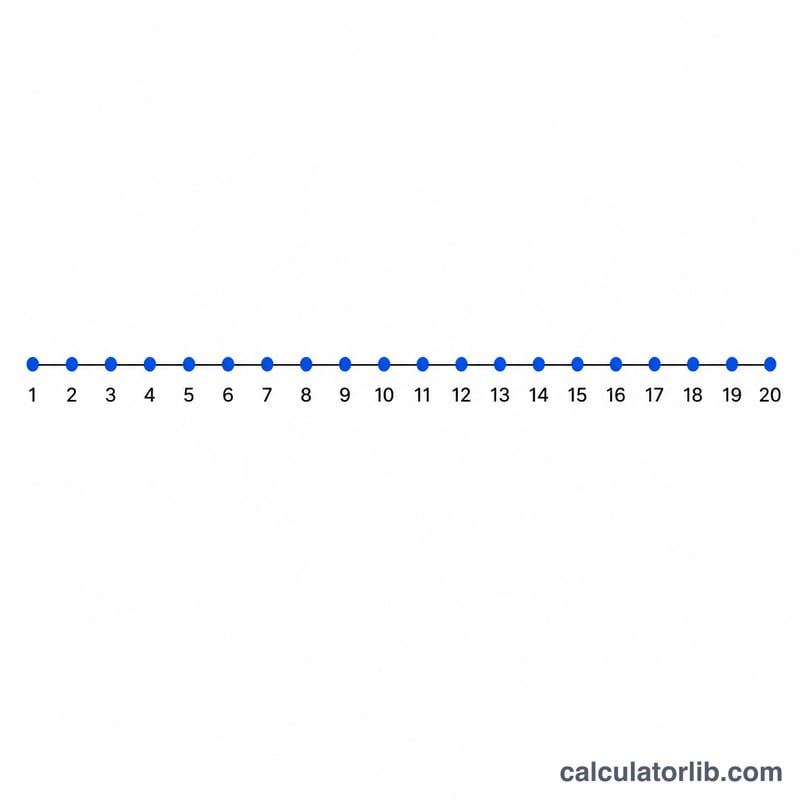
Suppose you roll 2d20 and the dice land on 14 and 7 with a +3 modifier. The dice subtotal is \(14 + 7 = 21\), and the grand total is \(21 + 3 = 24\). The highest single roll is 14 and the lowest is 7.
D20 Probability Reference Table
A fair 20-sided die has 20 equally likely faces, so every single face has probability \(1/20 = 0.05\) (5%). The chance of rolling a given target number or higher on one raw d20 follows directly from counting the faces that qualify:
$$P(\text{roll} \ge N) = \frac{21 - N}{20}$$| Target N | P(exactly N) | P(N or higher) | Faces that succeed |
|---|---|---|---|
| 1 | 5% | 100% | 20 |
| 2 | 5% | 95% | 19 |
| 3 | 5% | 90% | 18 |
| 4 | 5% | 85% | 17 |
| 5 | 5% | 80% | 16 |
| 6 | 5% | 75% | 15 |
| 7 | 5% | 70% | 14 |
| 8 | 5% | 65% | 13 |
| 9 | 5% | 60% | 12 |
| 10 | 5% | 55% | 11 |
| 11 | 5% | 50% | 10 |
| 12 | 5% | 45% | 9 |
| 13 | 5% | 40% | 8 |
| 14 | 5% | 35% | 7 |
| 15 | 5% | 30% | 6 |
| 16 | 5% | 25% | 5 |
| 17 | 5% | 20% | 4 |
| 18 | 5% | 15% | 3 |
| 19 | 5% | 10% | 2 |
| 20 | 5% | 5% | 1 |
The following difficulty-class (DC) bands are the typical difficulty table published for Dungeons & Dragons 5th Edition (Wizards of the Coast, USA) and are a rule of that game system, not a universal probability standard — other RPGs use entirely different target scales. The percentages show how often an unmodified d20 meets each DC.
| Difficulty | DC | Raw d20 needed | Chance with no modifier |
|---|---|---|---|
| Very easy | 5 | 5+ | 80% |
| Easy | 10 | 10+ | 55% |
| Medium | 15 | 15+ | 30% |
| Hard | 20 | 20 | 5% |
| Very hard | 25 | Impossible on the die alone | 0% (needs +5 or better) |
| Nearly impossible | 30 | Impossible on the die alone | 0% (needs +10 or better) |
A modifier shifts the required die face down by exactly its value: the roll you need is \(N_{\text{needed}} = \text{DC} - \text{modifier}\). With a +7 bonus against DC 15 you need a raw 8 or better, which the table above puts at 65%. Equivalently, each +1 adds 5 percentage points of success — up to the point where the die can no longer fail (or no longer succeed), since the faces are capped at 1 and 20.
Interpreting Your Roll
The grand total is what you compare. The number to check against a target — a difficulty class (DC), an armour class (AC), or whatever threshold your game uses — is the die result plus your modifier:
$$\text{Total} = \text{raw d20} + \text{modifier}$$So a raw 12 with a modifier of +4 gives a total of 16, which beats DC 15 by one point. A negative modifier works the same way: a raw 12 with −3 gives 9 and fails DC 15.
One check means one die. For a normal single d20 check, set the number of dice to 1 — only that one face matters. Rolling a larger batch (say 10d20) is a convenience for resolving many separate checks in one click: ten attacks, ten saving throws, a table of random results. Each die in the batch is its own independent check with its own success or failure; the batch sum is not a meaningful "one big check" in d20 systems, because the target numbers are calibrated against a single 1–20 die. Read the individual dice, not the sum, unless your game explicitly asks you to add them.
Natural 20 and natural 1 come off the raw die. A "natural" result is the face shown before any modifier is applied — a raw 20 is still a natural 20 even if your modifier is 0, and a total of 20 reached as 16 + 4 is not a natural 20. Under D&D 5th Edition rules (a rule of that specific game system), a natural 20 on an attack roll always hits and scores a critical hit, and a natural 1 on an attack roll always misses. That automatic hit/miss applies only to attack rolls: ability checks and saving throws in 5e have no inherent auto-success or auto-failure on 20 or 1, though many tables house-rule one. Other RPGs that use a d20 treat 20s and 1s differently, so check your own rulebook.
Advantage and disadvantage. To emulate advantage, roll 2d20 and use the higher raw die; for disadvantage, use the lower. Apply your modifier to the die you kept, not to both. This changes the odds substantially: with advantage, your chance of rolling at least 15 on the kept die rises from 30% to \(1 - 0.70^2 = 51\%\), while with disadvantage it drops to \(0.30^2 = 9\%\). Keep the modifier out of that comparison — advantage affects the die, not the bonus.
Averages over many rolls. A fair d20 has expected value
$$E[d20] = \frac{1 + 2 + \cdots + 20}{20} = \frac{210}{20} = 10.5$$so a batch of \(n\) dice averages \(10.5n\) in total, and a single modified check averages \(10.5 + \text{modifier}\). For example, 8d20 with a +2 modifier has an expected grand total of \(10.5 \times 8 + 2 = 86\). Treat that as a long-run average only: with so few dice, real batches swing widely around it, and a streak of low or high faces is ordinary randomness rather than a sign of a loaded generator. Because the distribution of a single d20 is flat, every face is equally surprising — there is no "most likely" roll to anchor on, which is exactly why small modifiers matter so much in d20 games.
FAQ
Are the rolls truly random? They use a pseudo-random number generator that produces a uniform, fair distribution across 1–20 for typical gaming use.
Can I roll a natural 20? Yes — any single die can return 20 (a "crit") or 1 (a "fumble"), shown in the highest and lowest rows.
Why do I get a new result each time? Every submission re-rolls the dice, so totals change between rolls just like real dice.