

What Is the False Positive Rate?
The false positive rate (FPR), also known as the fall-out, measures how often a classifier or diagnostic test incorrectly flags an actual negative case as positive. It is a core metric in machine learning, medical testing, and statistics, and it forms the x-axis of the ROC curve.
How to Use This Calculator
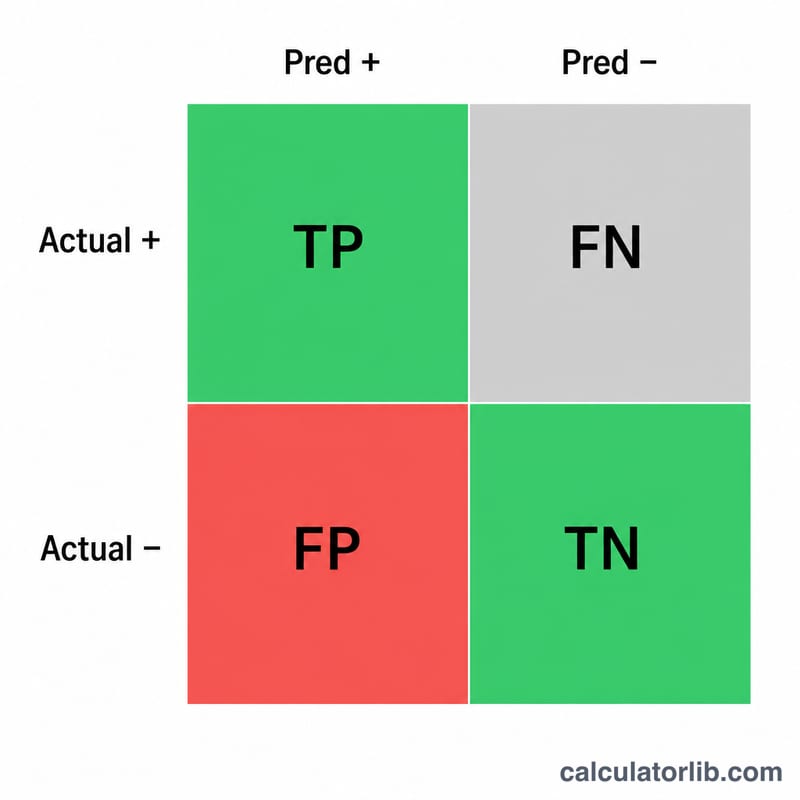
Enter the number of false positives (FP) — negative cases wrongly predicted as positive — and the number of true negatives (TN) — negative cases correctly identified. The calculator returns the FPR as both a proportion and a percentage, along with the corresponding specificity.
The Formula Explained
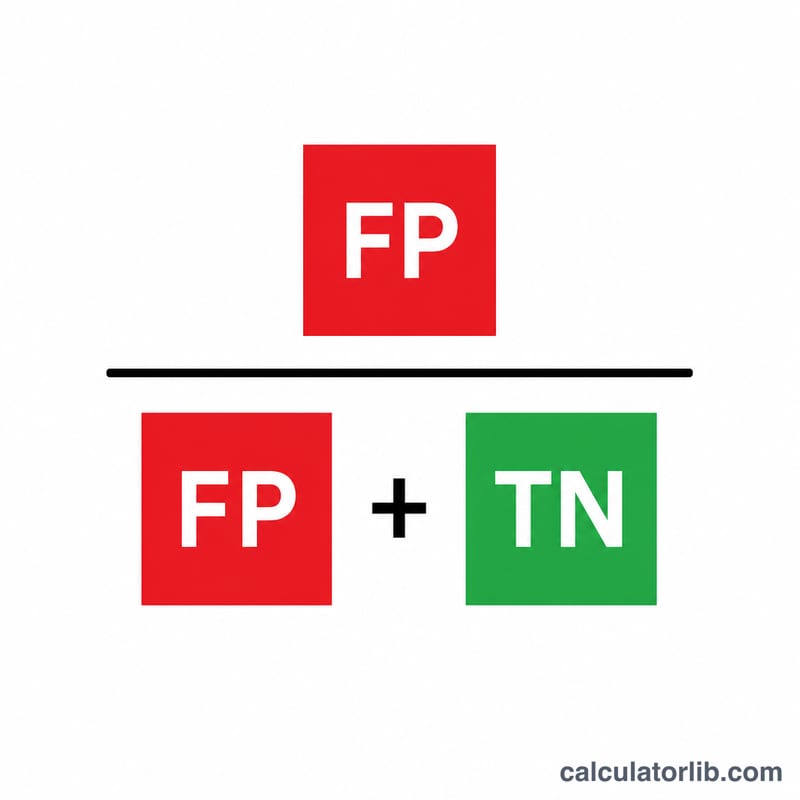
The false positive rate is calculated as:
$$\text{FPR} = \frac{\text{FP}}{\text{FP} + \text{TN}}$$The denominator \((\text{FP} + \text{TN})\) is the total number of actual negative cases. Because specificity (the true negative rate) equals \(\text{TN} / (\text{FP} + \text{TN})\), the FPR is simply its complement: \(\text{FPR} = 1 - \text{specificity}\). A lower FPR indicates a test that rarely raises false alarms.
Worked Example
Suppose a screening test produces 10 false positives and 90 true negatives. Then $$\text{FPR} = \frac{10}{10 + 90} = \frac{10}{100} = 0.10,$$ or 10%. The specificity is \(1 - 0.10 = 0.90\), or 90%. This means the test correctly clears 90% of healthy individuals but falsely alarms on 10%.
FAQ
What is a good false positive rate? Lower is better. The ideal FPR is 0, meaning no negatives are misclassified, though real-world tests trade off FPR against sensitivity.
How is FPR different from precision? FPR uses the count of all actual negatives as its denominator, while precision focuses on predicted positives \((\text{TP} / (\text{TP} + \text{FP}))\).
Can FPR be greater than 1? No. Since FP cannot exceed FP + TN, the FPR is always between 0 and 1 (0% to 100%).