What is the Greatest to Least Calculator?
The Greatest to Least Calculator takes any list of numbers and arranges them in descending order — starting with the largest value and ending with the smallest. This is a common task in math homework, data organization, and statistics where ordering values matters. The tool handles whole numbers, decimals, and negative numbers alike.
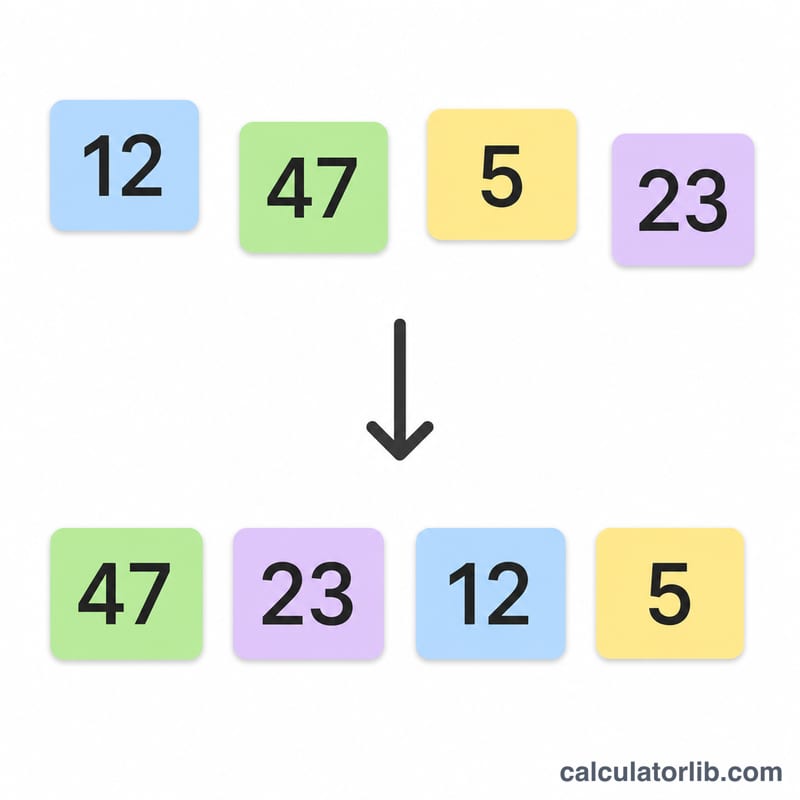
How to use it
Type your numbers into the box, separating them with commas or spaces (for example 3, 17, 5, 21, 8). Press calculate and the tool returns the same numbers reordered from greatest to least, plus the count, the largest value, and the smallest value.
The formula explained
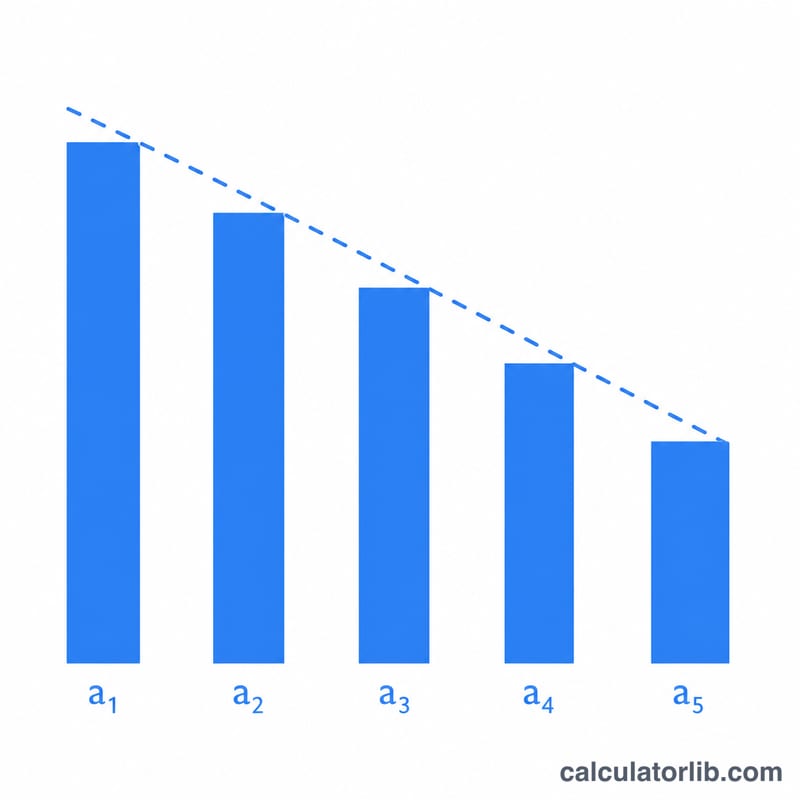
Sorting from greatest to least means producing a sequence where every term is greater than or equal to the one that follows it:
$$\text{Sorted} = \operatorname{desc\,sort}\left(\text{Numbers}\right) \;\Rightarrow\; a_1 \geq a_2 \geq \cdots \geq a_n$$
The calculator compares each pair of values and places them so no number is smaller than the one before it. Equal values stay grouped together.
Worked example
Suppose your list is 3, 17, 5, 21, 8. The largest is 21, then 17, then 8, then 5, then 3. The sorted result is:
$$3, 17, 5, 21, 8 \;\Rightarrow\; 21, 17, 8, 5, 3$$
Here the count is \(5\), the largest is \(21\), and the smallest is \(3\).
How to Sort Numbers from Greatest to Least by Hand
Sorting in descending order means arranging numbers so each one is greater than or equal to the number after it. Follow these steps:
- List all the numbers. Write them out and count them. For example: 3.4, -1, 3.04, 0, -1.5 (5 numbers).
- Identify the largest number. Compare carefully:
- Positives beat zero, and zero beats negatives.
- Decimals: align the decimal places by adding trailing zeros, then compare digit by digit from the left. 3.4 becomes 3.40, which is larger than 3.04. Do not compare by length, since 2.5 is larger than 2.07 even though 2.07 has more digits.
- Negatives: the negative number closer to zero is larger. -1 is greater than -1.5, and -2 is greater than -9.
- Write it first and cross it off. Sorted so far: 3.4. Remaining: -1, 3.04, 0, -1.5.
- Repeat with the remaining numbers. The largest remaining is 3.04, then 0, then -1, then -1.5. Each time, write the number next in your sorted list and cross it off the original.
- Check the result. Confirm that \(a_1 \geq a_2 \geq \cdots \geq a_n\) by comparing each neighboring pair, and that the count of numbers in the sorted list equals the count in the original list. Final answer: 3.4, 3.04, 0, -1, -1.5 (5 numbers, each ≥ the next).
Ties and duplicates: if a number appears more than once, keep every copy. Equal values sit next to each other, and the list stays in valid descending order because \(a_i \geq a_{i+1}\) allows equality. Never drop a duplicate, or the count check in step 5 will fail.
Sorting Different Types of Number Lists
| Input list | Type of list | Sorted greatest to least |
|---|---|---|
| 4, 12, 9, 1 | All positive integers | 12, 9, 4, 1 |
| -2, -9, 0, 5 | Negatives with zero and a positive | 5, 0, -2, -9 |
| 2.5, 2.75, 2.07 | Decimals | 2.75, 2.5, 2.07 |
| 7, 3, 7, 1 | Duplicates | 7, 7, 3, 1 |
| 0.5, 0.75, 0.25, 1.5 (that is ½, ¾, ¼, 1½ written as decimals) | Fractions converted to decimals | 1.5, 0.75, 0.5, 0.25 |
Why each ordering is correct
- Positive integers: a larger whole number is simply farther to the right on the number line, so 12 > 9 > 4 > 1.
- Negatives: 5 is positive, 0 is next, and between -2 and -9 the one closer to zero (-2) is larger.
- Decimals: write them with equal places: 2.75, 2.50, 2.07. Compare 2.75 > 2.50 > 2.07. The extra digit in 2.07 does not make it larger.
- Duplicates: both 7s are kept and placed together at the front, so the list still has 4 numbers.
- Fractions as decimals: convert first (½ = 0.5, ¾ = 0.75, ¼ = 0.25, 1½ = 1.5), then compare as ordinary decimals. When entering numbers into the calculator, use the decimal forms.
FAQ
Does it work with negative numbers? Yes. Negatives are ranked correctly — for example \(-2\) is greater than \(-9\), so \(-2\) appears first.
Can I use decimals? Absolutely. Decimal values like \(2.5\) and \(2.75\) are ordered by their true numeric size.
What is the difference between greatest to least and least to greatest? Greatest to least is descending order (largest first); least to greatest is ascending order (smallest first). This tool produces descending order.