
What Is the Probability of At Least One?
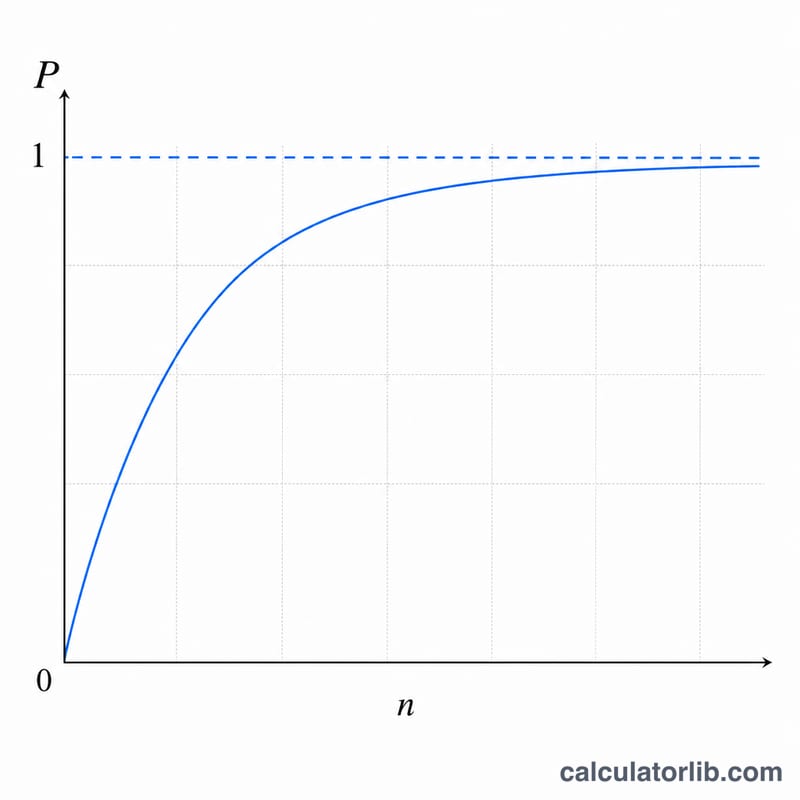
The "probability of at least one" tells you how likely an event is to happen one or more times when you repeat an experiment several times. Even when a single event is unlikely, repeating the experiment many times can make at least one occurrence almost certain. This calculator uses the simple complement rule for independent trials.
The Formula
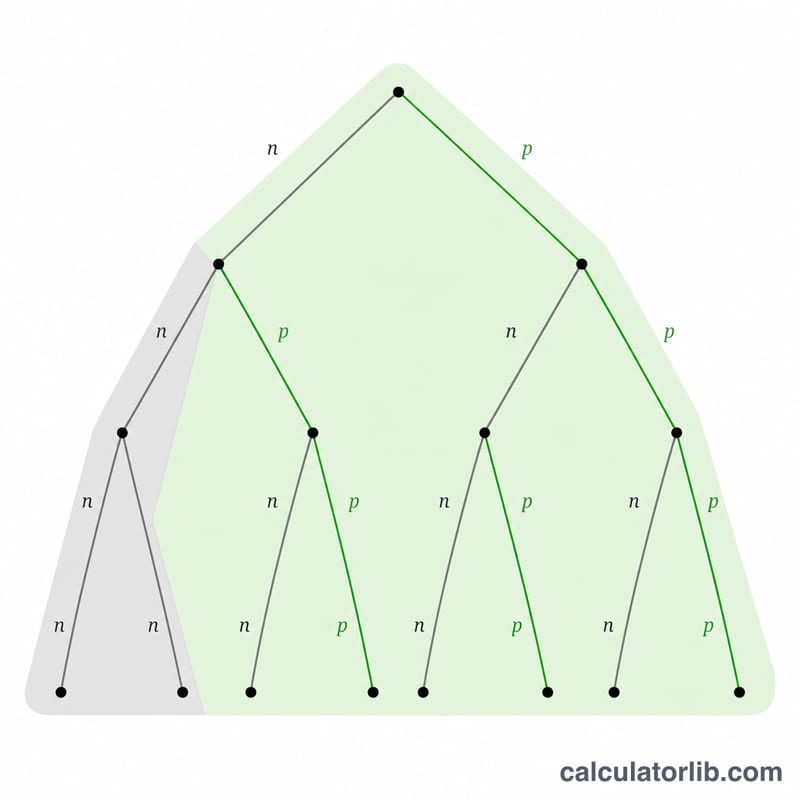
If each trial has the same probability p of success and the trials are independent, then:
$$P(\text{at least one}) = 1 - \left(1 - p\right)^{n}$$
The trick is to compute the easier opposite first. The probability that the event never happens in one trial is \((1 - p)\). Across n independent trials that becomes \((1 - p)^{n}\). Subtracting that from 1 gives the chance it happens at least once.
How to Use It
Enter the per-trial probability p as a decimal between 0 and 1 (for example, 0.1 means a 10% chance), and the number of trials n. The calculator returns the probability of at least one occurrence, both as a decimal and a percentage, plus the probability of zero occurrences.
Worked Example
Suppose a single dice roll has a \(1/6 \approx 0.1667\) chance of landing a six, and you roll 4 times. The chance of no six is $$(1 - 0.1667)^{4} = (0.8333)^{4} \approx 0.4823.$$ So the probability of at least one six is \(1 - 0.4823 \approx 0.5177\), or about 51.8%.
FAQ
Does this assume independent trials? Yes. Each trial must be independent and have the same probability p. If outcomes affect each other, this formula does not apply directly.
Can p be a percentage? Convert it to a decimal first — 25% becomes 0.25.
Why compute the complement? Calculating "none happen" is a single product, which is far easier than summing the probabilities of exactly one, exactly two, and so on.