
What This Calculator Does
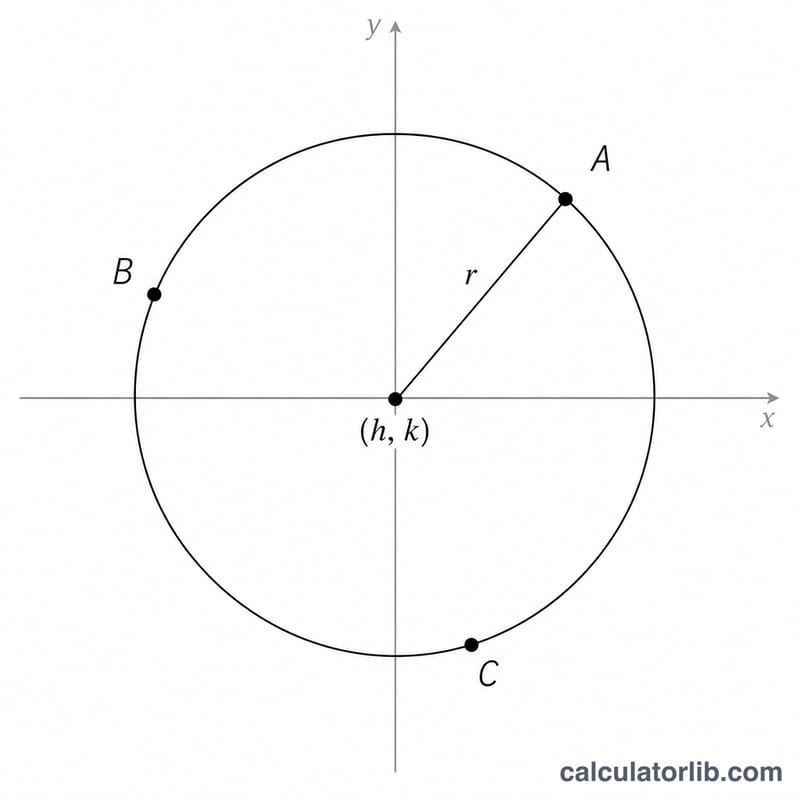
Given three points in the plane, there is exactly one circle that passes through all of them — provided the points are not on a single straight line. This tool solves for that unique circle, returning its center (h, k), radius r, the standard equation \((x - h)^2 + (y - k)^2 = r^2\), plus the circle's area and circumference.
How to Use It
Enter the x and y coordinates of all three points. Click calculate. The result shows the full circle equation and a table with the center coordinates, radius, area, and circumference. If the three points happen to be collinear, the calculator tells you that no unique circle exists.
The Formula Explained
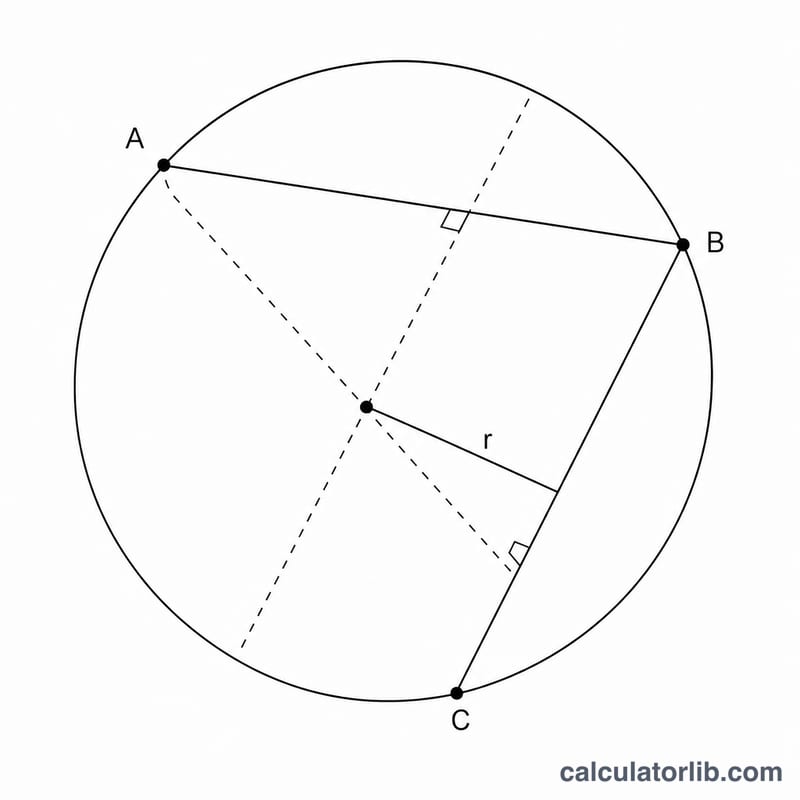
Each point on a circle satisfies $$(x - h)^2 + (y - k)^2 = r^2.$$ Subtracting the equations pairwise eliminates the squared terms and gives two linear equations in \(h\) and \(k\) — geometrically these are the perpendicular bisectors of two chords, which intersect at the center. Using \(S = x^2 + y^2\) for each point and the determinant \(D = 2[x_1(y_2-y_3) + x_2(y_3-y_1) + x_3(y_1-y_2)]\), the center is found directly. If \(D = 0\) the points are collinear. The radius is then simply the distance from the center to any point.
Worked Example
Take the points (0,0), (4,0) and (0,4). By symmetry the center is (2,2). The radius is $$\sqrt{(0-2)^2 + (0-2)^2} = \sqrt{8} \approx 2.828.$$ So the equation is \((x - 2)^2 + (y - 2)^2 = 8\), with area \(\approx 25.13\) and circumference \(\approx 17.77\).
FAQ
What if my points are in a straight line? Then no unique circle passes through them — the perpendicular bisectors are parallel (\(D = 0\)) and the tool returns a warning.
Can I use negative or decimal coordinates? Yes. Any real coordinates work, including negatives and decimals.
Why is the center sometimes outside the triangle? The circumcenter (center of this circle) lies outside the triangle whenever the triangle is obtuse — this is normal.