
What Is Mean Absolute Error (MAE)?
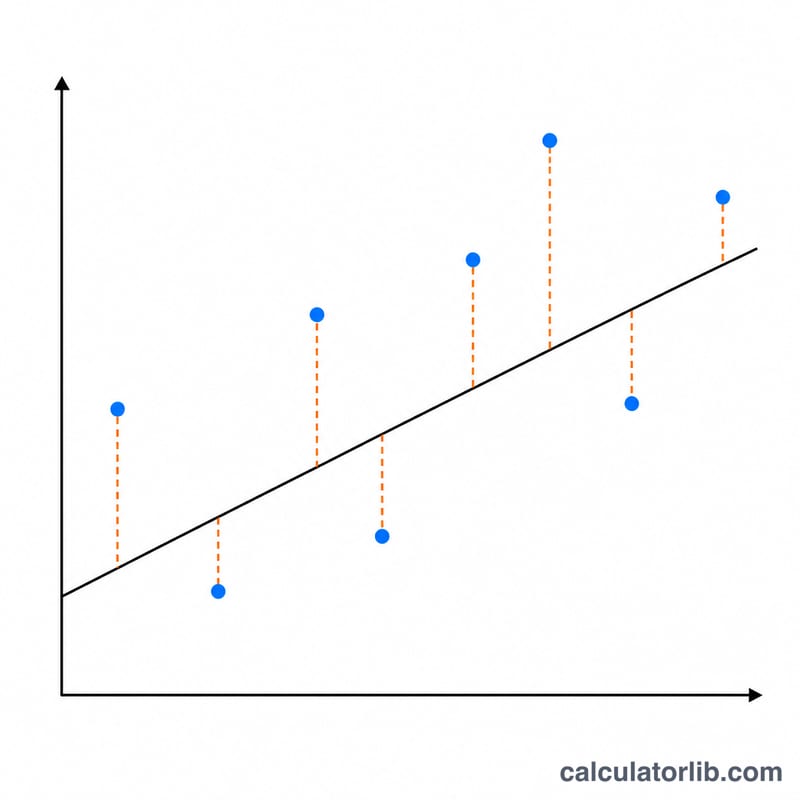
The Mean Absolute Error (MAE) is one of the most common metrics used to evaluate the accuracy of a regression model or forecast. It measures the average magnitude of the errors between predicted values and actual observed values, without considering their direction. Because it uses absolute values, every error contributes positively to the total, making MAE easy to interpret: it is the average amount by which your predictions are wrong, expressed in the same units as the data.
How to Use This Calculator
Enter your list of actual (observed) values and your list of predicted (forecast or model) values in the two boxes. Separate each number with a comma or a space. Make sure both lists contain the same number of values, lined up so that the first actual matches the first prediction, and so on. Click calculate to get the MAE along with the sum of absolute errors and the number of paired observations used.
The Formula Explained
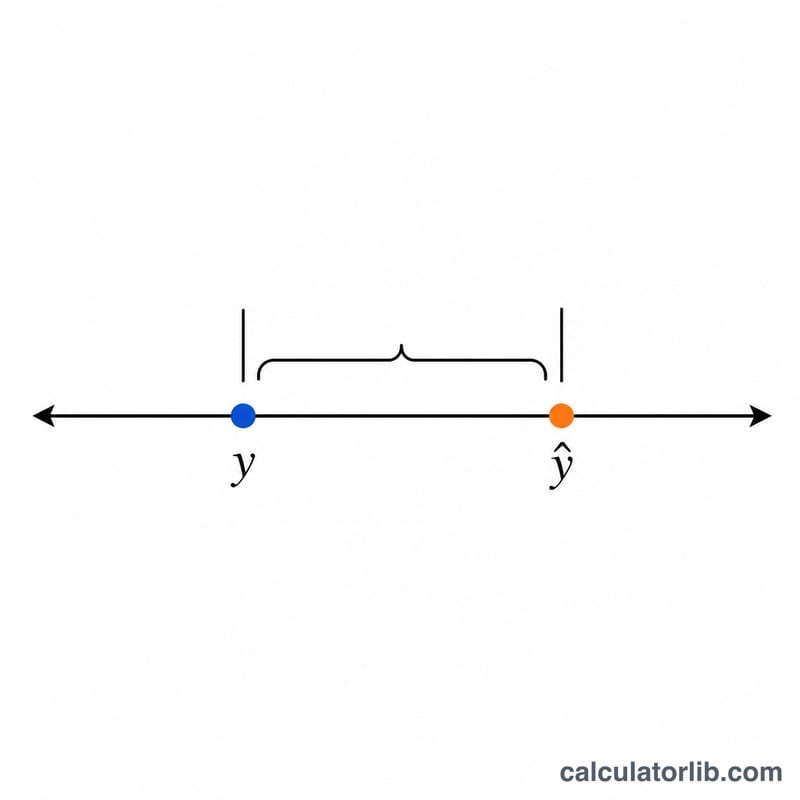
The formula is $$\text{MAE} = \frac{1}{n}\sum_{i=1}^{n}\left| y_i - \hat{y}_i \right|$$ For each observation you subtract the predicted value (\(\hat{y}_i\)) from the actual value (\(y_i\)), take the absolute value of that difference (ignoring the minus sign), add all of these absolute differences together, and finally divide by \(n\), the number of observations. The result is the typical size of a single prediction error.
Worked Example
Suppose the actual values are 3, 5, 2, 7 and the predicted values are 2.5, 5, 4, 8. The absolute errors are \(|3-2.5| = 0.5\), \(|5-5| = 0\), \(|2-4| = 2\), and \(|7-8| = 1\). Their sum is 3.5. Dividing by \(n = 4\) gives $$\text{MAE} = 3.5 / 4 = 0.875$$
FAQ
How is MAE different from MSE? MAE averages absolute errors, while Mean Squared Error (MSE) averages squared errors. MSE penalizes large errors more heavily, whereas MAE treats all errors proportionally.
What is a good MAE value? Lower is better, and \(\text{MAE} = 0\) means perfect predictions. There is no universal threshold — interpret it relative to the scale and typical range of your data.
Can MAE be negative? No. Because it averages absolute (always non-negative) differences, MAE is always zero or positive.