
What is rounding to the nearest hundred?
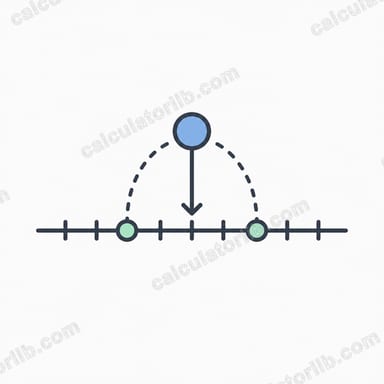
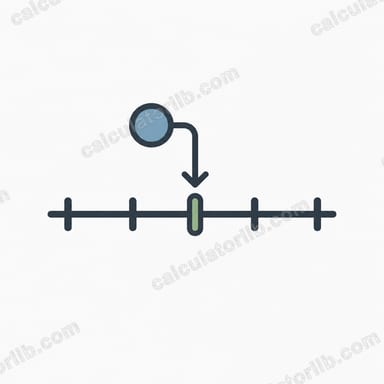
Rounding to the nearest hundred replaces a number with the closest multiple of 100 (such as 0, 100, 200, 300, …). It keeps the magnitude of a value while removing detail in the tens and units places. This is handy for quick estimates, budgeting, reporting large figures, and simplifying mental math.
How to use this calculator
Enter any number — positive, negative, whole, or decimal — and the calculator instantly returns the nearest multiple of 100. It also shows your original number so you can compare the two values side by side.
The formula explained
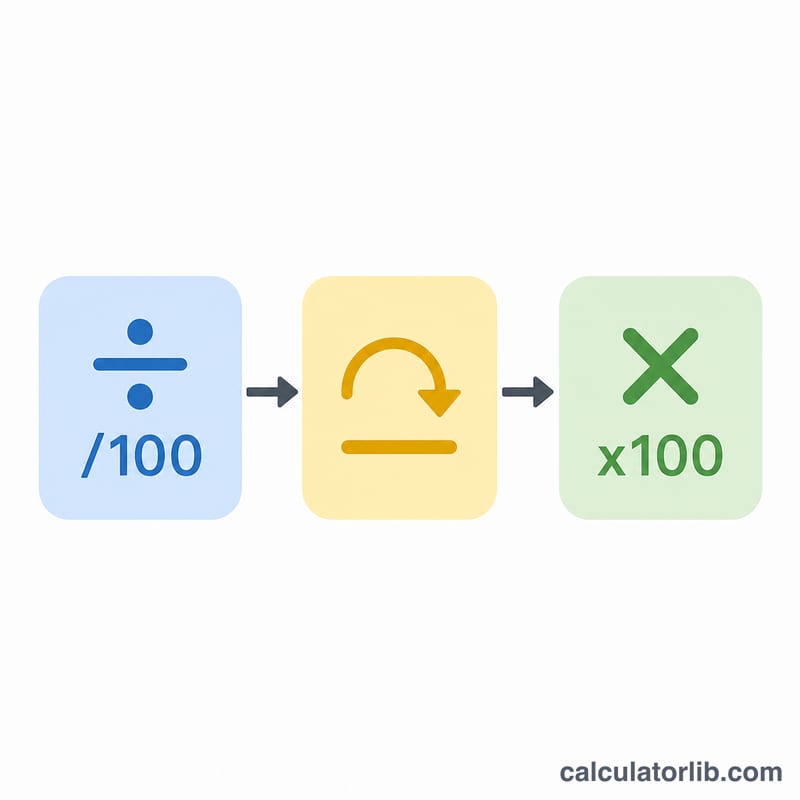
The rule is $$\text{Rounded} = \operatorname{round}\!\left(\frac{\text{Number}}{100}\right) \times 100$$. First the number is divided by 100, which moves the hundreds place into the ones place. That intermediate value is rounded to the nearest whole number, then multiplied by 100 to restore the scale. The key step is the standard rounding rule: if the tens digit is 5 or more, round up; if it is 4 or less, round down.
Worked example
Suppose \(x = 1234\). Divide by 100 to get \(12.34\). Rounding \(12.34\) to the nearest whole number gives \(12\) (because the decimal \(.34\) is below \(.5\)). Multiplying back: $$12 \times 100 = 1200$$ So 1234 rounds to 1200. By contrast, \(1250 \to 12.5 \to 13 \to 1300\).
FAQ
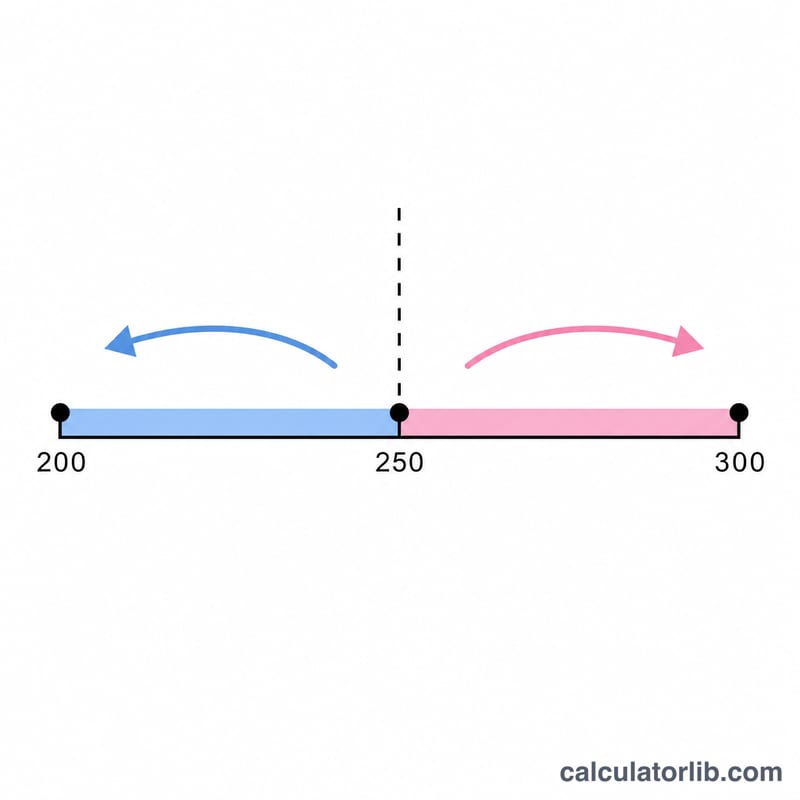
What happens at exactly 50? A value ending in 50, like 250, sits halfway. This calculator rounds half up, so 250 becomes 300.
Does it work with negative numbers? Yes. For example, \(-1234\) rounds to \(-1200\), and \(-1250\) rounds to \(-1200\) as well (rounding half toward positive infinity).
Can I round decimals? Absolutely — \(1234.7\) still rounds to 1200, because only the hundreds place matters when rounding to the nearest hundred.