
What is the Rounding Calculator?
The Rounding Calculator takes any number and rounds it to a chosen number of decimal places. Beyond standard "round to nearest," it also supports ceiling (always up), floor (always down) and truncation (drop digits toward zero). It's handy for finance, statistics, engineering, schoolwork, and cleaning up messy measurements.
How to use it
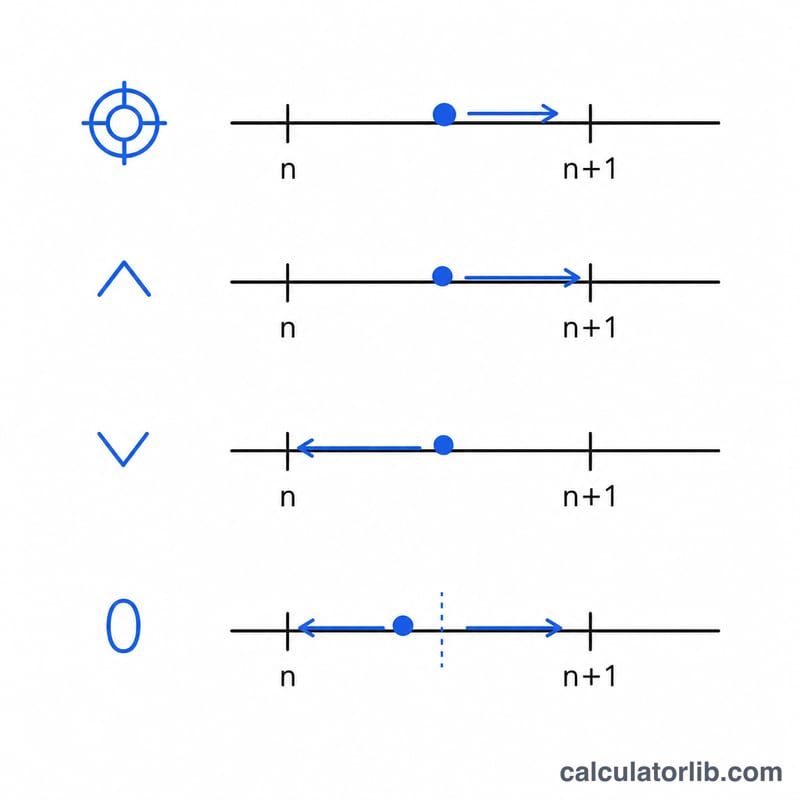
Enter the number you want to round, choose how many decimal places to keep, and pick a rounding mode. Positive decimal places keep digits after the point (2 → hundredths). A value of 0 rounds to a whole number, and negative values round to the left of the decimal point: −1 rounds to the nearest ten, −2 to the nearest hundred.
The formula explained
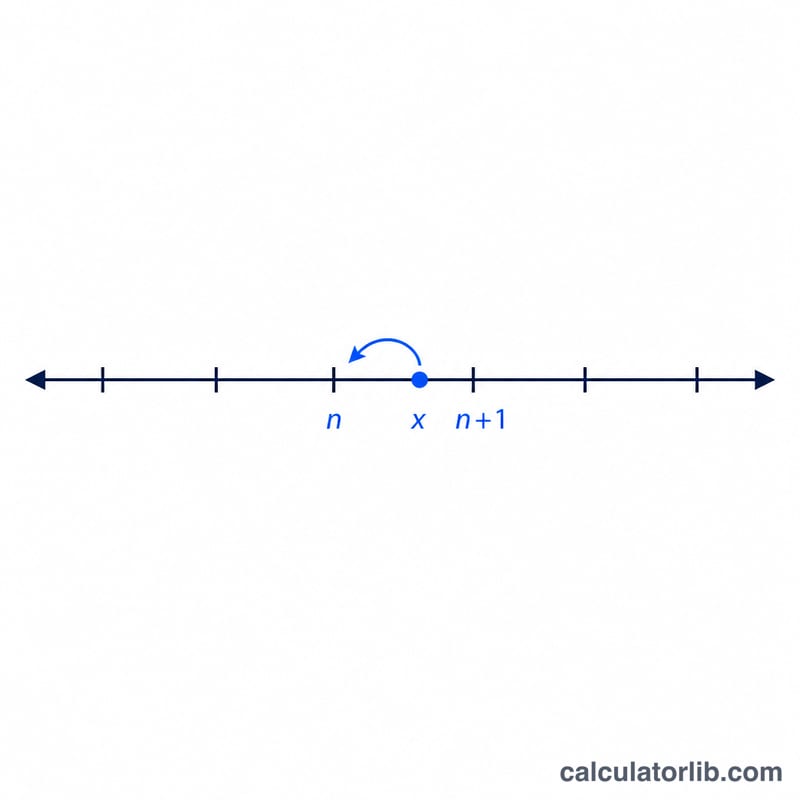
Rounding to d decimal places works in three steps. First multiply by \(10^{d}\) to shift the digits you want to keep to the left of the decimal point. Then round that scaled value to the nearest integer. Finally divide by \(10^{d}\) to shift back. In symbols: $$\text{rounded} = \frac{\operatorname{round}(x \times 10^{d})}{10^{d}}$$ The "nearest" mode rounds halves up (3.145 → 3.15), while ceiling, floor and truncate replace the rounding step with ceil, floor, or drop-toward-zero.
Worked example
Round 3.14159 to 2 decimal places. Multiply: \(3.14159 \times 10^{2} = 314.159\). Round to the nearest integer: 314. Divide back: \(314 \div 100 = \mathbf{3.14}\). Now try −1 decimal place on 1234: \(1234 \times 10^{-1} = 123.4\), round → 123, \(\div\, 0.1 \to \mathbf{1230}\).
FAQ
How are exact halves handled? In the default nearest mode, a trailing .5 rounds up (away from zero for positives), e.g. 2.5 → 3.
What does a negative decimal place do? It rounds to tens, hundreds and so on. −2 rounds 1567 to 1600.
What is the difference between floor and truncate? For positive numbers they match, but for negatives floor goes more negative (−2.3 → −3) while truncate drops the fraction toward zero (−2.3 → −2).