What is the Timesheet Rounding Calculator?
This tool rounds a clocked time entry to the nearest payroll-friendly interval — such as 15 minutes (a quarter hour) — and converts the result into decimal hours. Many employers round punch times so that pay can be calculated in clean increments. This calculator shows the rounded hours and minutes, the decimal-hour equivalent, and the exact adjustment applied.
How to use it
Enter the hours and minutes from your timesheet, then choose the rounding interval your employer uses (commonly 15 minutes, sometimes 6, 10, or 30). The calculator converts everything to total minutes, rounds to the nearest multiple of the interval, and converts back to hours and minutes plus decimal hours.
The formula explained
The core equation is \(\text{rounded} = \text{round}\!\left( \frac{\text{minutes}}{\text{interval}} \right) \times \text{interval}\). The total time is first expressed in minutes (hours \(\times\) 60 + minutes). Dividing by the interval and rounding to the nearest whole number gives the number of intervals; multiplying back by the interval produces the rounded total minutes. Standard "round half up" behavior is used, which is the common timesheet convention where exactly half an interval rounds up.
$$\text{Rounded} = \text{round}\!\left( \frac{T}{I} \right) \times I \quad \text{minutes}$$where
$$\left\{ \begin{aligned} T &= \text{Hours} \times 60 + \text{Minutes} \\ I &= \text{Interval (min)} \end{aligned} \right.$$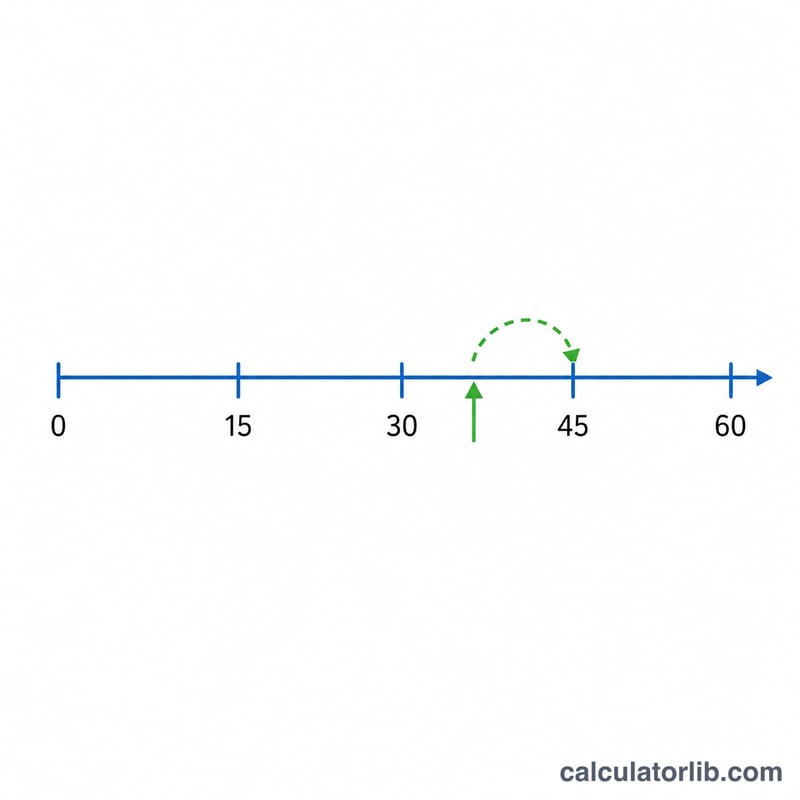
Worked example
Suppose you logged 8 hours 7 minutes and round to the nearest 15 minutes. Total minutes = \(8 \times 60 + 7 = 487\). Then \(487 \div 15 = 32.47\), which rounds to 32. Multiplying \(32 \times 15 = 480\) minutes = 8 hours 0 minutes = 8.00 decimal hours. The adjustment is \(-7\) minutes.
Minutes to Decimal Hours Conversion Chart
Payroll systems usually need time in decimal hours, not hours and minutes. To convert, divide the minutes by 60:
$$\text{Decimal hours} = \frac{\text{Minutes}}{60}$$For example, 45 minutes is \(45 \div 60 = 0.75\) hours, so 7 hours 45 minutes is 7.75 hours. The chart below covers every 15-minute mark (quarter hours) and every 6-minute mark (tenths of an hour). These values are exact.
| Minutes | Decimal hours | Mark type |
|---|---|---|
| 0 | 0.00 | 15-min and 6-min |
| 6 | 0.10 | 6-min (tenth) |
| 12 | 0.20 | 6-min (tenth) |
| 15 | 0.25 | 15-min (quarter) |
| 18 | 0.30 | 6-min (tenth) |
| 24 | 0.40 | 6-min (tenth) |
| 30 | 0.50 | 15-min and 6-min |
| 36 | 0.60 | 6-min (tenth) |
| 42 | 0.70 | 6-min (tenth) |
| 45 | 0.75 | 15-min (quarter) |
| 48 | 0.80 | 6-min (tenth) |
| 54 | 0.90 | 6-min (tenth) |
| 60 | 1.00 | 15-min and 6-min |
Other minute values don't convert to short decimals. Most of them give repeating decimals, so they have to be rounded. Here are some common ones at two-decimal precision:
| Minutes | Exact value | Rounded to 2 decimals |
|---|---|---|
| 1 | 0.01666… | 0.02 |
| 5 | 0.08333… | 0.08 |
| 7 | 0.11666… | 0.12 |
| 8 | 0.13333… | 0.13 |
| 10 | 0.16666… | 0.17 |
| 20 | 0.33333… | 0.33 |
| 40 | 0.66666… | 0.67 |
| 50 | 0.83333… | 0.83 |
This is why 6-minute rounding is popular for billing in tenths of an hour. Every multiple of 6 minutes converts to an exact tenth (\(6 \div 60 = 0.1\)), so you never round the decimal a second time. Fifteen-minute rounding works the same way and always gives .00, .25, .50 or .75. With 5- or 10-minute intervals, most results are repeating decimals. For example, 10 minutes is \(0.1\overline{6}\) hours, so check how many decimal places your payroll system keeps.
FAQ
Why convert to decimal hours? Payroll systems multiply decimal hours by an hourly rate, so 8h 15m becomes 8.25 hours.
Is rounding legal? In many jurisdictions rounding is permitted if it is neutral over time and does not systematically underpay workers. Check your local labor rules.
What does the 7-minute rule mean? With 15-minute rounding, 1–7 minutes round down and 8–14 minutes round up — exactly what this calculator does.