
What this calculator does
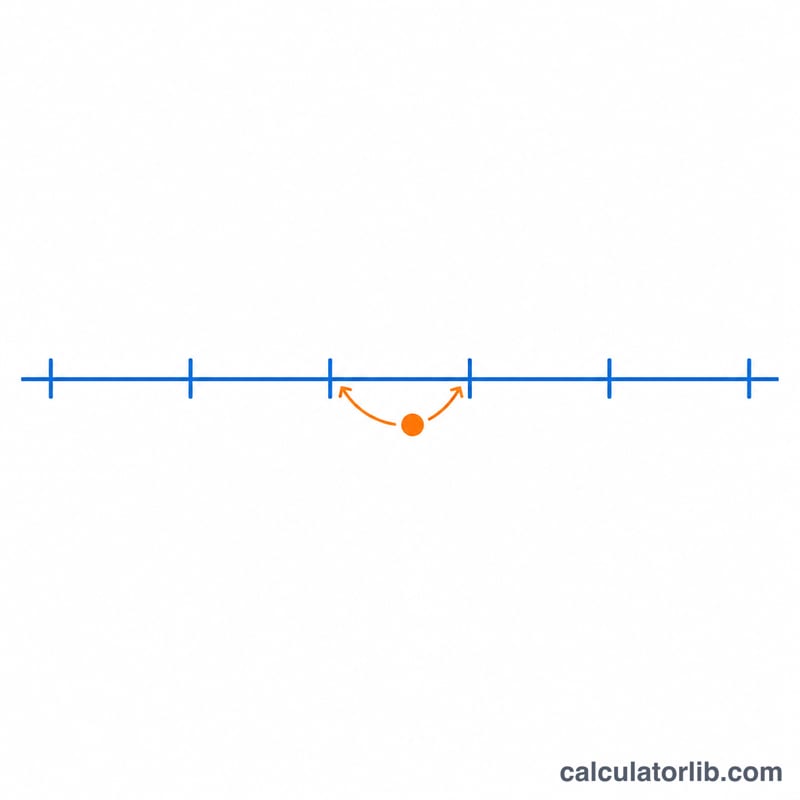
The Rounding Methods Calculator rounds any positive or negative number to a place value you choose — from billions on the left of the decimal point down to billionths on the right — using one of nine rounding methods. Most rounding rules agree on every value except exact halfway "ties" (a digit of 5 with nothing meaningful after it); the method you pick decides what happens at those ties.
How to use it
Pick a Method, type the Value you want to round (a leading minus sign is allowed for negatives), and choose the Round To place. The calculator returns the rounded answer plus a plain-English description of the place value and the rule that was applied.
The formula explained
Let p be the number of decimal places to keep (negative for whole-number places). The value is scaled by a factor \(f = 10^{p}\), which shifts the digit being rounded into the ones position. The scaled value \(s = \text{value} \times f\) is rounded to an integer n using the selected method, then the answer is \(n \div f\). The general rule is $$\text{Result} = \frac{\operatorname{round}\!\left(\text{Value} \times 10^{\,p}\right)}{10^{\,p}}$$ To recover genuine ties that binary floating point would otherwise miss (1.15 is stored as slightly less than 1.15), the scaled value is rounded to nine decimals before the tie is detected.
Worked example
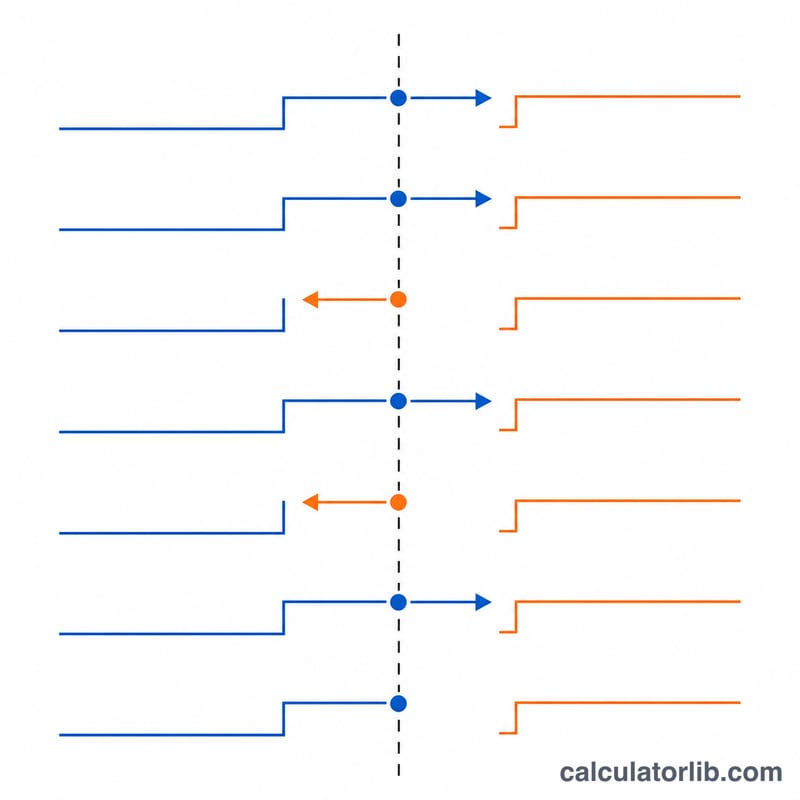
Value 1.15, method Round Half Up, Round To Tenths (\(p = 1\)). \(f = 10\), so \(s = 11.5\) — an exact halfway value. Round Half Up sends ties toward positive infinity, giving $$\lceil 11.5 \rceil = 12, \quad 12 \div 10 = \mathbf{1.2}$$
FAQ
What is Bankers' rounding? Round Half Even sends ties to the nearest even integer, so 2.5 becomes 2 and 3.5 becomes 4. Spreading ties evenly reduces cumulative bias in long sums.
How do negative Round To places work? A negative place rounds to the left of the decimal point: Thousands (\(p = -3\)) snaps to the nearest 1000, so 12,345 becomes 12,000.
Why does Round Half Random give different answers? That method flips a 50/50 coin on each tie, so it is intentionally non-deterministic and may return a different result on each calculation.