
What is the Scientific Notation Converter?
This tool takes any number you type — a plain decimal like 357096, a caret-style scientific expression like 3.456 x 10^11, or e-notation like 5.6e-3 — and instantly rewrites it in every common form: proper scientific notation, e notation, engineering notation with its SI metric prefix, standard form, order of magnitude, the fully expanded real number, and the number spelled out in English words. It is a universal math tool with no units involved.
How to use it
Enter a single value in the box and submit. The parser accepts three formats: (a) ordinary decimals/integers, with optional thousands commas; (b) mantissa times a power of ten written with a caret, e.g. 3.45 x 10^5, 3.45*10^5; and (c) e/E notation such as 3.45e5. Everything is converted to one real value and re-formatted.
The formula explained
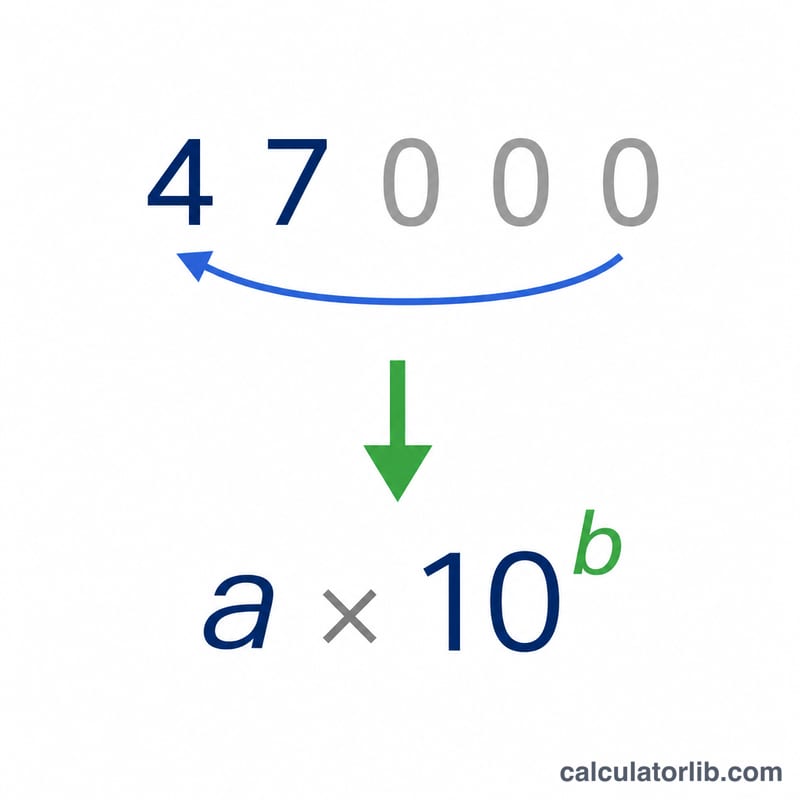
For a nonzero value V, the order of magnitude is \(b = \lfloor \log_{10}|V| \rfloor\) and the mantissa is \(a = V / 10^{b}\), normalized so that \(1 \le |a| < 10\). Scientific notation and standard form are both
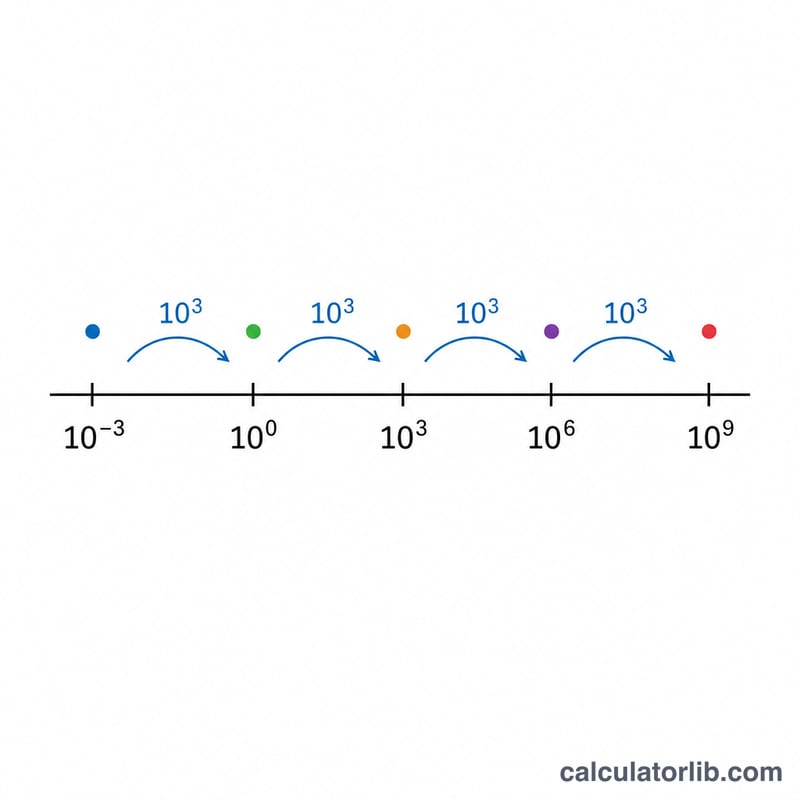
$$\text{Value} = a \times 10^{b}, \quad 1 \le |a| < 10$$e notation is a e b. Engineering notation snaps the exponent to a multiple of three: \(p = 3 \times \lfloor b/3 \rfloor\) and \(m = V / 10^{p}\) with \(1 \le |m| < 1000\). Each p maps to an SI prefix (giga-, mega-, kilo-, milli-, etc.).
Worked example
Input 3.456 x 10^11 gives \(V = 345{,}600{,}000{,}000\). Then \(b = \lfloor 11.54 \rfloor = 11\) and \(a = 3.456\), so
Engineering: \(p = 9\), \(m = 345.6\), prefix giga- (G), name billion. Order of magnitude = 11, real number = 345600000000, word form = "three hundred forty-five billion six hundred million".
FAQ
What about zero? Zero is a special case: it shows as \(0 \times 10^{0}\), real number 0, word form "zero".
Are negative numbers supported? Yes — the sign stays on the mantissa and the word form is prefixed with "negative"; the exponent is computed from the absolute value.
Why does engineering notation use multiples of three? Because each step of three powers of ten matches an SI metric prefix (kilo, mega, giga, milli, micro...), which is convenient for science and engineering.