
What Is Scientific Notation?
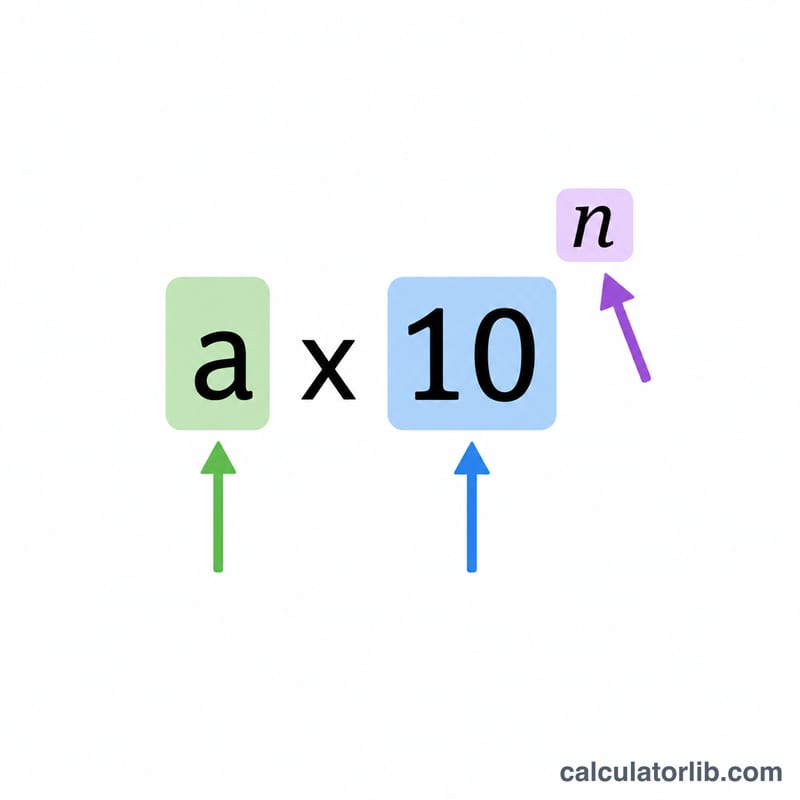
Scientific notation is a compact way to write very large or very small numbers using the form \(a \times 10^{n}\), where a is the coefficient (usually between 1 and 10) and n is an integer exponent. For example, the speed of light is about \(3 \times 10^{8}\) m/s, which expands to 300,000,000. This converter takes the coefficient and exponent you enter and turns them back into a standard decimal number you can read at a glance.
How to Use This Converter
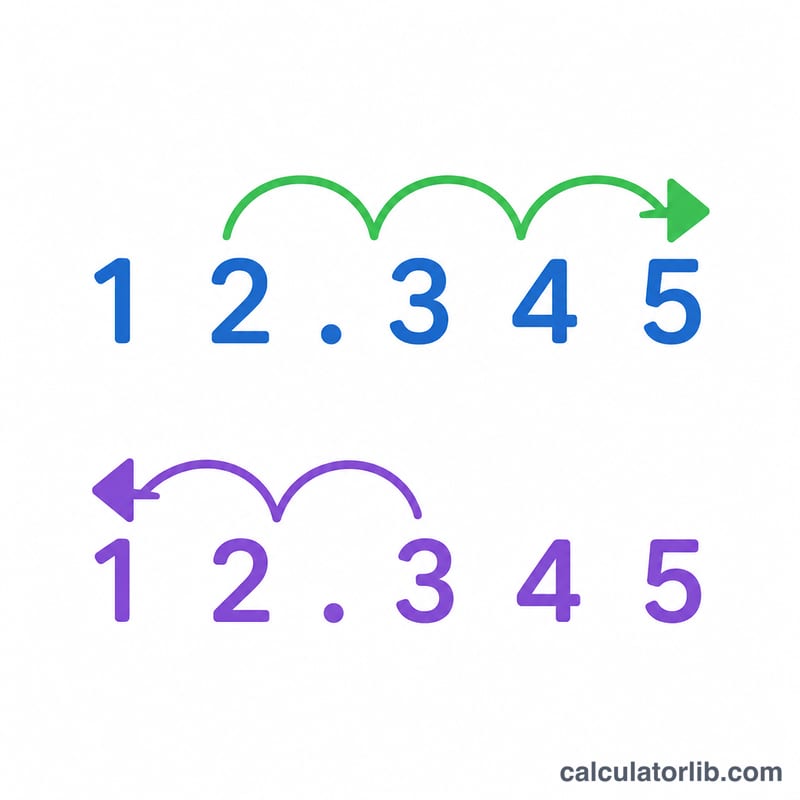
Enter the coefficient a (it can include decimals, like 6.022) and the exponent n (a positive or negative whole number). The calculator multiplies the coefficient by 10 raised to the exponent and displays the full decimal form. Positive exponents move the decimal point to the right (making the number larger); negative exponents move it to the left (making the number smaller).
The Formula Explained
The conversion uses the simple identity
$$d = a \times 10^{n}$$A positive exponent of n appends n decimal-place shifts to the right, while a negative exponent shifts the decimal point n places to the left, padding with zeros as needed.
Worked Example
Suppose you have \(6.022 \times 10^{5}\). Compute \(10^{5} = 100{,}000\), then multiply:
$$6.022 \times 100{,}000 = 602{,}200$$So the decimal form is 602,200. For a negative exponent like \(4.5 \times 10^{-3}\), you get \(4.5 \times 0.001 = 0.0045\).
FAQ
What happens with a negative exponent? The result becomes a small fraction less than the coefficient — the decimal point moves left. For example, \(2 \times 10^{-2} = 0.02\).
Can the coefficient be any number? Yes. While proper scientific notation keeps the coefficient between 1 and 10, this tool accepts any value and still computes \(a \times 10^{n}\) correctly.
What does an exponent of 0 do? Since \(10^{0} = 1\), the decimal form simply equals the coefficient itself.