
What Is a Summation Calculator?
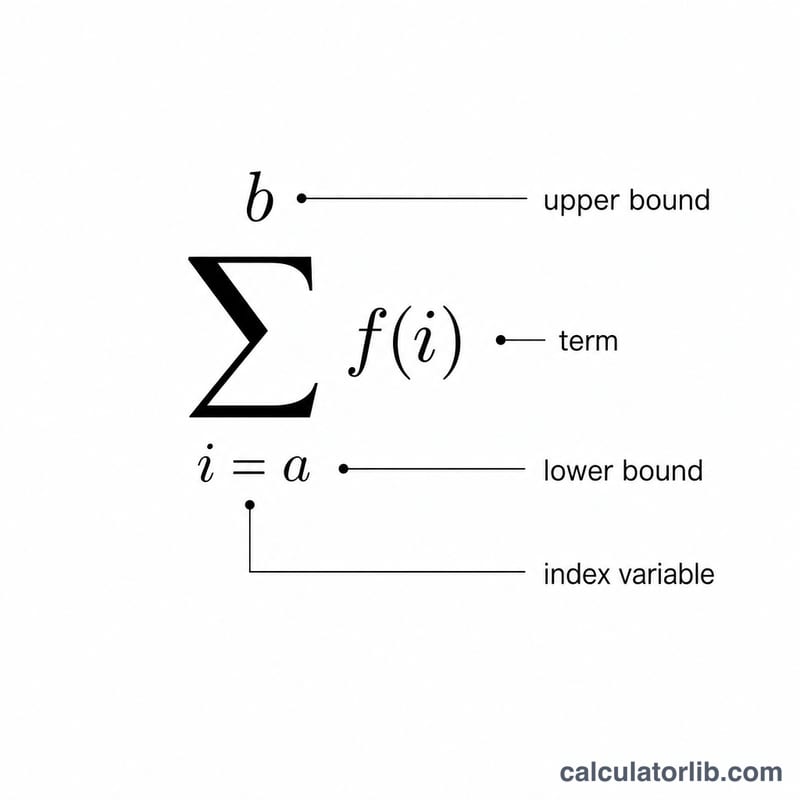
A summation calculator evaluates expressions written in sigma notation, the compact mathematical shorthand for adding a sequence of terms. The notation Σ (the Greek capital letter sigma) tells you to add up the value of a function \(f(i)\) for every integer \(i\) starting at a lower limit a and ending at an upper limit b, inclusive. This tool handles several of the most common functions: \(f(i) = i\), \(i^{2}\), \(i^{3}\), \(1/i\) (the harmonic series), and a constant 1.
How to Use It
Pick the function \(f(i)\) you want to sum, then enter the lower limit (a) and upper limit (b). The calculator loops from \(i = a\) to \(i = b\), evaluates \(f(i)\) at each step, and adds the results together. It also reports how many terms were added so you can sanity-check the range.
The Formula Explained
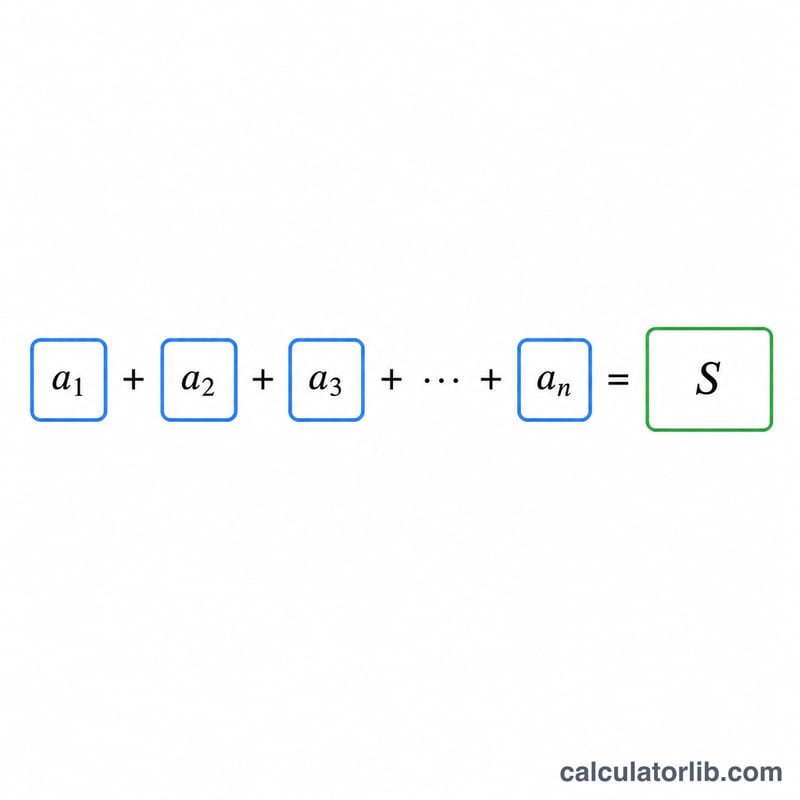
Sigma notation expands like this: $$\sum_{i=a}^{b} f(i) = f(a) + f(a+1) + \ldots + f(b).$$ For example, \(\sum_{i=1}^{4} i\) means \(1 + 2 + 3 + 4\). Many sums have neat closed forms — the sum of the first \(n\) positive integers is \(\frac{n(n+1)}{2}\), and the sum of squares is \(\frac{n(n+1)(2n+1)}{6}\) — but this calculator works for any integer range, including negative starting values.
Worked Example
Suppose you want \(\sum_{i=1}^{5} i^{2}\). Evaluate each term: $$1^{2} + 2^{2} + 3^{2} + 4^{2} + 5^{2} = 1 + 4 + 9 + 16 + 25 = 55.$$ The closed form confirms it: $$\frac{5 \cdot 6 \cdot 11}{6} = \frac{330}{6} = 55.$$ There are 5 terms in the sum.
FAQ
What does i mean in sigma notation? It is the index of summation — a counter that increases by 1 from the lower limit to the upper limit.
Can the lower limit be larger than the upper limit? Conventionally an empty sum (when \(a > b\)) equals 0, which is what this calculator returns.
Does it include both endpoints? Yes. Sigma notation is inclusive of both a and b, so \(\sum_{i=2}^{4}\) sums \(i = 2, 3\) and \(4\).