
What is the Summation Notation Evaluator?
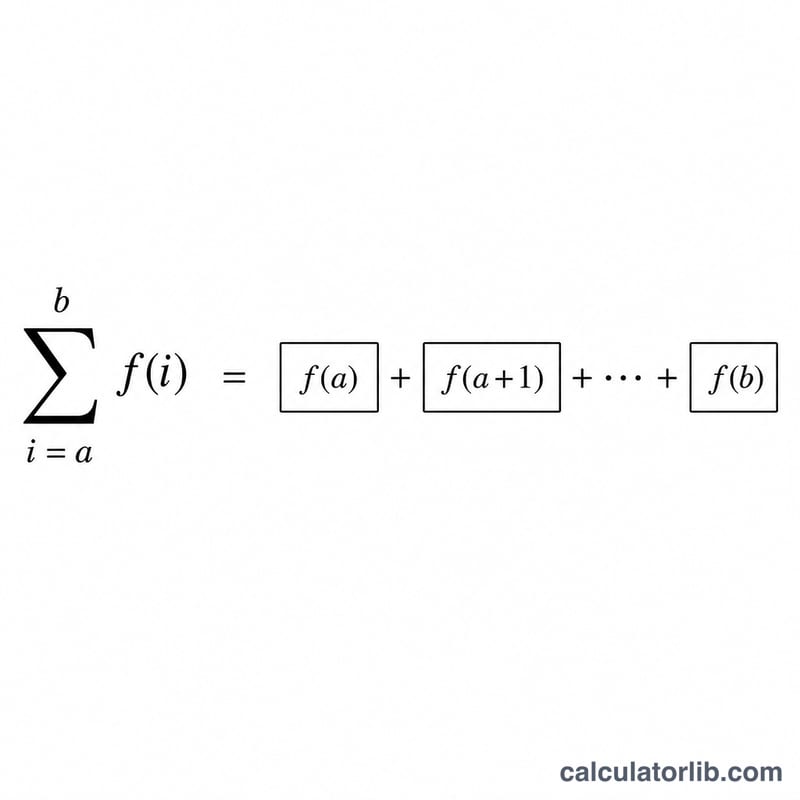
Sigma notation (Σ) is a compact way to write the sum of many terms. The expression \(\sum_{i=a}^{b} f(i)\) means: substitute each integer i from the lower limit a up to the upper limit b into the function f(i), then add all the results together. This calculator evaluates that sum termwise so you can check homework, verify closed-form identities, or quickly total any indexed series.
How to use it
Type the function of the index i in the function box — for example i^2, 2*i+1, or 1/i. Set the lower limit a and the upper limit b (both whole numbers). The calculator loops over every integer from a to b, evaluates f(i), and reports the total sum, the number of terms, and the first and last terms. Supported operators are + - * / and ^ (power), plus functions sqrt, sin, cos, tan, log, ln, abs, exp and the constants pi and e.
The formula explained
The capital Greek letter sigma stands for "sum". Below it sits the index variable and its starting value (i = a); above it sits the ending value (b). Everything to the right is the rule applied to each index. So \(\sum_{i=1}^{4} i^2\) expands to \(1^2 + 2^2 + 3^2 + 4^2\).
Worked example
Evaluate \(\sum_{i=1}^{5} i^2\). Plug in each index: $$1^2 + 2^2 + 3^2 + 4^2 + 5^2 = 1 + 4 + 9 + 16 + 25 = 55$$ The closed-form check is \(\frac{n(n+1)(2n+1)}{6} = \frac{5\cdot 6\cdot 11}{6} = 55\), which matches.

FAQ
What variable should I use? Always use the letter i for the index — it is the only variable the parser substitutes.
Can the lower limit be larger than the upper limit? If a is greater than b there are no terms, so the sum is defined as 0 (an empty sum).
Does it handle decimals and negative results? Yes. Terms can be negative or fractional (for example 1/i), and the final sum is shown with full precision.