
What this calculator does
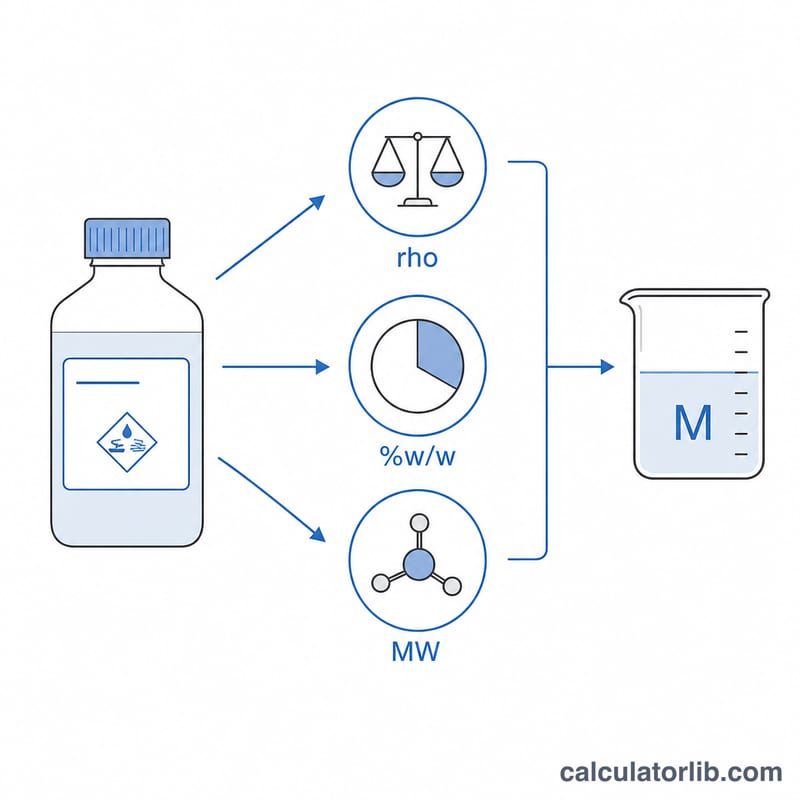
This tool converts a stock reagent specification into a usable molar concentration. Concentrated acids and bases on the shelf are usually labeled with two numbers: a density (specific gravity, in g/mL) and a percent purity by weight (% w/w). Combined with the substance molar mass (MW), these tell you exactly how many moles of solute sit in one liter, which is the molarity you need for dilution and stoichiometry calculations.
How to use it
Enter the density printed on the bottle (for example 1.18 g/mL for concentrated HCl), the % w/w concentration (37% for that HCl), and the molar mass of the compound (36.46 g/mol for HCl). The calculator returns the molarity in mol/L plus the grams of pure solute per liter.
The formula explained
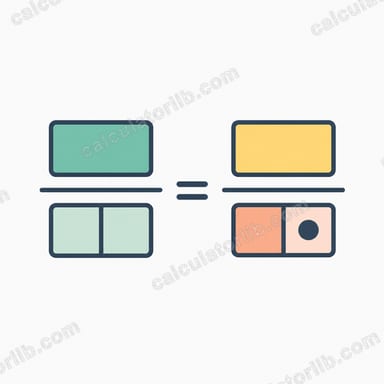
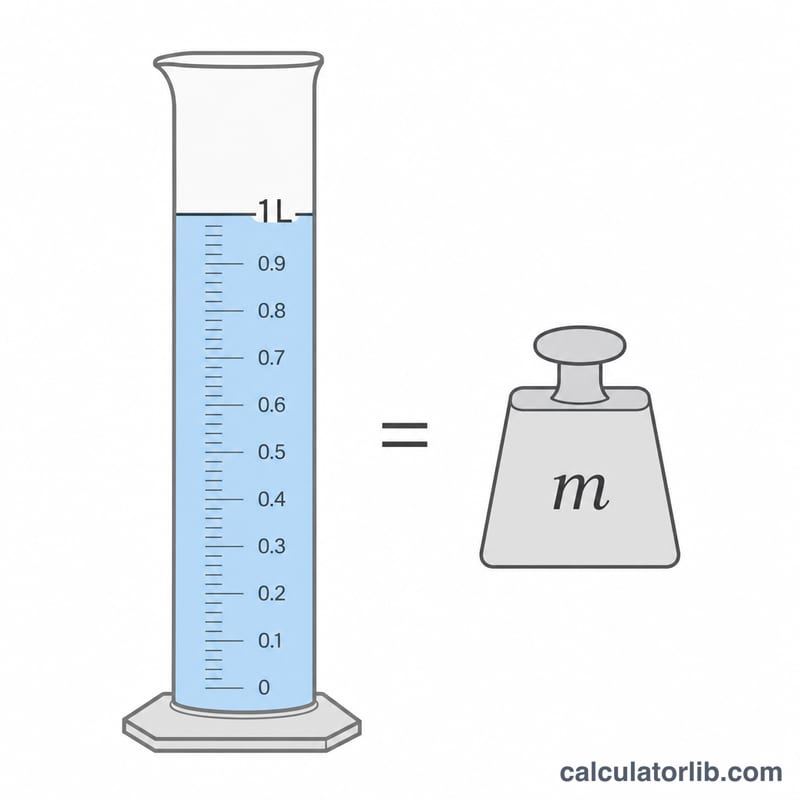
The mass of one liter of solution is 1000 mL × density (g/mL). Multiplying by the mass fraction (%w/w ÷ 100) gives the grams of pure solute in that liter. Dividing by the molar mass converts grams to moles, yielding mol/L:
$$M = \frac{1000 \times \text{Density (g/mL)} \times \frac{\text{Purity (\% w/w)}}{100}}{\text{MW (g/mol)}}$$
Worked example
For concentrated hydrochloric acid: \(\rho = 1.18\) g/mL, %w/w = 37, MW = 36.46 g/mol.
$$\text{g/L} = 1000 \times 1.18 \times 0.37 = 436.6 \text{ g/L}$$ $$M = \frac{436.6}{36.46} \approx 11.97 \text{ mol/L}$$ the familiar ~12 M figure for stock HCl.
FAQ
Is % w/w the same as % v/v? No. This calculator uses weight percent (mass of solute per mass of solution). Volume percent requires a different conversion.
Where do I get the density and purity? They are printed on the reagent bottle label or the Certificate of Analysis (CoA).
Can I use this for bases or salts in solution? Yes, any solution specified by density and % w/w works, as long as you supply the correct molar mass.