
What this calculator does
This tool multiplies or divides two fractions written as a/b and c/d, then reduces the answer to lowest terms. While it works on numeric coefficients, the same rules govern rational expressions with variables: the coefficients combine by these formulas while like variable factors cancel, so the numeric engine here shows exactly how the constant part of your answer simplifies.
How to use it
Pick Multiply or Divide, then type the four numbers: the numerator and denominator of the first fraction (a and b) and of the second fraction (c and d). The calculator returns the unreduced product, the greatest common divisor it cancels, the fully simplified fraction, and a decimal approximation.
The formula explained
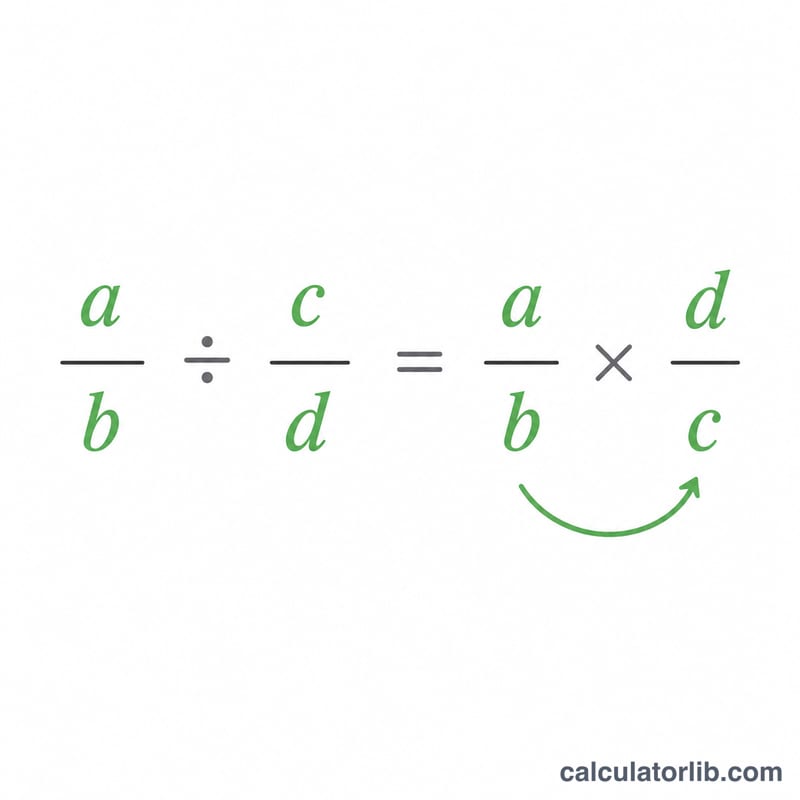
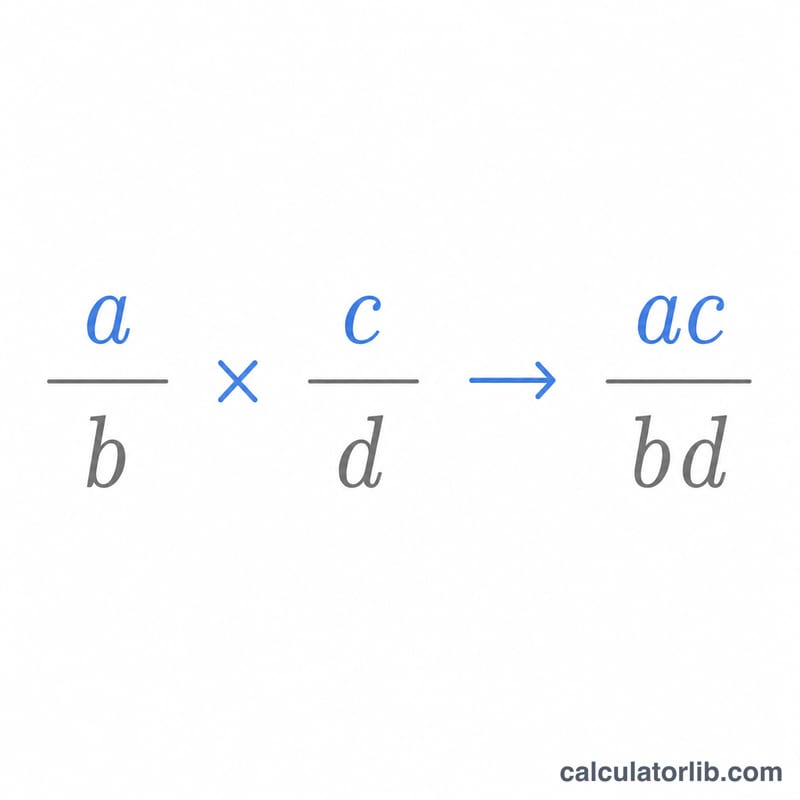
To multiply, go straight across: $$\frac{a}{b} \cdot \frac{c}{d} = \frac{ac}{bd}$$ To divide, flip the second fraction and multiply: $$\frac{a}{b} \div \frac{c}{d} = \frac{ad}{bc}$$ After combining, divide both numerator and denominator by their greatest common divisor (GCD) to reduce. When variables are present you also cancel any common variable factors, e.g. \(\frac{2x}{3} \cdot \frac{9}{4x} = \frac{18x}{12x} = \frac{3}{2}\).
Worked example
Divide 2/3 by 4/5. Using the reciprocal rule: $$\frac{2}{3} \div \frac{4}{5} = \frac{2\cdot 5}{3\cdot 4} = \frac{10}{12}$$ The GCD of 10 and 12 is 2, so the reduced answer is \(\frac{5}{6} \approx 0.8333\).
FAQ
Do I need a common denominator? No. Common denominators are only needed for addition and subtraction, not for multiplying or dividing.
What happens with variables? Numeric coefficients follow the formulas above; identical variable factors (like x or x+1) in a numerator and denominator cancel to 1.
Can I get a negative answer? Yes. The calculator keeps the denominator positive and moves any sign to the numerator.