
What Is an Even or Odd Function?
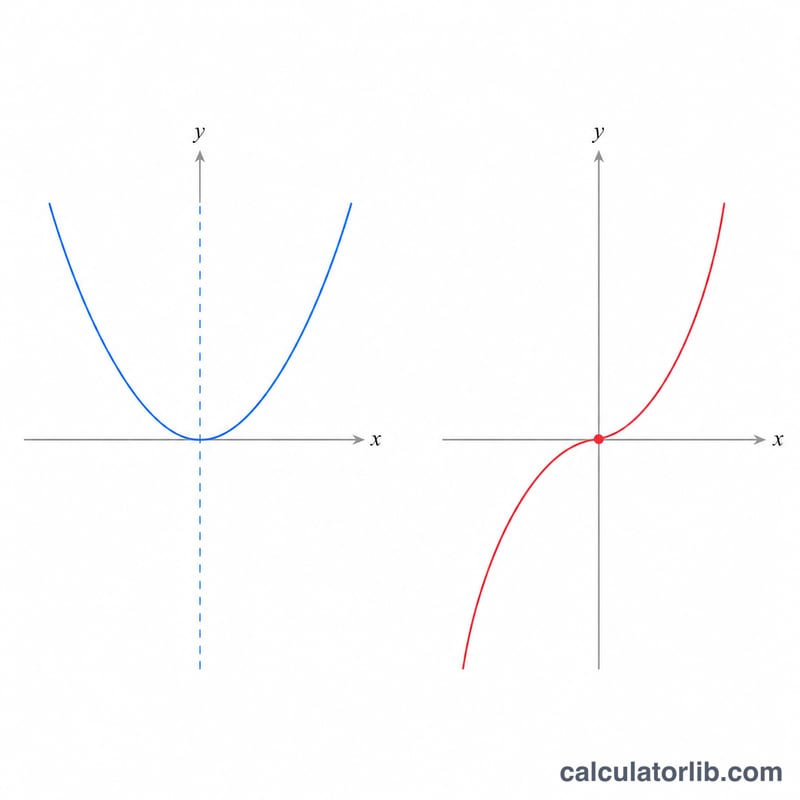
A function describes a relationship between an input x and an output f(x). One of its most useful structural properties is symmetry. A function is even if its graph is mirror-symmetric about the y-axis, meaning \(f(-x) = f(x)\) for every x. A function is odd if its graph has rotational symmetry about the origin, meaning \(f(-x) = -f(x)\). Many functions are neither.
How to Use This Calculator
This tool tests a single power term of the form \(f(x) = a \cdot x^{p}\). Enter the coefficient a, the integer exponent p, and a non-zero test value x. The calculator evaluates \(f(x)\) and \(f(-x)\), then compares them: if \(f(-x)\) equals \(f(x)\) the term is even, if \(f(-x)\) equals \(-f(x)\) it is odd, otherwise it is neither.
The Formula Explained
For a pure power term, the exponent decides the symmetry. When p is even, \((-x)^{p} = x^{p}\), so \(f(-x) = f(x)\) and the function is even. When p is odd, \((-x)^{p} = -x^{p}\), so \(f(-x) = -f(x)\) and the function is odd. The constant a does not change the classification (except \(a = 0\), which gives the zero function, considered even).
$$f(x) = a \cdot x^{p} \;\Rightarrow\; \begin{cases} \text{Even} & \text{if } f(-x) = f(x) \\[4pt] \text{Odd} & \text{if } f(-x) = -f(x) \\[4pt] \text{Neither} & \text{otherwise} \end{cases}$$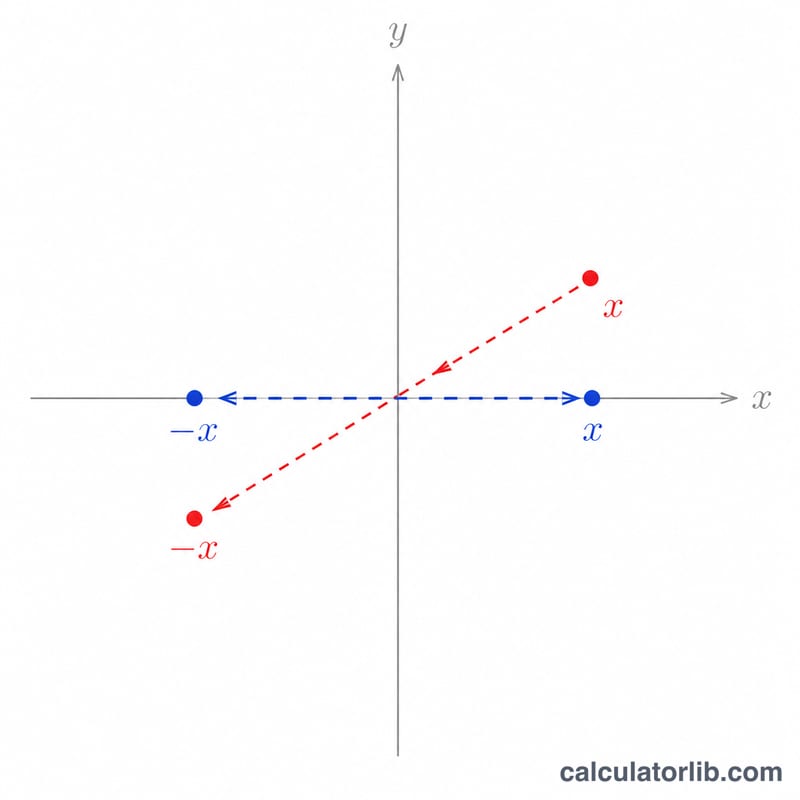
Worked Example
Take \(f(x) = 2x^{3}\) with \(x = 3\). Then
$$f(3) = 2 \cdot 27 = 54 \quad\text{and}\quad f(-3) = 2 \cdot (-27) = -54.$$Since \(f(-3) = -f(3)\), the function is odd.
FAQ
Can a function be both even and odd? Only the zero function \(f(x) = 0\) is both, because \(0 = 0 = -0\).
What does even or odd tell me? It reveals graph symmetry and can simplify integrals: odd functions integrate to zero over symmetric intervals.
Does this handle full polynomials? This version checks one power term. A sum of terms is even only if every term is even, and odd only if every term is odd.