
What Is a Slant (Oblique) Asymptote?
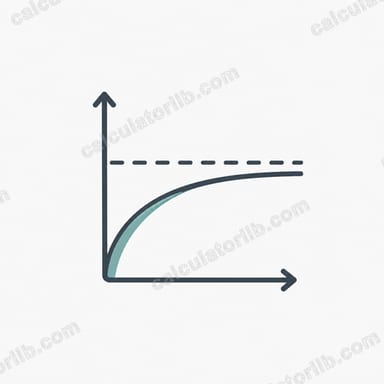
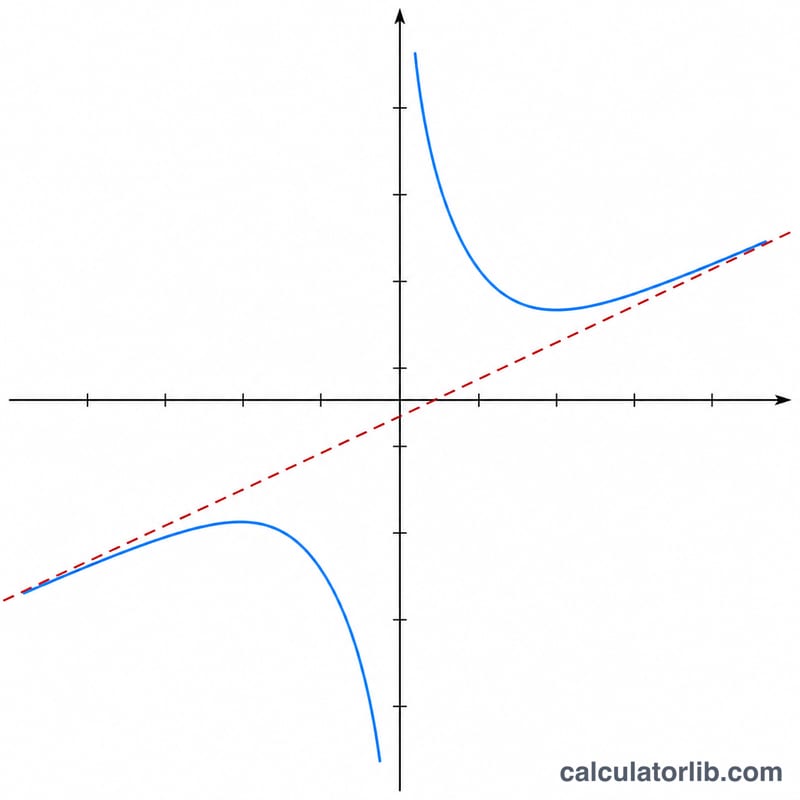
A slant or oblique asymptote is a straight, non-horizontal line that a rational function approaches as x heads toward positive or negative infinity. It occurs only when the degree of the numerator is exactly one greater than the degree of the denominator. This calculator handles the common case of a quadratic numerator divided by a linear denominator: \( f(x) = \dfrac{a_2 x^2 + a_1 x + a_0}{b_1 x + b_0} \).
How to Use It
Enter the three numerator coefficients (a2, a1, a0) and the two denominator coefficients (b1, b0). The tool performs polynomial long division and returns the equation of the slant asymptote in the form \( y = mx + c \), along with the individual slope and intercept values. The remainder term shrinks to zero as x grows, so only the quotient defines the line.
The Formula Explained
Dividing \( a_2 x^2 + a_1 x + a_0 \) by \( b_1 x + b_0 \) gives a quotient \( mx + c \) plus a remainder over the denominator. Matching leading terms, the slope is \( m = \dfrac{a_2}{b_1} \). Substituting back, the intercept is \( c = \dfrac{a_1 - m \cdot b_0}{b_1} \). The slant asymptote is therefore
$$ y = mx + c \quad\text{where}\quad \left\{ \begin{aligned} m &= \dfrac{a_2}{b_1} \\ c &= \dfrac{a_1 - m\cdot b_0}{b_1} \end{aligned} \right. $$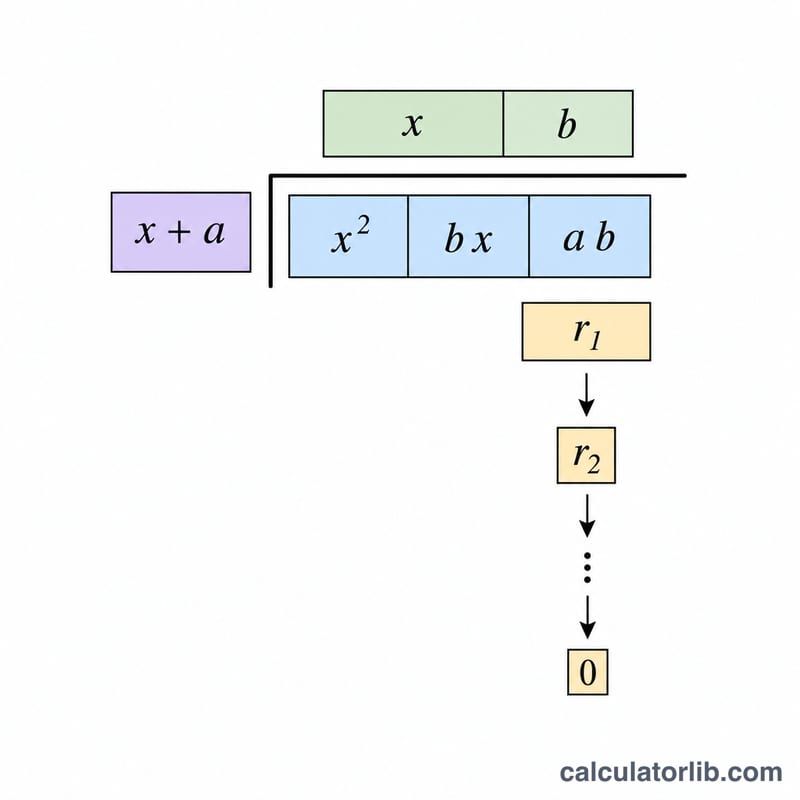
Worked Example
Take \( f(x) = \dfrac{x^2 + 3x + 2}{x - 1} \), so \( a_2 = 1 \), \( a_1 = 3 \), \( a_0 = 2 \), \( b_1 = 1 \), \( b_0 = -1 \). The slope $$ m = \frac{1}{1} = 1. $$ The intercept $$ c = \frac{3 - 1\cdot(-1)}{1} = 4. $$ The slant asymptote is \( y = x + 4 \). (Indeed, long division gives \( x + 4 \) with remainder 6.)
FAQ
When does a slant asymptote exist? Only when the numerator degree is exactly one more than the denominator degree. If they are equal you get a horizontal asymptote instead.
What if b1 is zero? Then the denominator is not linear and no oblique asymptote of this form exists; the calculator requires a non-zero \( b_1 \).
Does the remainder matter? No — the remainder term vanishes as x approaches infinity, so it does not affect the asymptote line, only the curve near finite x.