
What Is the Oblique Triangle Area Calculator?
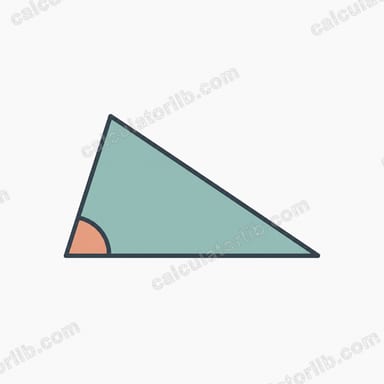
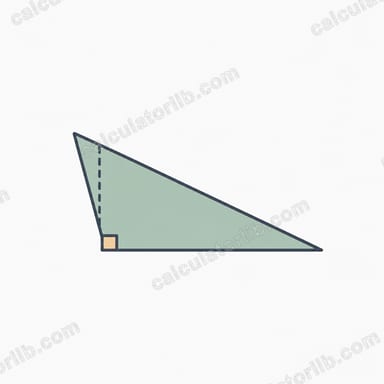
An oblique triangle is any triangle that does not contain a right angle. When you know two side lengths and the angle between them (the "included" angle), you can find the area without first computing the height. This calculator uses the side-angle-side (SAS) formula, one of the most reliable ways to find a triangle's area in trigonometry.
How to Use It
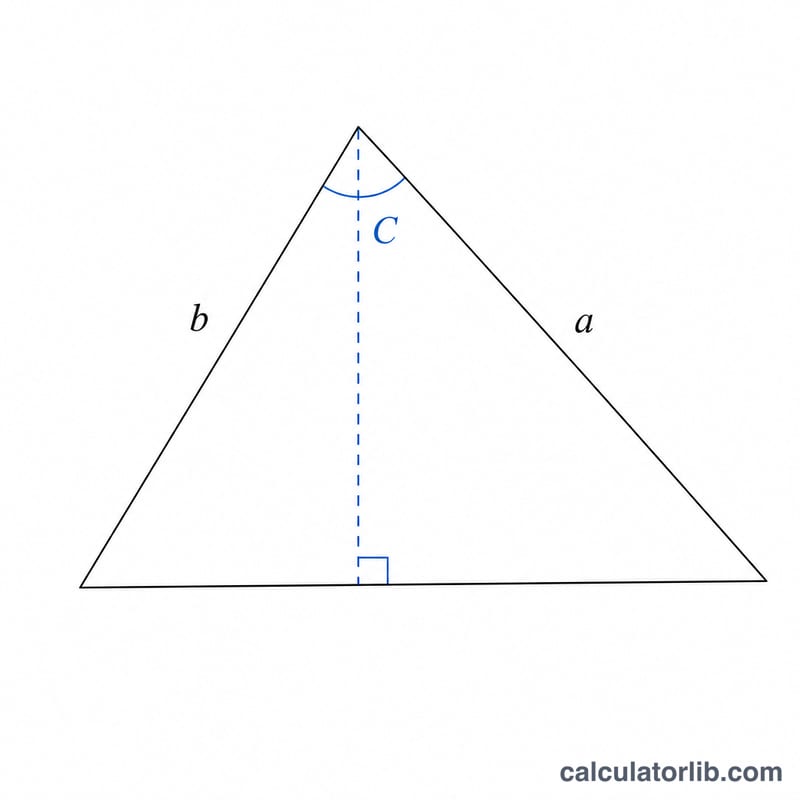
Enter the two known sides, labelled a and b, in any consistent unit (cm, m, inches, etc.). Then enter the included angle C in degrees — this is the angle formed where sides a and b meet. Press calculate and the tool returns the area in square units, along with the sine of the angle used in the computation.
The Formula Explained
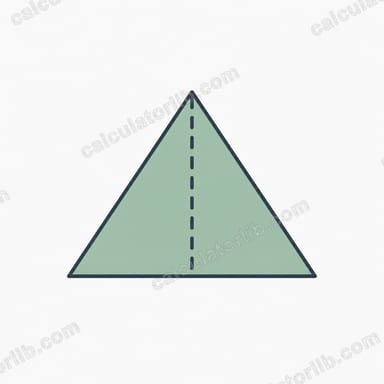
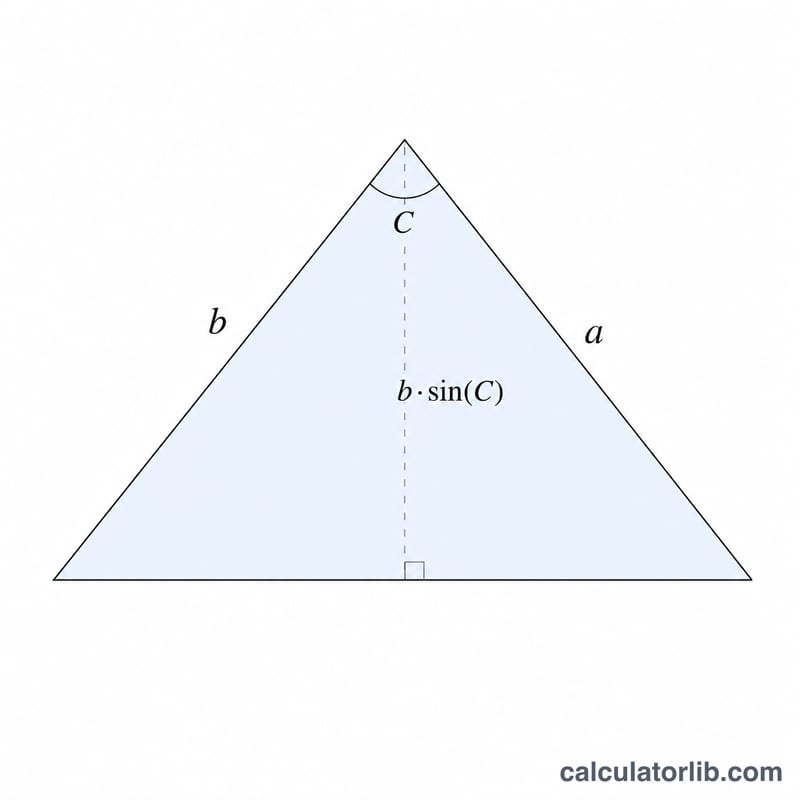
The area equals one-half the product of the two sides times the sine of the included angle: $$\text{Area} = \frac{1}{2} \cdot \text{Side }a \cdot \text{Side }b \cdot \sin\!\left(\text{Angle }C\right)$$ This works because \(b\cdot\sin(C)\) is exactly the perpendicular height of the triangle relative to base \(a\). Multiplying base by height and halving gives the area — the familiar \(\tfrac{1}{2}\cdot\text{base}\cdot\text{height}\) rule disguised in trigonometric form. The angle is converted from degrees to radians internally before applying the sine.
Worked Example
Suppose \(a = 8\), \(b = 11\), and \(C = 37°\). Then \(\sin(37°) \approx 0.601815\). The area is $$\frac{1}{2} \cdot 8 \cdot 11 \cdot 0.601815 = 44 \cdot 0.601815 \approx 26.48 \text{ square units}$$
FAQ
Does the angle have to be between the two sides? Yes. The formula only works when \(C\) is the included angle between sides \(a\) and \(b\). Using a non-included angle gives a wrong result.
What units does the area use? Square units of whatever length unit you entered for the sides. If sides are in metres, the area is in square metres.
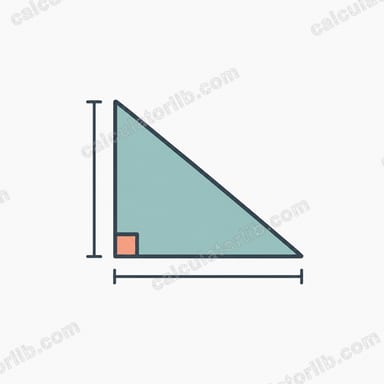
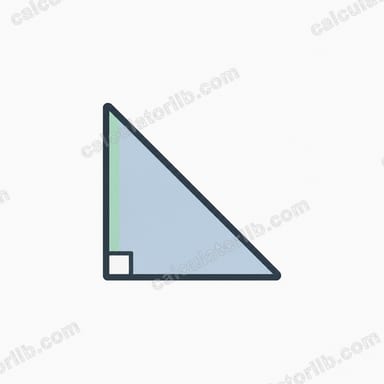
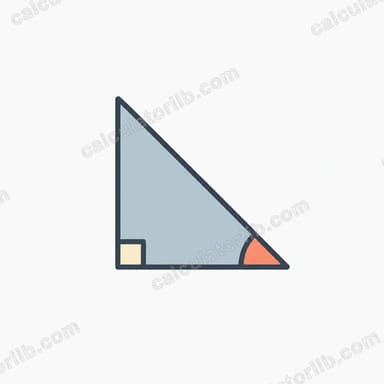
Can C be 90°? Yes — at 90° \(\sin(C) = 1\), and the formula reduces to \(\tfrac{1}{2}\cdot a\cdot b\), the area of a right triangle.