
What Is a Complementary Angle?
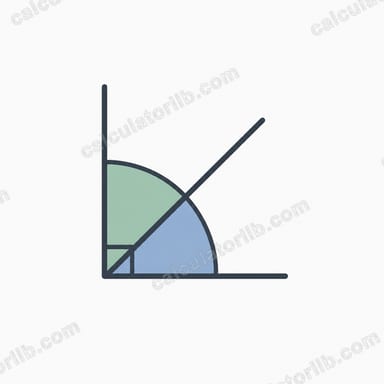
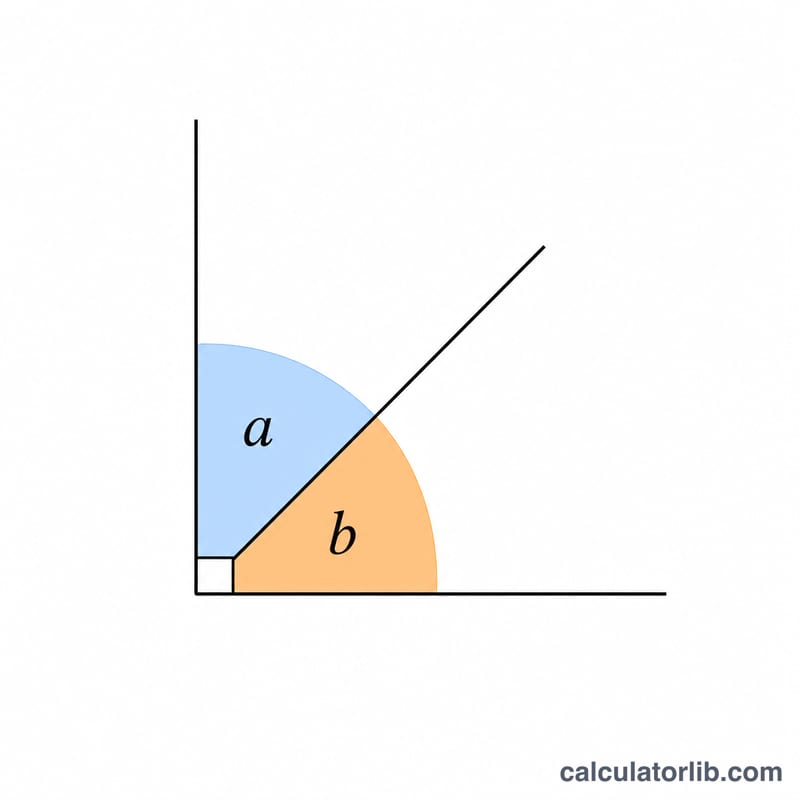
Two angles are complementary when their measures add up to exactly 90°, forming a right angle together. The complement of any angle θ is found by subtracting it from 90°. For example, the complement of 30° is 60°, because 30° + 60° = 90°. This calculator gives you the complement of any angle between 0° and 90° instantly.
How to Use This Calculator
Enter your angle in degrees (any value from 0 to 90) and the calculator returns its complement. The result table also shows the original angle and confirms that the two add up to 90°. This is handy for geometry homework, trigonometry, drafting, and construction where right-angle relationships matter.
The Formula Explained
The relationship is simple linear arithmetic:
$$\text{Complement} = 90^{\circ} - \text{Angle}$$
Because complementary angles must sum to a right angle, the formula is fully reversible: if you know one angle, subtracting it from 90° always gives the other. Note that an angle of 90° has a complement of 0°, and angles greater than 90° have no complement (their complement would be negative).
Worked Example
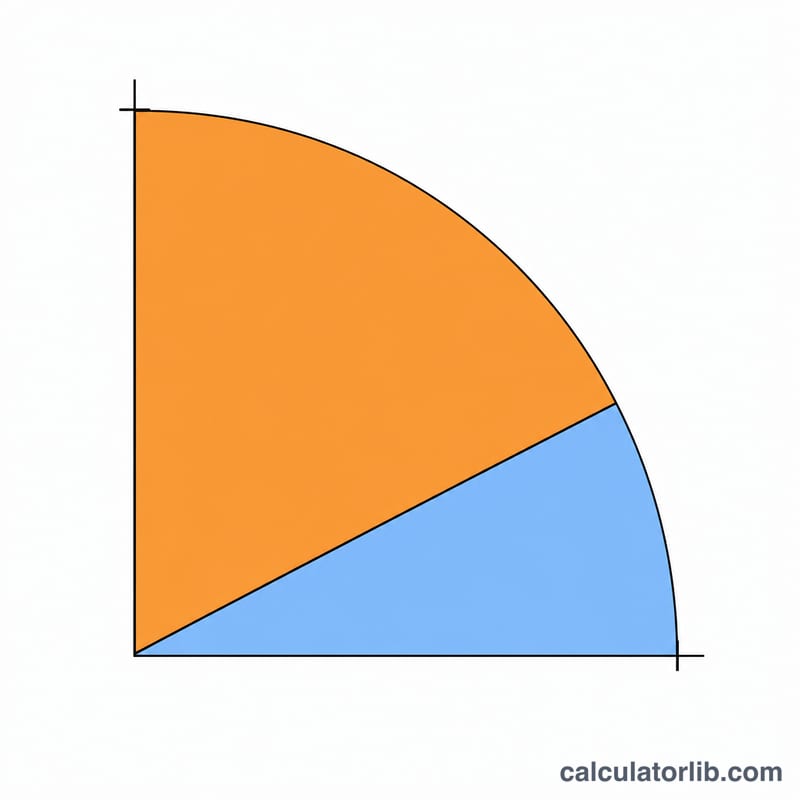
Suppose you have an angle of 25°. Its complement is:
$$\text{complement} = 90^{\circ} - 25^{\circ} = \mathbf{65^{\circ}}$$
Check: \(25^{\circ} + 65^{\circ} = 90^{\circ}\) ✓. The two angles are complementary.
FAQ
What is the difference between complementary and supplementary angles? Complementary angles add to 90°; supplementary angles add to 180°.
Can an angle have a complement greater than 90°? No. Since both angles must be positive and sum to 90°, each complement is between 0° and 90°.
Do complementary angles have to be adjacent? No. They simply need to add up to 90°, whether they sit next to each other or not.