
What this calculator does
This tool returns the sine, cosine and tangent of the five "special" angles you meet most often in trigonometry: 0°, 30°, 45°, 60° and 90°. These angles have clean, exact values such as \(\sin 30° = \frac{1}{2}\) and \(\sin 45° = \frac{\sqrt{2}}{2}\), which is why teachers, students and engineers memorise them. Pick an angle and instantly see its full trig row as a decimal.
How to use it
Choose one of the five special angles from the dropdown and submit. The calculator converts the angle to radians, evaluates sin, cos and tan, and lays them out in a small table. At 90° the cosine is 0, so the tangent is undefined — the tool labels it as such instead of showing a misleading huge number.
The formula explained
Computer trig functions work in radians, so the angle in degrees is first multiplied by \(\frac{\pi}{180}\). Then \(\sin\theta\) and \(\cos\theta\) are evaluated directly, and \(\tan\theta\) is simply \(\sin\theta\) divided by \(\cos\theta\).
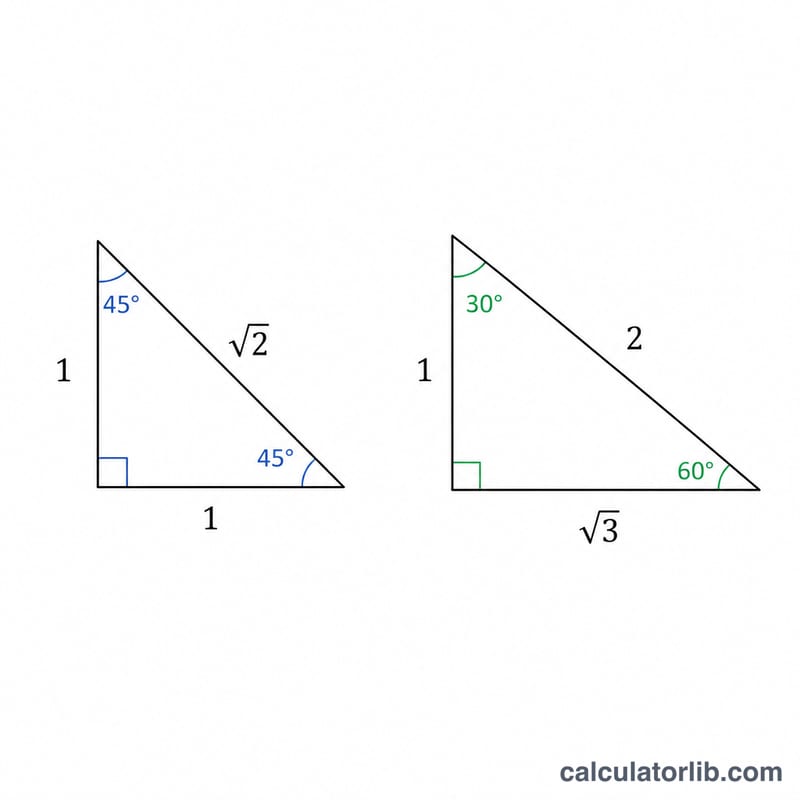
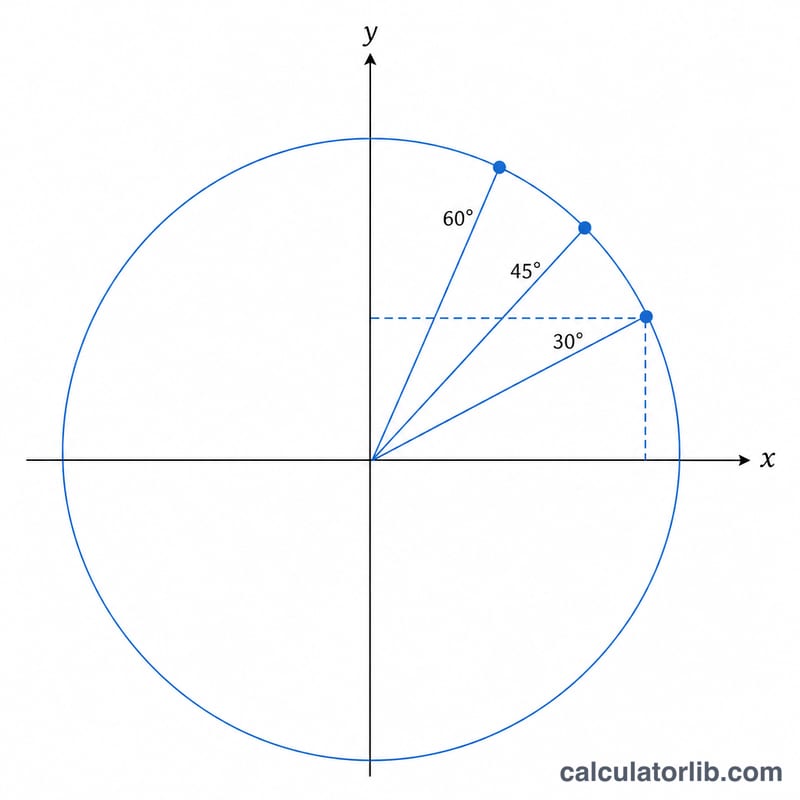
$$\theta = \text{Angle} \times \frac{\pi}{180}$$$$\sin\theta, \quad \cos\theta, \quad \tan\theta = \frac{\sin\theta}{\cos\theta}$$The famous exact forms come from the unit circle and the 30-60-90 and 45-45-90 reference triangles: \(\sin 30° = \frac{1}{2} \approx 0.5\), \(\sin 45° = \frac{\sqrt{2}}{2} \approx 0.7071\), \(\sin 60° = \frac{\sqrt{3}}{2} \approx 0.8660\).
Worked example
For 60°: radians = \(60 \times \frac{\pi}{180} = \frac{\pi}{3} \approx 1.0472\). Then
$$\sin 60° = \frac{\sqrt{3}}{2} \approx 0.866025, \quad \cos 60° = \frac{1}{2} = 0.5$$$$\tan 60° = \frac{0.866025}{0.5} = \sqrt{3} \approx 1.732051$$That matches the standard special-angle table exactly.
FAQ
Why is tan 90° undefined? Because \(\cos 90° = 0\), and division by zero is undefined; the tangent grows without bound as the angle approaches 90°.
Are the decimals exact? Values like 0.5 and 1 are exact; irrational ones such as \(\frac{\sqrt{2}}{2}\) and \(\frac{\sqrt{3}}{2}\) are shown rounded to six decimals.
Can I get other angles? This calculator focuses on the five classic special angles, which are the ones most commonly required from memory.