
What is the projectile range calculator?
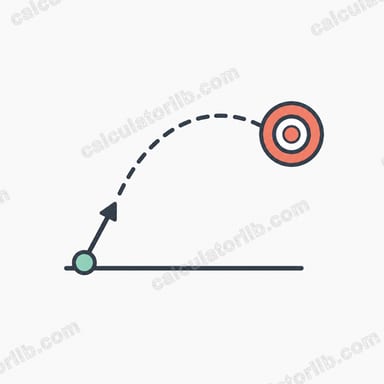
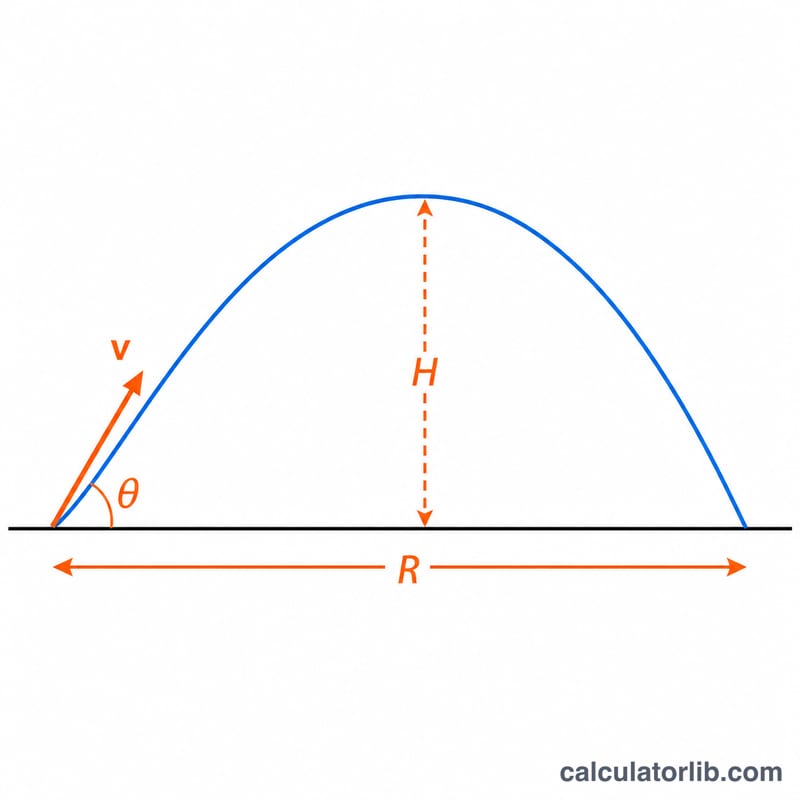
This tool computes the horizontal range of a projectile launched over flat, level ground with no air resistance. Given the initial speed, launch angle, and gravitational acceleration, it returns how far the projectile travels, how high it climbs, and how long it stays in the air. It is a classic physics tool useful for students, engineers, and anyone modeling idealized ballistic motion.
How to use it
Enter the initial velocity in metres per second, the launch angle in degrees (0–90), and the gravitational acceleration (9.81 m/s² on Earth, or change it for the Moon, Mars, etc.). Press calculate to get the range, peak height, and total time of flight.
The formula explained
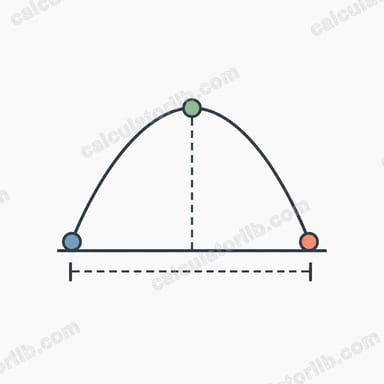
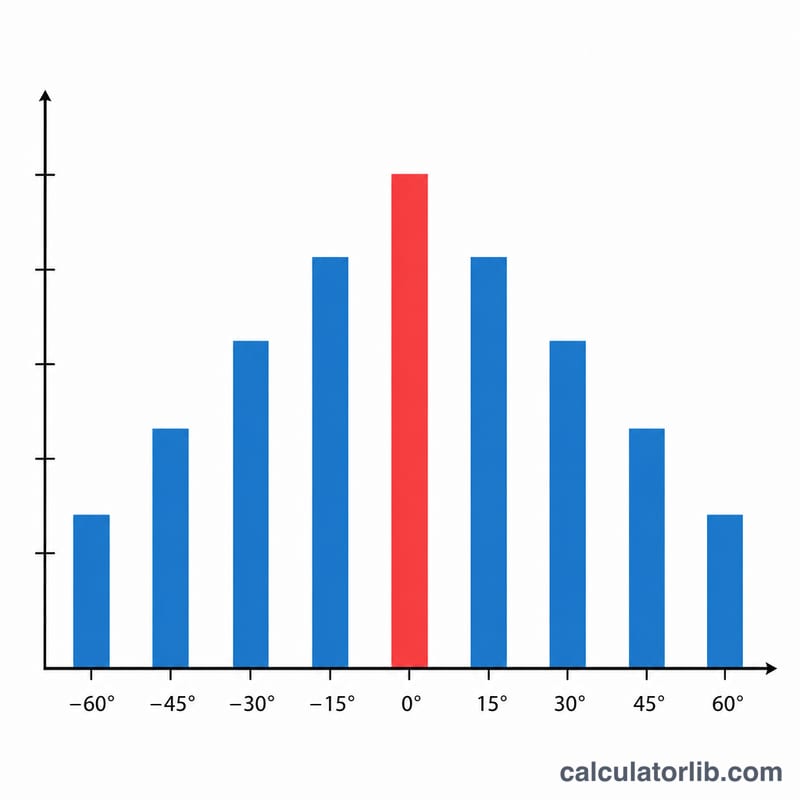
The range equation is $$R = \frac{\text{v}^{2}\,\sin\!\left(2\,\theta\right)}{\text{g}}$$ The factor \(\sin(2\theta)\) reaches its maximum value of 1 at \(\theta = 45\degree\), which is why a 45° launch gives the greatest distance in a vacuum. Maximum height follows from the vertical velocity component: $$H = \frac{\text{v}^{2}\,\sin^{2}\theta}{2\text{g}}$$ and total flight time is $$T = \frac{2\text{v}\,\sin\theta}{\text{g}}$$ All assume the launch and landing heights are equal and air drag is negligible.
Worked example
Launch at \(v = 20\ \text{m/s}\), \(\theta = 45\degree\), \(g = 9.81\ \text{m/s}^2\). Then \(\sin(90\degree) = 1\), so $$R = \frac{20^{2} \times 1}{9.81} = \frac{400}{9.81} \approx 40.77\ \text{m}$$ Max height $$H = \frac{400 \times \sin^{2}(45\degree)}{2 \times 9.81} = \frac{400 \times 0.5}{19.62} \approx 10.19\ \text{m}$$ Flight time $$T = \frac{2 \times 20 \times \sin(45\degree)}{9.81} \approx \frac{28.28}{9.81} \approx 2.883\ \text{s}$$
FAQ
What angle gives the maximum range? On level ground with no air resistance, 45° maximizes range because \(\sin(2\theta)\) peaks there.
Does this account for air resistance? No. This is the idealized vacuum model. Real-world range is shorter due to drag.
Can I use it for other planets? Yes — just change the gravity value (e.g. 1.62 for the Moon, 3.71 for Mars).