
What is the Projectile Motion Calculator?
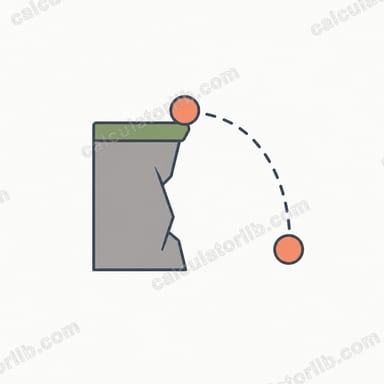
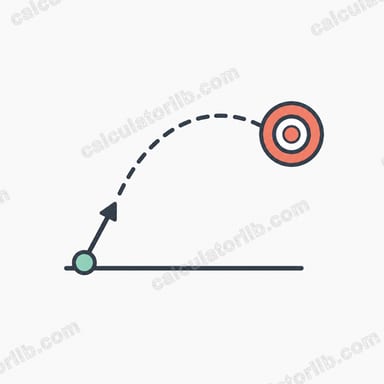
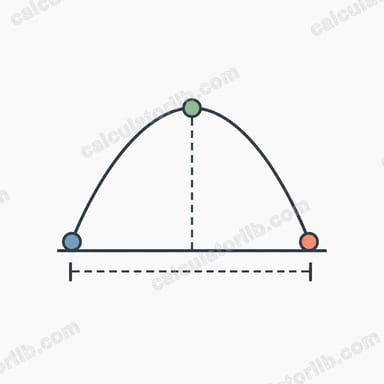
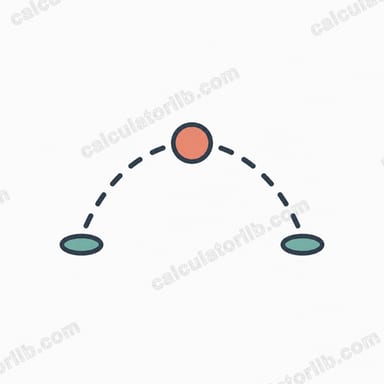
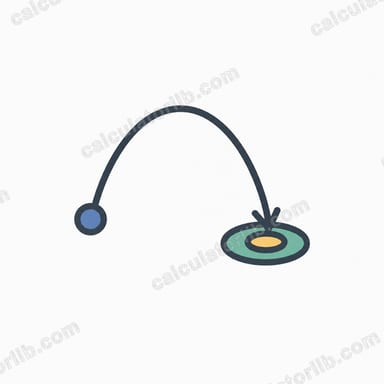
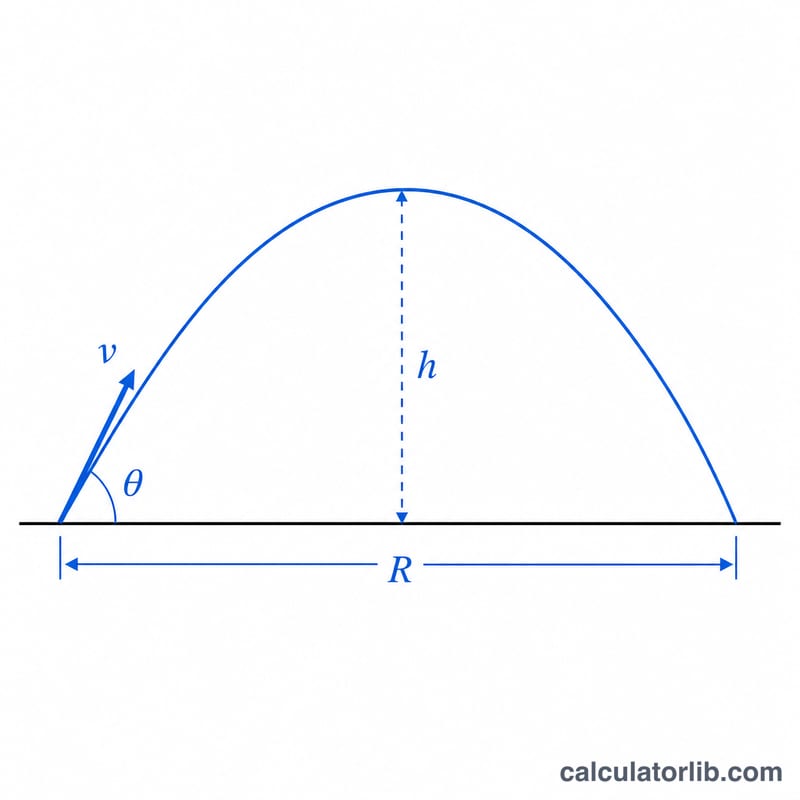
This calculator models the path of an object launched into the air with no air resistance, landing at the same height from which it was launched. Given an initial velocity, a launch angle and the gravitational acceleration, it returns three key quantities: the horizontal range, the maximum height, and the total time of flight.
How to use it
Enter the initial speed in metres per second, the launch angle in degrees (0–90), and the local gravitational acceleration (Earth ≈ 9.81 m/s²). The calculator instantly returns range, peak height and flight time. The maximum range for a given speed occurs at a 45° launch angle.
The formulas explained
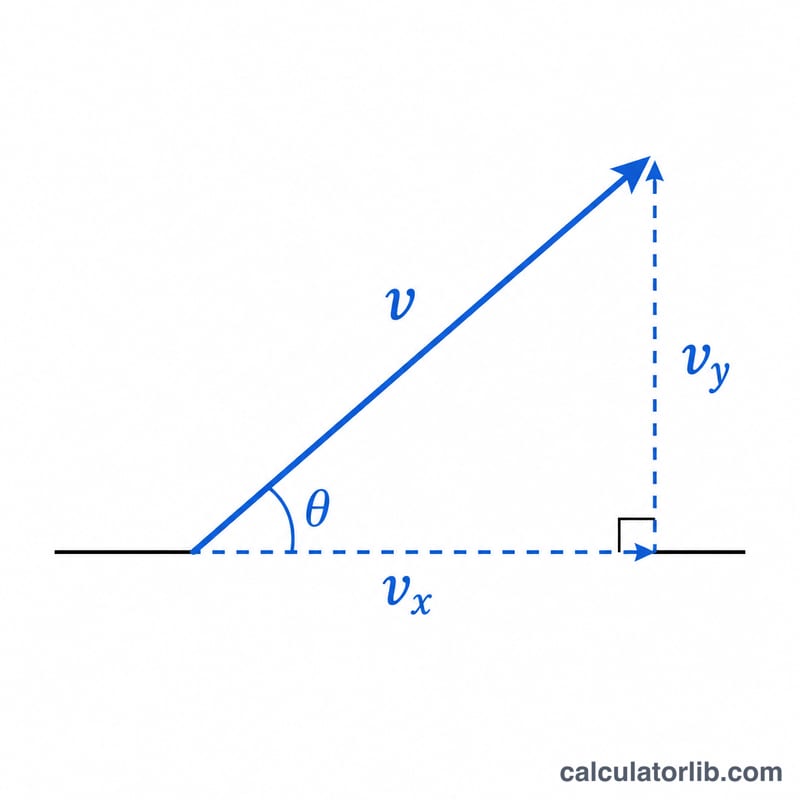
Range is given by $$R = \frac{v^{2}\,\sin\!\left(2\theta\right)}{g}$$ maximum height by $$H = \frac{v^{2}\,\sin^{2}\!\left(\theta\right)}{2g}$$ and time of flight by $$T = \frac{2v\,\sin\!\left(\theta\right)}{g}$$ Here \(v\) is speed, \(\theta\) is the launch angle, and \(g\) is gravity. These come from resolving velocity into horizontal and vertical components and applying constant-acceleration kinematics.
Worked example
Launch a ball at 30 m/s at 30° with \(g = 9.81\) m/s². $$R = \frac{30^{2}\cdot\sin(60°)}{9.81} = \frac{900\cdot 0.866025}{9.81} \approx 79.43\ \text{m}$$ $$H = \frac{900\cdot\sin^{2}(30°)}{2\cdot 9.81} = \frac{900\cdot 0.25}{19.62} \approx 11.47\ \text{m}$$ $$T = \frac{2\cdot 30\cdot\sin(30°)}{9.81} = \frac{30}{9.81} \approx 3.06\ \text{s}$$
FAQ
What angle gives the longest range? On level ground, 45° produces the maximum range for a fixed launch speed.
Does this account for air resistance? No. It assumes ideal projectile motion in a vacuum with constant gravity.
Why are the launch and landing heights assumed equal? These standard formulas apply when the projectile lands at its launch height; different start/end heights require the full quadratic time-of-flight equation.