
What this calculator does
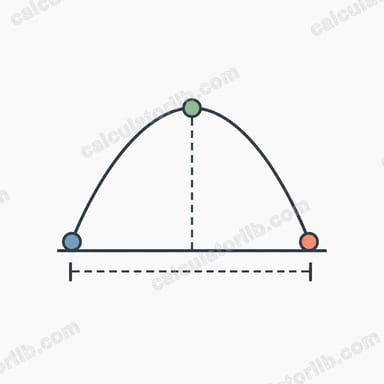
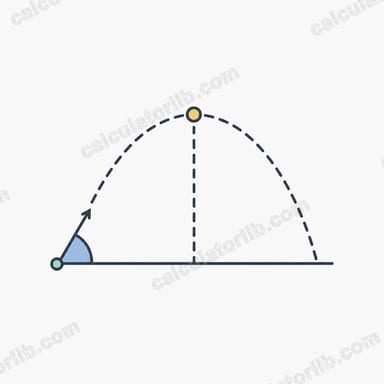
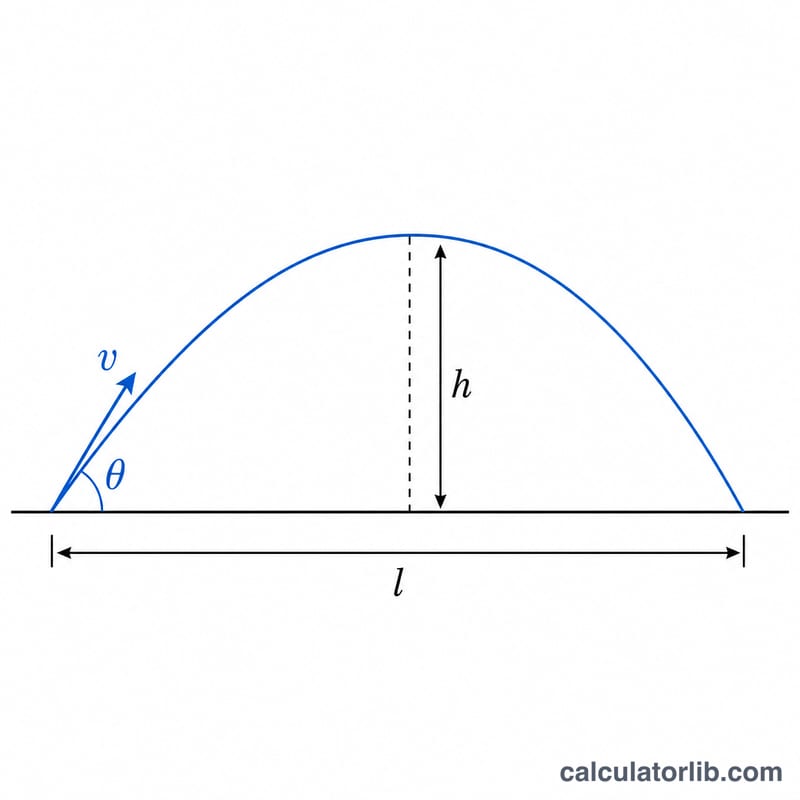
This projectile motion calculator works backwards from a target. Instead of giving you the range from a known speed, it tells you the initial speed you need to hit a desired horizontal range at a given launch angle. It also returns the total time of flight and the peak height of the trajectory. The model assumes no air resistance and that launch and landing happen at the same height (a symmetric parabola).
How to use it
Enter the launch angle in degrees (strictly between 0 and 90), the desired horizontal range in meters, and optionally the gravitational acceleration (default is standard gravity, 9.80665 m/s²). The calculator returns the required initial speed in both m/s and km/h, the time of flight in seconds, and the peak height in meters.
The formulas
From the range relation \(l = v^{2}\cdot\sin(2\theta)/\text{g}\), solving for the initial speed gives:
$$v = \sqrt{\dfrac{\text{g}\cdot l}{\sin(2\theta)}}$$where \(\sin(2\theta) = 2\cdot\sin\theta\cdot\cos\theta\).
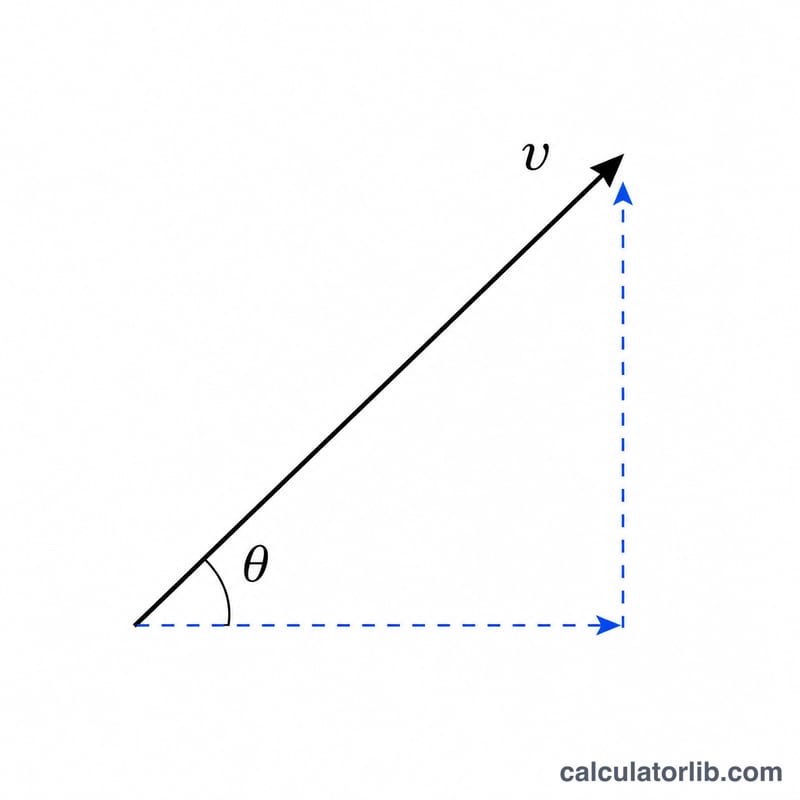
The time of flight is the range divided by the horizontal velocity component: $$t = \dfrac{l}{v\cdot\cos\theta}$$ The peak height, reached at half the flight time, is $$h = \dfrac{\text{g}\,t^{2}}{8}$$
Worked example
For \(\theta = 60°\), \(l = 80\,\text{m}\), \(\text{g} = 9.80665\,\text{m/s}^2\): \(\sin(120°) = 0.866025\), so $$v = \sqrt{9.80665 \times 80 / 0.866025} = 30.0982\,\text{m/s}\ (108.35\,\text{km/h})$$ Time of flight $$t = 80 / (30.0982 \times 0.5) = 5.3159\,\text{s}$$ Peak height $$h = 9.80665 \times 5.3159^{2} / 8 = 34.640\,\text{m}$$
FAQ
Why must the angle be between 0 and 90 degrees? At 0° the projectile never rises, and at 90° it has no horizontal velocity, so both produce a divide-by-zero and no meaningful range.
Does this include air resistance? No. It is the idealized vacuum model with launch and landing at equal height.
Is peak height measured from the ground? It is measured relative to the launch height.