
What is a square prism?
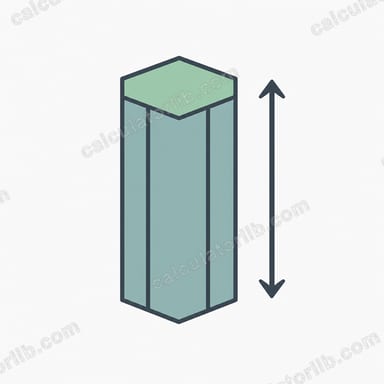
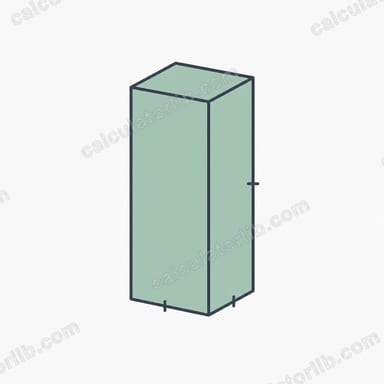
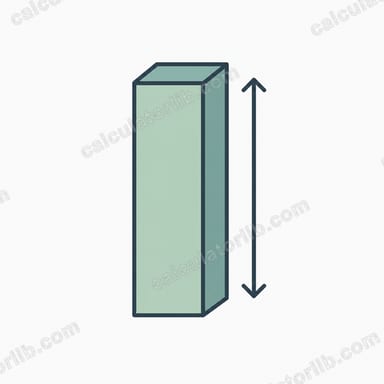
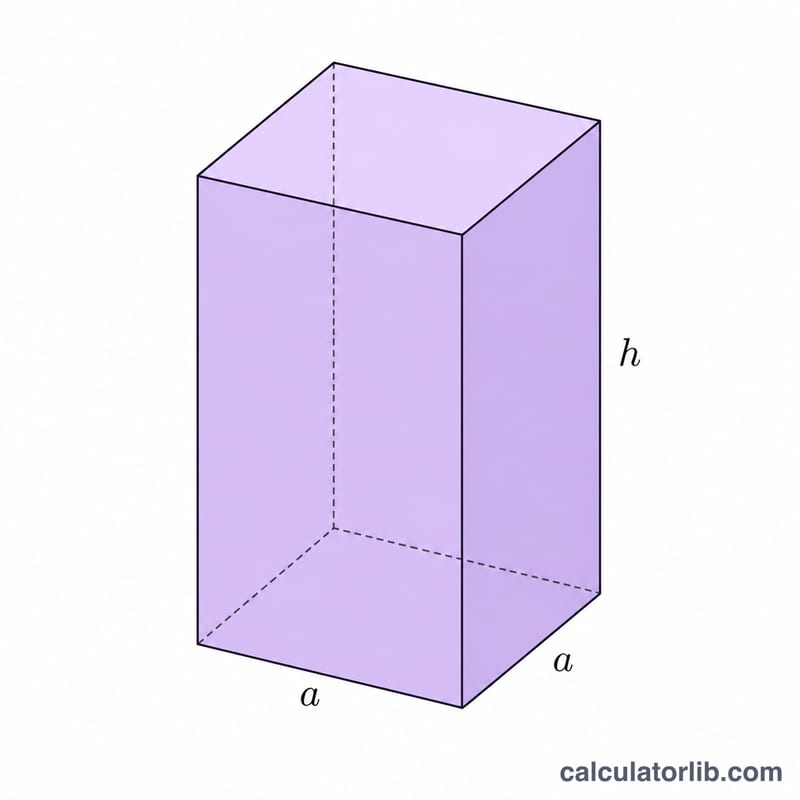
A square prism, also called a square-based prism or square column, is a right prism whose two parallel bases are squares. If each side of the square base has length a and the prism stands a height h tall, it is simply a rectangular box with a square cross-section. This calculator solves for the height h when you already know the prism's volume V and the base edge length a.
How to use it
Enter two values: the Volume V and the Base edge length a. Keep your units consistent — if the edge length is in centimeters, the volume must be in cubic centimeters, and the resulting height will be in centimeters. There are no unit dropdowns, so the numbers are used exactly as entered. Press calculate and the height appears instantly.
The formula explained
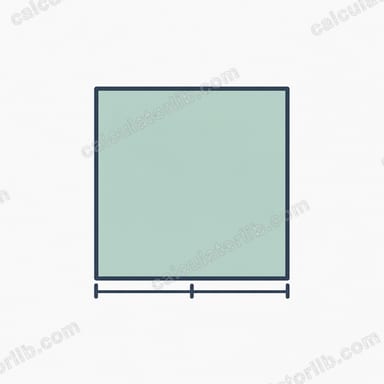
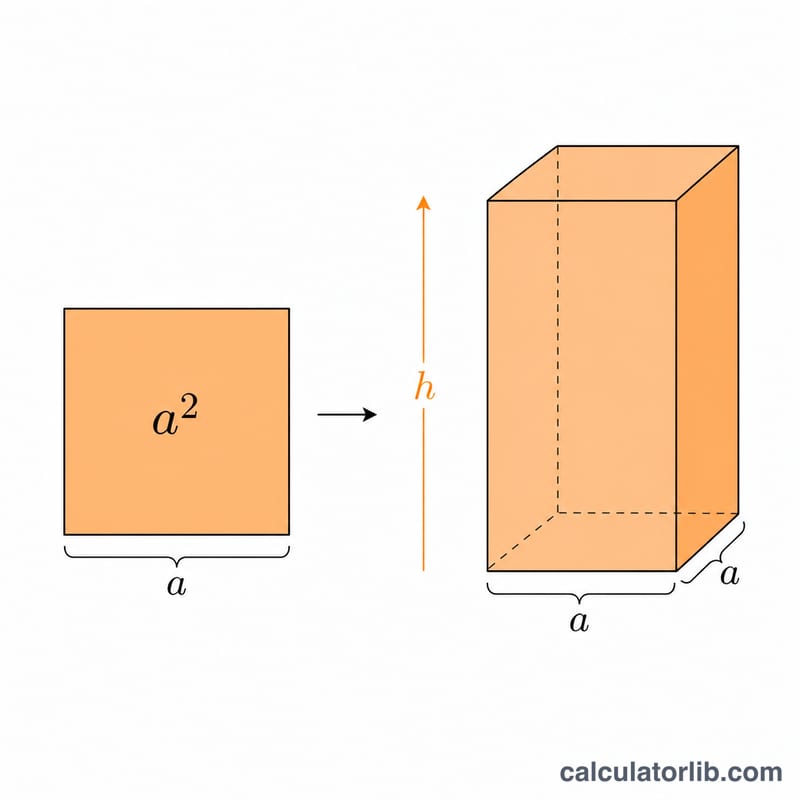
The volume of any prism is the area of its base multiplied by its height. For a square base of side a, the base area is a², giving the volume relation \(V = a^{2} \cdot h\). Rearranging to isolate the height yields $$h = \frac{V}{a^{2}}$$ The base edge a must be positive, because a length cannot be zero or negative; if a = 0 the base area is zero and the division is undefined.
Worked example
Suppose a square prism has a volume of 50 cm³ and a base edge of 5 cm. The base area is \(5^{2} = 25\) cm². Dividing gives $$h = \frac{50}{25} = 2 \text{ cm}$$ As a second check, with \(V = 2\) and \(a = 1\), the height is \(\frac{2}{1^{2}} = 2\).
FAQ
What units does the height come out in? The same linear unit as the base edge length a. Volume must be in that unit cubed for the result to be correct.
Why does a = 0 give an error? A zero base edge means zero base area, so \(V / a^{2}\) divides by zero and has no defined value. A real prism must have a positive base.
Can the volume be zero? Yes — a volume of 0 simply yields a height of 0. Negative volumes are rejected because they are non-physical.