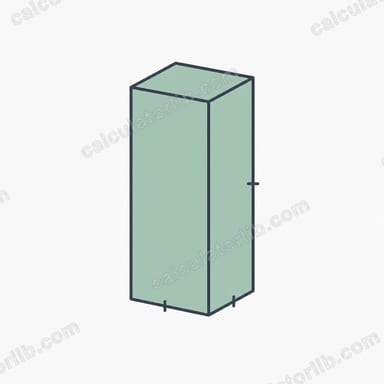

What is a square prism?
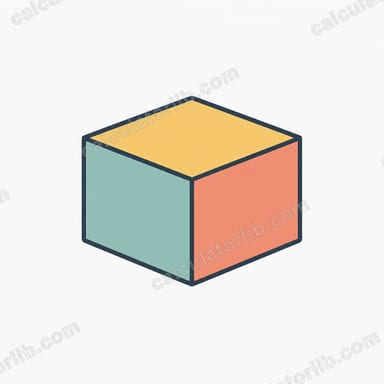
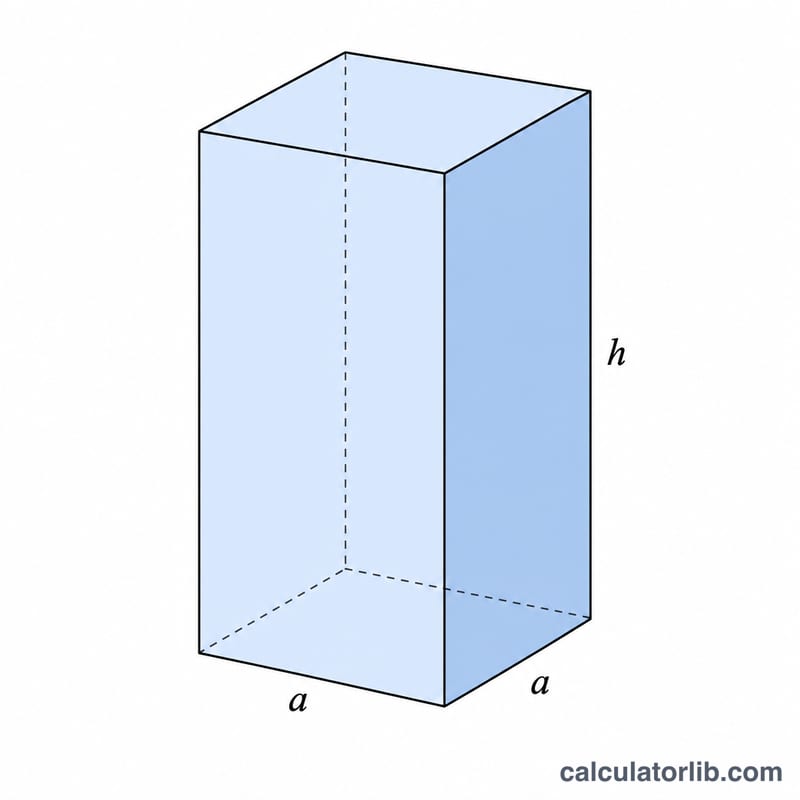
A right square prism (also called a square box or a "Yakkakuchu" type cuboid in Japanese geometry, romanized) is a three-dimensional solid with two parallel square faces joined by four equal rectangular sides. It is a special case of a rectangular cuboid where the two base dimensions are equal: the base is a square of side a, and the prism rises to a height h. This calculator computes both the volume V and the total surface area S from those two numbers.
How to use it
Enter the square base edge length a and the height h. Use any consistent length unit for both values — the tool does no unit conversion. The volume is returned in that unit cubed and the surface area in that unit squared. Both inputs must be positive numbers.
The formulas explained
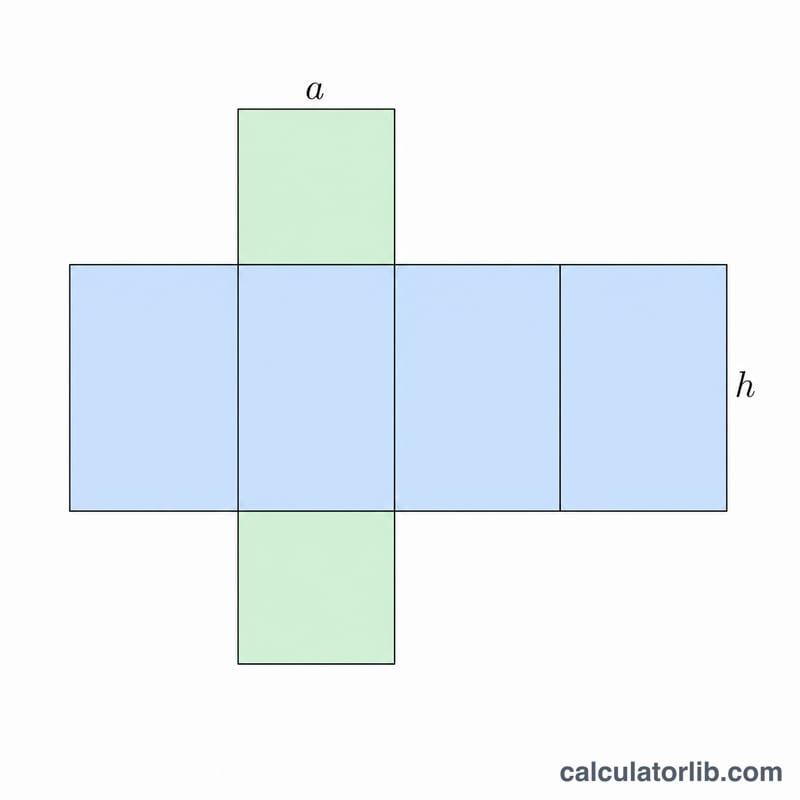
The volume is simply the base area times the height: since the base is a square of side a, its area is \(a^{2}\), so \(V = a^{2} \cdot h\). For the surface area, the two square caps contribute \(2 \cdot a^{2}\) and the four identical rectangular sides each measure \(a \times h\), contributing \(4 \cdot a \cdot h\). Adding and factoring gives \(S = 2a^{2} + 4ah = 2a(a + 2h)\).
Worked example
For a = 1 and h = 2: $$V = 1^{2} \cdot 2 = 2,$$ and $$S = 2 \cdot 1 \cdot (1 + 2 \cdot 2) = 2 \cdot 5 = 10.$$ For a = 3 and h = 5: $$V = 3^{2} \cdot 5 = 45,$$ and $$S = 2 \cdot 3 \cdot (3 + 10) = 6 \cdot 13 = 78.$$
FAQ
What units does it use? Whatever consistent length unit you supply — volume comes out cubed, surface area squared. There is no unit dropdown.
What if a or h is zero? The solid degenerates and the volume becomes zero; enter positive values for a meaningful prism.
Is this the same as a cube? Only when a = h. A cube is the special square prism whose height equals its base edge.