
What This Calculator Does
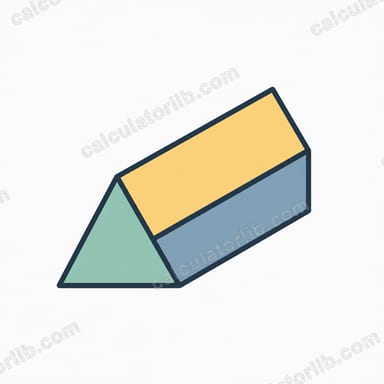
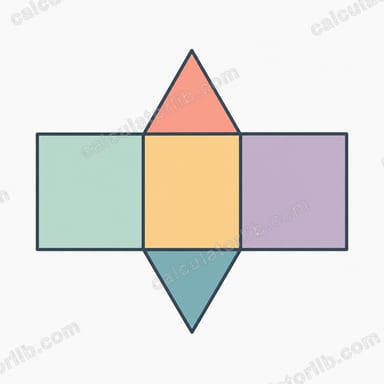
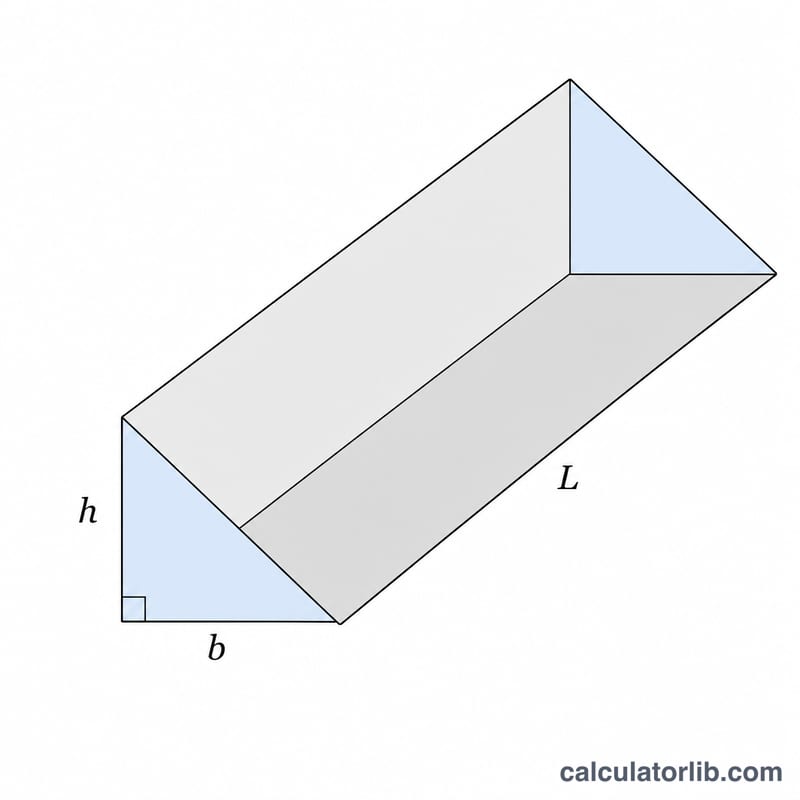
The Triangular Prism Surface Area Calculator finds the total outer surface area of a triangular prism — a 3D shape with two identical triangular ends joined by three rectangular sides. It is built specifically for a right-angled triangular cross-section, where the triangle base and triangle height meet at 90°. You enter three measurements and the tool instantly returns the complete surface area, so you don't have to work out each face by hand.
The Inputs You Provide
- Triangle Base (b): the length of the base of the triangular end face.
- Triangle Height (h): the perpendicular height of that triangle.
- Prism Length (l): how long the prism is — the distance between the two triangular ends.
Use the same unit for all three (cm, m, inches). The result will be in those units squared.
The Formula Explained
The calculator uses:
A = 2(½bh) + (b + h + √(b² + h²)) × l
This is two parts added together:
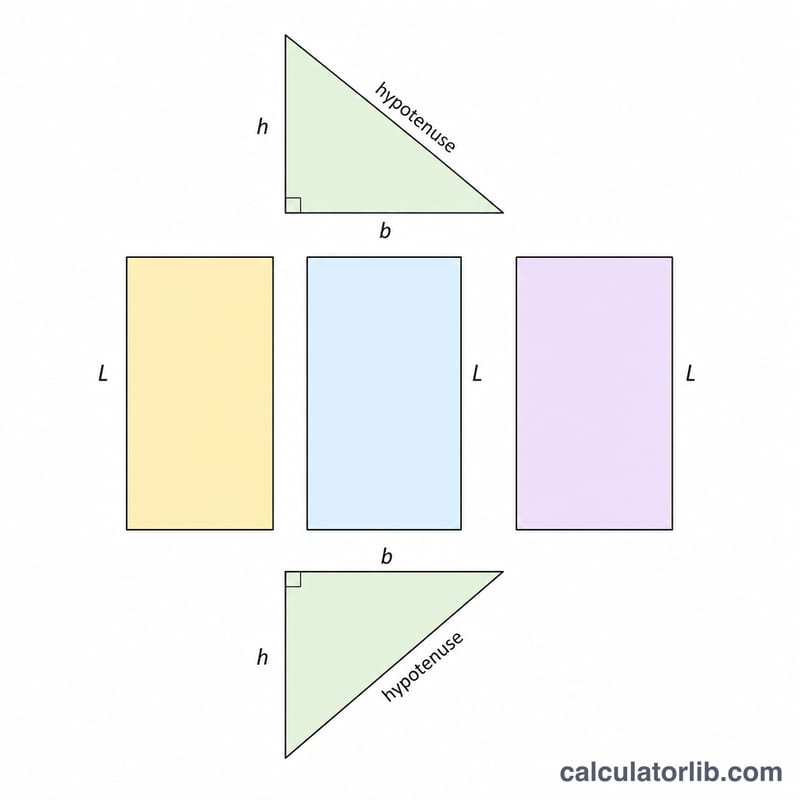
- The two triangle ends: 2 × (½ × b × h). Each triangle has area ½bh, and there are two of them.
- The three rectangular sides: the triangle's perimeter multiplied by the prism length. Since this is a right triangle, the third side (hypotenuse) is found with the Pythagorean theorem: √(b² + h²). So the perimeter is b + h + √(b² + h²).
Worked Example
Suppose the triangle base is 6, the triangle height is 8, and the prism length is 10.
- Triangle area = ½ × 6 × 8 = 24, so both ends = 48.
- Hypotenuse = √(6² + 8²) = √100 = 10.
- Triangle perimeter = 6 + 8 + 10 = 24.
- Rectangular sides = 24 × 10 = 240.
- Total surface area = 48 + 240 = 288 square units.
Frequently Asked Questions
Does this work for any triangular prism? It is designed for right-angled triangles, because it calculates the hypotenuse automatically as √(b² + h²). For a general triangle with a known third side, you would need to supply that side directly.
What units does the result use? Whatever unit you input, the surface area comes out in that unit squared — enter centimetres and you get cm².
What's the difference between surface area and volume? Surface area measures the total area of all outer faces (this calculator). Volume measures the space inside, which would be ½bh × l.