
What is a number sequence?
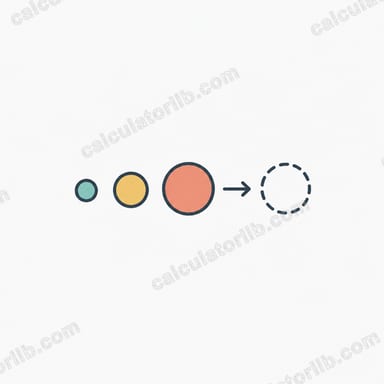
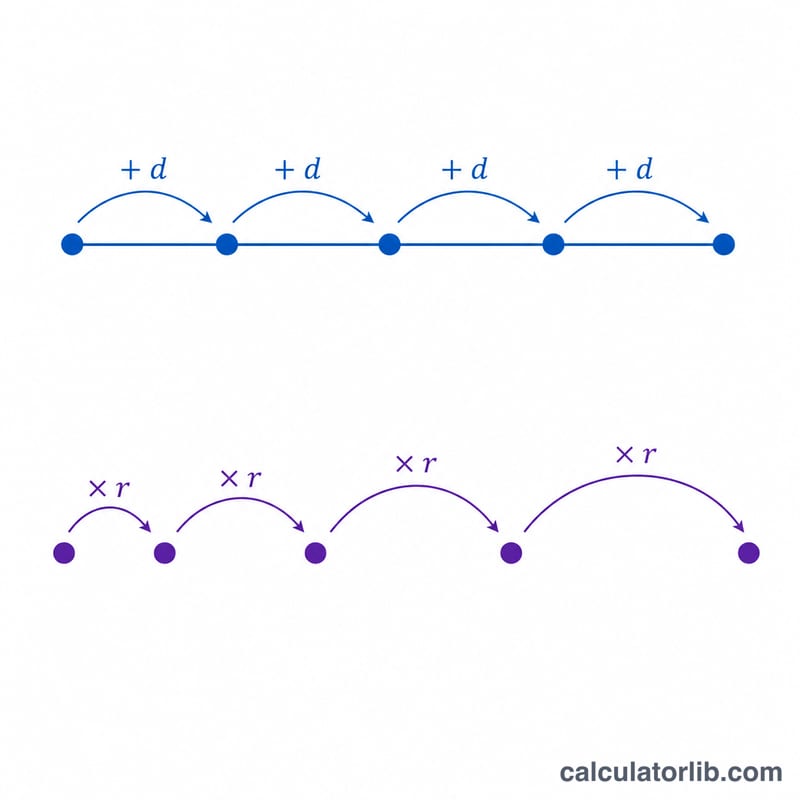
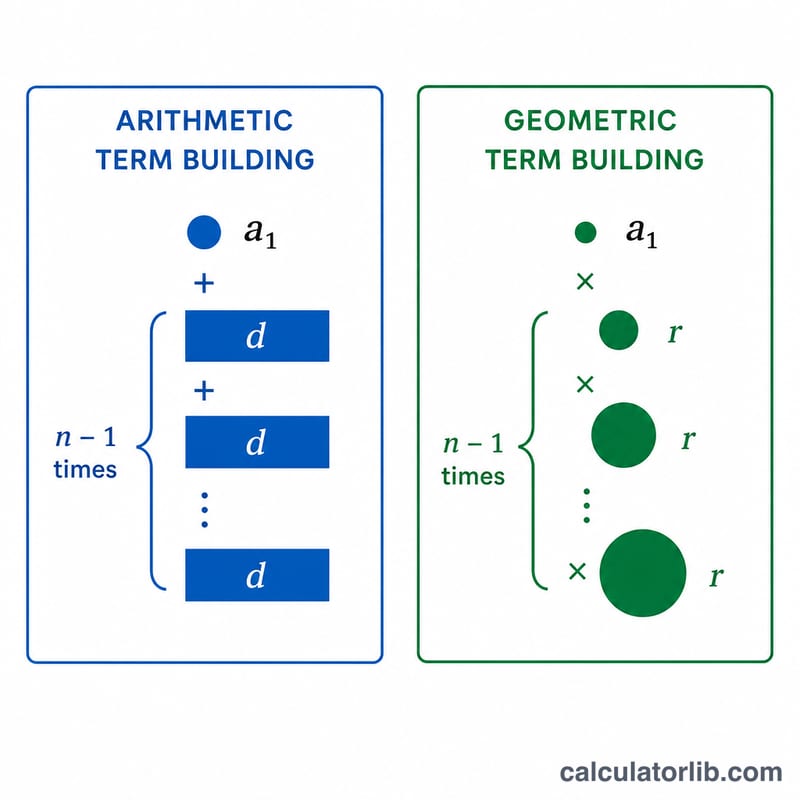
A number sequence is an ordered list of numbers that follows a fixed rule. The two most common types are arithmetic sequences, where each term increases by a constant amount (the common difference, \(d\)), and geometric sequences, where each term is multiplied by a constant factor (the common ratio, \(r\)). This calculator finds both the value of any chosen term (the nth term) and the sum of all terms up to that position.
How to use the calculator
Pick the sequence type, then enter three values: the first term (\(a_1\)), the common difference or ratio (\(d\) for arithmetic, \(r\) for geometric), and the term position \(n\) you want to evaluate. Press calculate to see the nth term \(a_n\) and the partial sum \(S_n\) of the first \(n\) terms.
The formulas explained
For an arithmetic sequence, every step adds \(d\), so the nth term is $$a_n = a_1 + (n-1)d$$ and the sum of the first \(n\) terms is $$S_n = \frac{n}{2}\left(2a_1 + (n-1)d\right),$$ which simply averages the first and last terms and multiplies by how many there are.
For a geometric sequence, every step multiplies by \(r\), giving $$a_n = a_1 \cdot r^{\,n-1}.$$ The sum is $$S_n = a_1 \cdot \frac{r^{\,n} - 1}{r - 1}$$ when \(r \neq 1\); if \(r = 1\) the sum is just \(a_1 \cdot n\).
Worked example
Take an arithmetic sequence with \(a_1 = 2\), \(d = 3\), and \(n = 10\). The 10th term is $$2 + (10-1)\cdot 3 = 2 + 27 = 29.$$ The sum of the first 10 terms is $$\frac{10}{2}\left(2\cdot 2 + 9\cdot 3\right) = 5\cdot(4 + 27) = 5\cdot 31 = 155.$$
FAQ
Can the common difference or ratio be negative? Yes. A negative \(d\) makes an arithmetic sequence decrease; a negative \(r\) makes a geometric sequence alternate sign.
What if the ratio is exactly 1? The geometric sum reduces to \(a_1 \times n\), which the calculator handles automatically.
Does n have to be a whole number? Yes — term position \(n\) is a positive integer (1, 2, 3, …).