
What is a linear (arithmetic) number sequence?
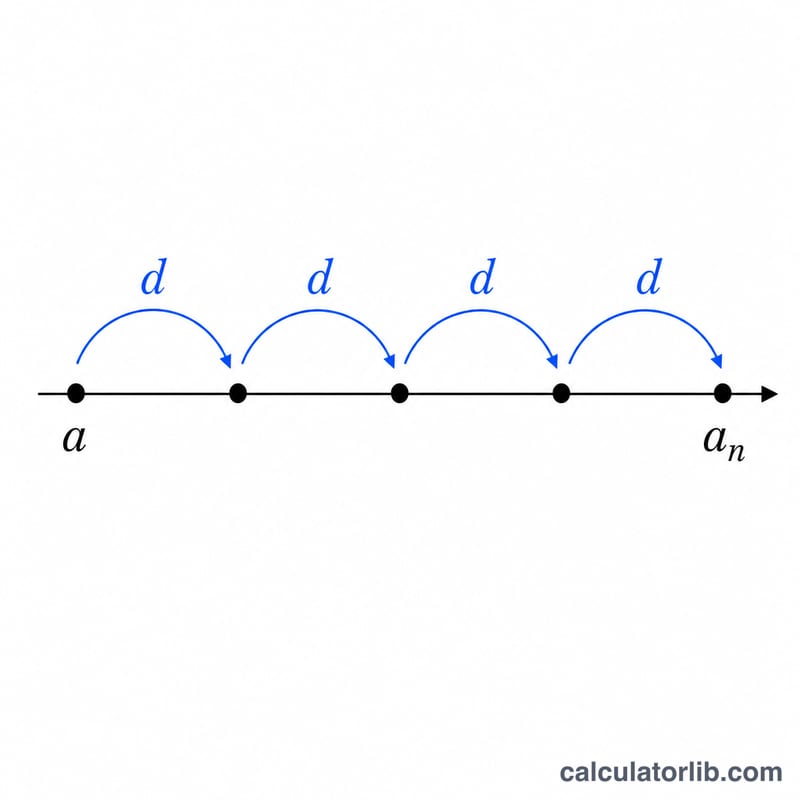
A linear number sequence — more commonly called an arithmetic sequence — is a list of numbers where each term increases (or decreases) by the same constant amount, called the common difference. Because the terms grow evenly, the whole sequence can be summed with a single, elegant formula instead of adding every term by hand. This calculator computes that total instantly.
How to use this calculator
Enter three values: the first term \(a_1\), the last term \(a_n\), and the total number of terms \(n\). Press calculate and you'll get the sum of the sequence, the number of terms, and the average term. You do not need to know the common difference — only the endpoints and how many terms there are.
The formula explained
The sum of a linear sequence is:
$$S = \frac{n \times (a_1 + a_n)}{2}$$
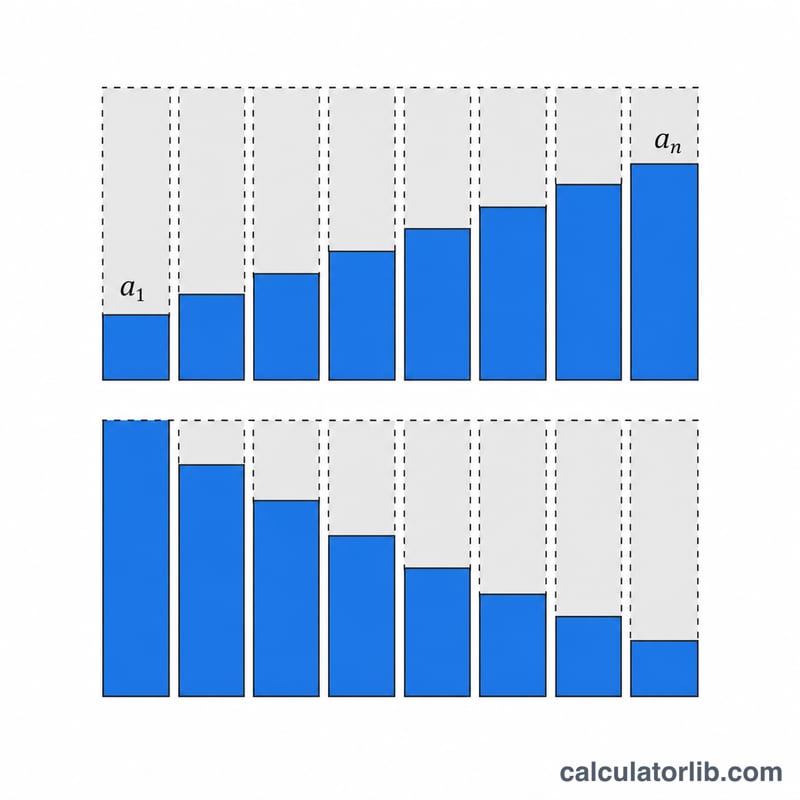
The idea is simple and famously attributed to Gauss: pair the first term with the last, the second with the second-to-last, and so on. Each pair adds up to the same value \((a_1 + a_n)\). With \(n\) terms you have \(n/2\) such pairs, giving \(S = n(a_1 + a_n)/2\). Equivalently, the sum equals the number of terms multiplied by the average term.
Worked example
Add the whole numbers from 1 to 100. Here \(a_1 = 1\), \(a_n = 100\), and \(n = 100\). So $$S = \frac{100 \times (1 + 100)}{2} = \frac{100 \times 101}{2} = 5050.$$ The average term is \((1 + 100)/2 = 50.5\), and \(100 \times 50.5 = 5050\) — exactly matching.
FAQ
Do I need the common difference? No. As long as you know the first term, the last term, and how many terms there are, the formula works for any arithmetic sequence.
Can the terms be negative or decimals? Yes. The formula handles negative numbers and decimal terms; just enter them directly.
What if the sequence decreases? That's fine — enter the larger value as \(a_1\) and the smaller value as \(a_n\). The sum will still be correct.