
What This Calculator Does
The Multiplying Exponents Calculator multiplies two powers that share the same base. Using the product of powers rule, it keeps the common base and adds the exponents together, then evaluates the final numeric value. This is one of the core laws of exponents and shows up constantly in algebra, scientific notation, and simplifying expressions.
How to Use It
Enter the shared base (a), the first exponent (m), and the second exponent (n). The calculator returns the combined exponent (m + n) and the final value of \(a^{m+n}\). Exponents may be positive, negative, or decimal.
The Formula Explained
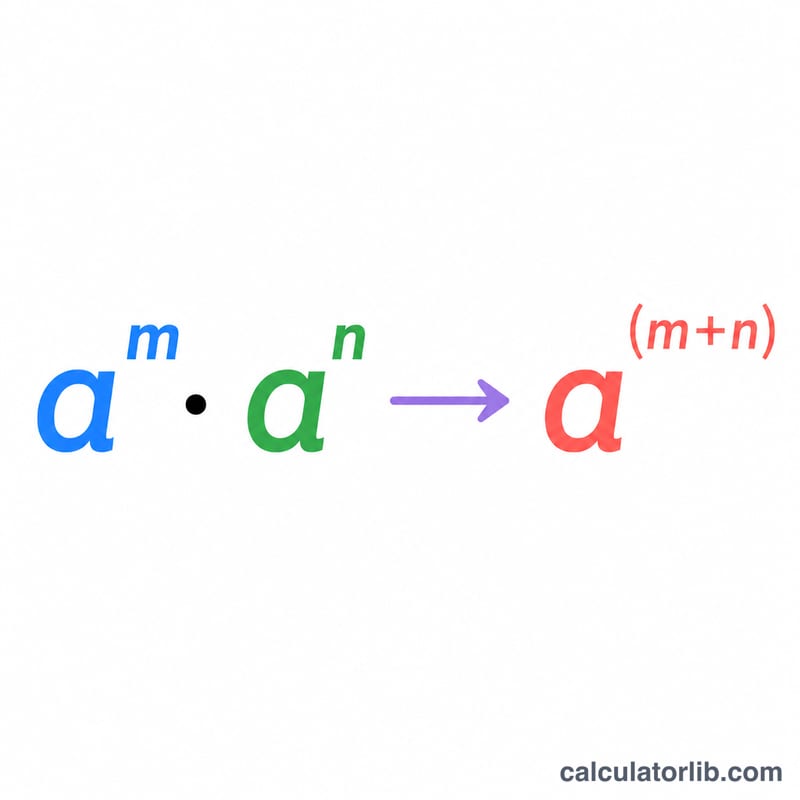
The rule is $$\text{a}^{\text{m}} \times \text{a}^{\text{n}} = \text{a}^{\left(\text{m} + \text{n}\right)}$$ It works because \(a^m\) means a multiplied by itself m times and \(a^n\) means a multiplied n times — putting them together gives a multiplied (m + n) times. The base must be identical for the rule to apply; you cannot combine \(2^3 \times 3^4\) this way.
Worked Example
Take \(2^3 \times 2^4\). Add the exponents: \(3 + 4 = 7\). So the answer is $$2^7 = 128$$ The calculator shows the combined exponent (7) and the final value (128).

FAQ
Can the bases be different? No. This rule only applies when both powers share the same base. With different bases you must evaluate each power separately.
Do negative exponents work? Yes. For example \(5^2 \times 5^{-2} = 5^0 = 1\).
What about dividing powers? For division you subtract exponents: \(a^m \div a^n = a^{(m-n)}\).