
What is the Large Exponents Calculator?
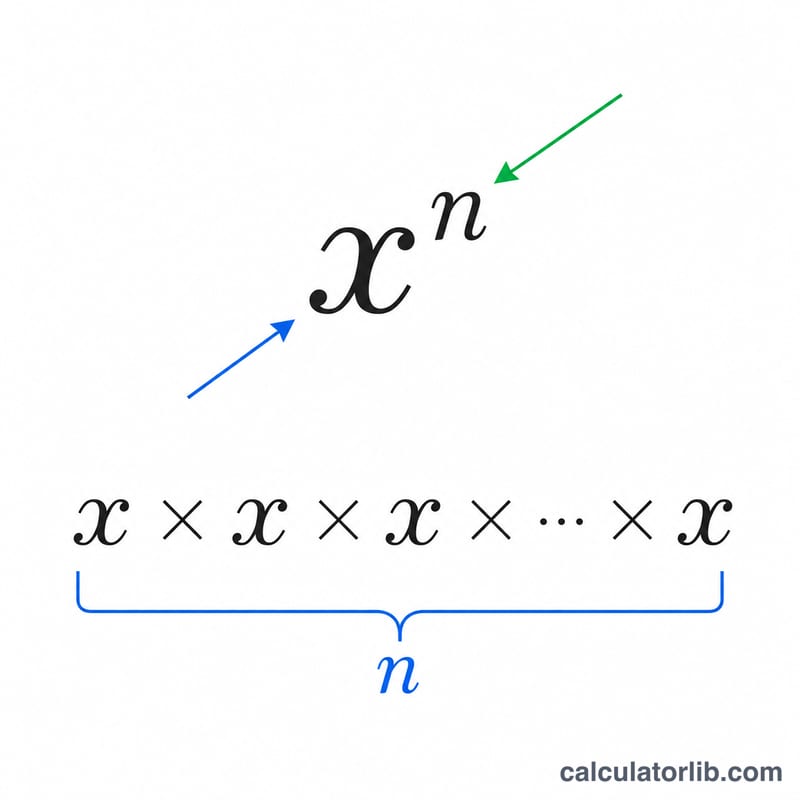
This calculator computes x raised to the power n (written \(x^n\)) for non-negative integers, including cases where the answer has thousands of digits. Because a number like \(2^{1000}\) has 302 digits, it is shown by default in scientific notation together with its total digit count. You can also display the complete exact integer, every digit included, using exact arbitrary-precision arithmetic.
How to use it
Enter the base x (0 to 9,999,999) and the exponent n (0 to 99,999). Both must be whole numbers greater than or equal to zero. Tick "show the full integer" if you want the entire number written out; leave it unchecked for a fast, compact scientific-notation result. For negative bases or decimal exponents, use a standard exponents calculator instead.
The formula explained
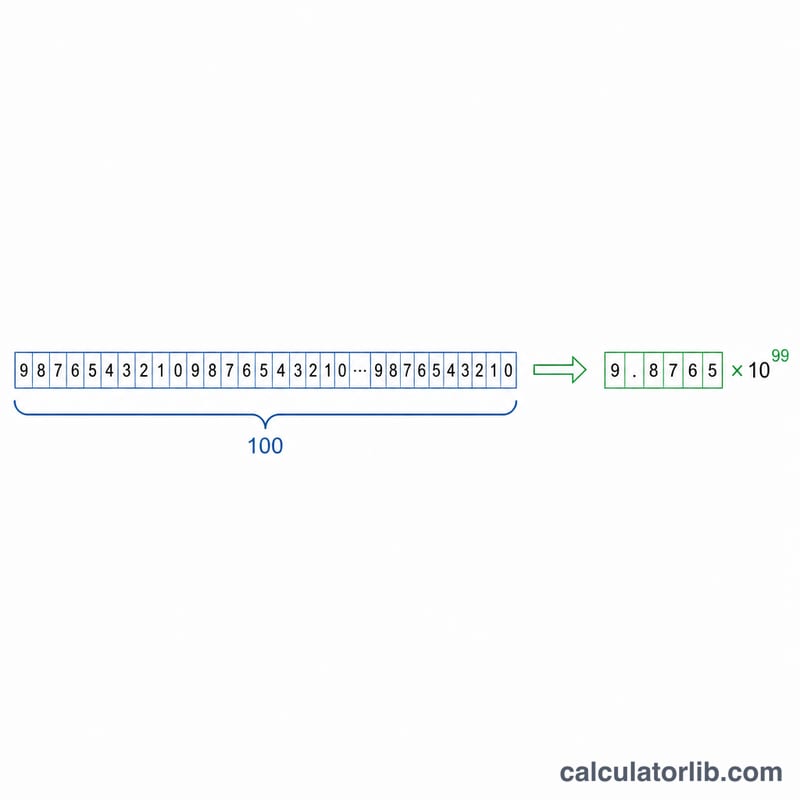
The exact value is \(r = x^n\). To express it in scientific notation we use logarithms: \(\log_{10}(r) = n \cdot \log_{10}(x)\). The power of ten is \(e = \lfloor \log_{10}(r) \rfloor\), and the mantissa is \(m = 10^{\log_{10}(r) - e}\), rounded to about ten significant figures. The number of digits in the full integer is simply \(D = e + 1\).
$$\text{x}^{\text{n}} = m \times 10^{e}$$
Worked example
Take \(x = 2\), \(n = 1000\). Then \(\log_{10}(2^{1000}) = 1000 \times 0.301029995664 = 301.029995664\). So \(e = 301\) and \(m = 10^{0.029995664} \approx 1.071508607\). Therefore $$2^{1000} \approx 1.071508607 \times 10^{301},$$ and it has \(301 + 1 = 302\) digits.
FAQ
What does \(0^0\) equal here? By this calculator's convention \(0^0 = 1\), matching most programming languages.
What is \(0^n\) for \(n > 0\)? It is 0, which we count as having 1 digit.
Why is the full integer hidden by default? Very large exponents can produce numbers with millions of digits, which are slow to render. Enable the checkbox only when you truly need every digit.