
What this calculator does
The Simplify Exponents Calculator applies the three core laws of exponents — the product rule, the quotient rule, and the power rule — to combine two exponents over a shared base into a single simplified power. It also computes the numeric value of the result, so you can check homework or verify algebra steps instantly.
How to use it
Enter the common base a, choose the operation you are performing, and type the two exponents m and n. The calculator returns the simplified expression in the form a raised to a single exponent, plus its decimal value.
- Product — for \(a^{m} \cdot a^{n}\)
- Quotient — for \(a^{m} / a^{n}\)
- Power — for \(\left(a^{m}\right)^{n}\)
The formula explained
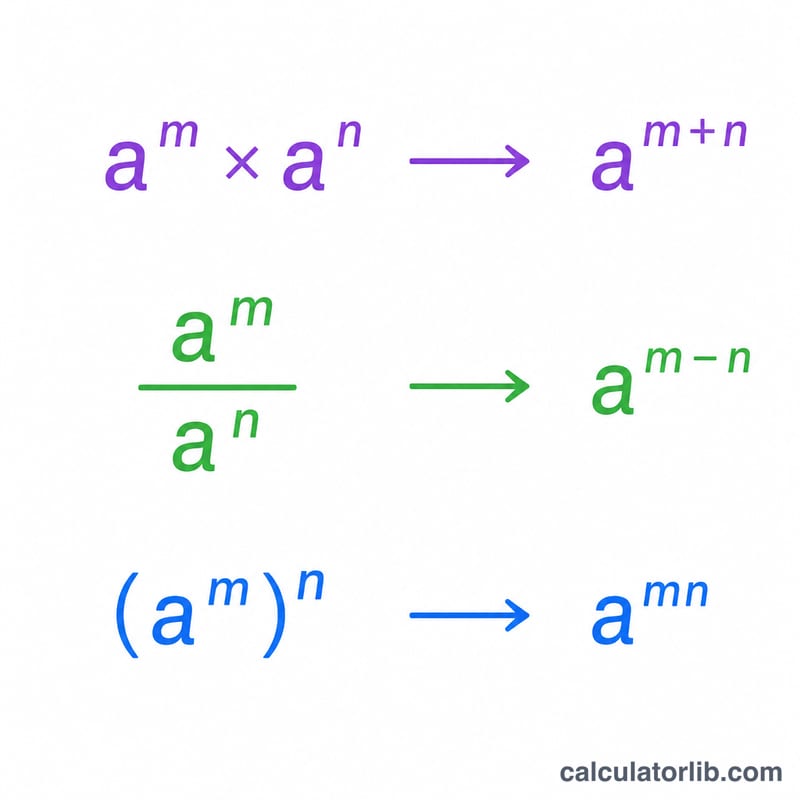
All three rules rely on the fact that an exponent counts repeated multiplication of the same base. Multiplying powers adds exponents: $$a^{m} \cdot a^{n} = a^{\,m + n}$$ Dividing subtracts them: $$\frac{a^{m}}{a^{n}} = a^{\,m - n}$$ Raising a power to another power multiplies them: $$\left(a^{m}\right)^{n} = a^{\,m \times n}$$ These hold for any real base and exponents (with \(a \neq 0\) for division).
Worked example
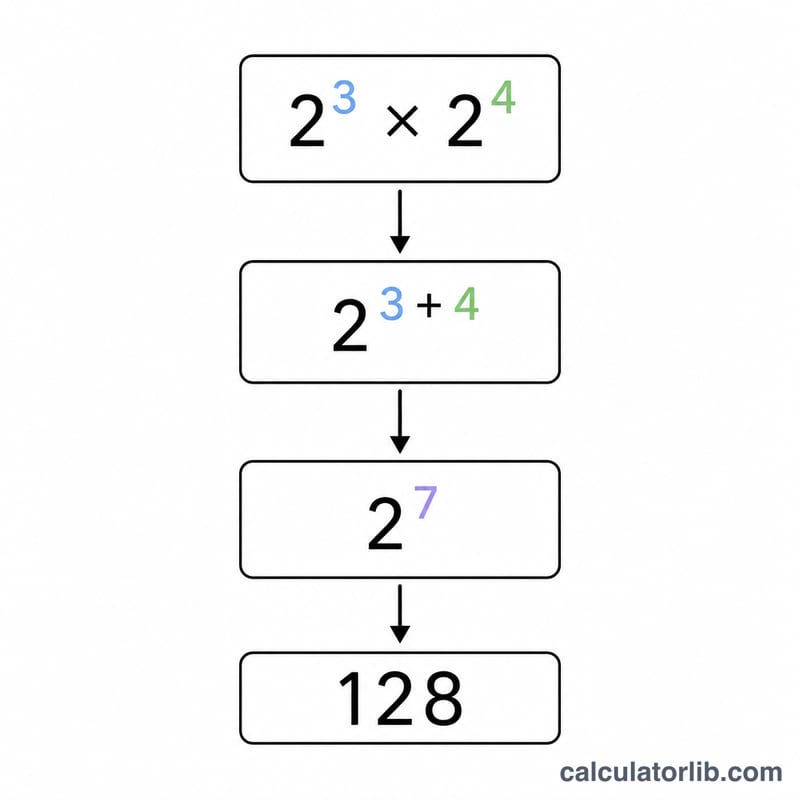
Simplify \(2^{3} \cdot 2^{2}\). Using the product rule, add the exponents: \(3 + 2 = 5\), so the result is $$2^{5} = 32$$ If instead you had \(\left(2^{3}\right)^{2}\), the power rule gives \(3 \times 2 = 6\), so $$2^{6} = 64$$
FAQ
Do the bases have to match? Yes. The product and quotient rules only apply when both powers share the same base.
Can I use negative or fractional exponents? Yes — the rules work for any real exponents. The numeric value may be a fraction or decimal.
What about a zero base? Avoid a base of 0 with division or negative exponents, since that produces an undefined value.