
What this converter does
This tool converts molar concentration between the common SI prefixes used in chemistry and biology: molar (M), millimolar (mM), micromolar (µM), nanomolar (nM) and picomolar (pM). It is a universal unit conversion — the same arithmetic applies everywhere in the world. A frequent lab task is converting micromolar to nanomolar, where the value is simply multiplied by 1000.
How to use it
Enter your concentration value, pick the unit you are converting from, then pick the unit you want the answer in. The result updates with the converted figure and shows the power-of-ten multiplier used.
The formula explained
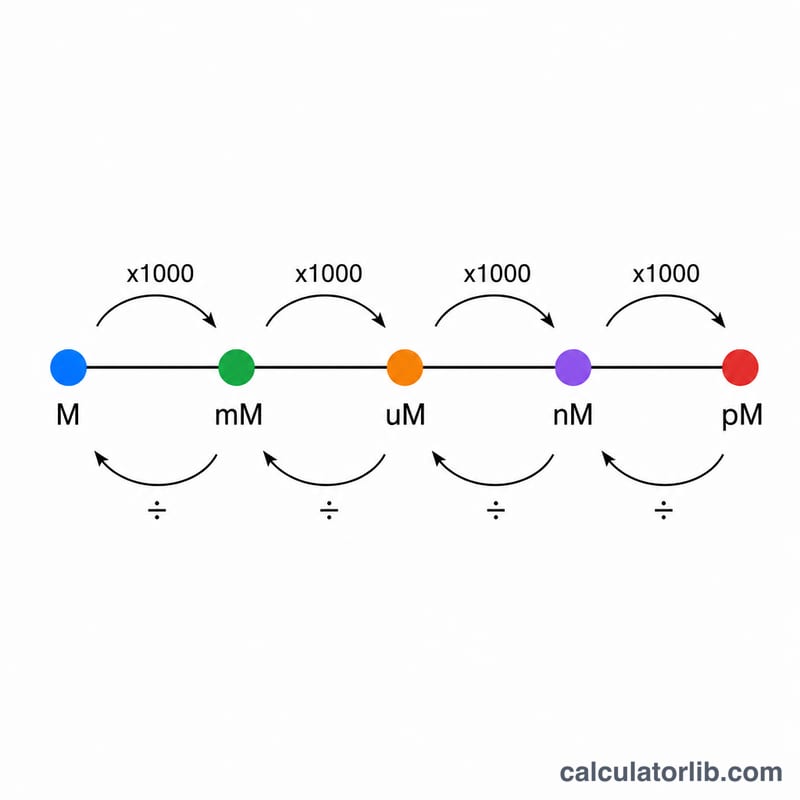
Each prefix corresponds to a power of ten relative to the base unit (molar). M is \(10^0\), mM is \(10^{-3}\), µM is \(10^{-6}\), nM is \(10^{-9}\) and pM is \(10^{-12}\). To convert, multiply your value by 10 raised to the difference of the source exponent and target exponent:
$$C_{\text{to}} = C_{\text{from}} \times 10^{\left(e_{\text{from}} - e_{\text{to}}\right)}$$Because each step down the list is a factor of 1000, moving one prefix smaller multiplies the number by 1000 and moving one larger divides by 1000.
Worked example
Convert 2.5 µM to nM. The source exponent is −6 and the target is −9, so the difference is \(-6 - (-9) = 3\). The multiplier is \(10^3 = 1000\), giving
$$2.5 \times 1000 = 2500 \text{ nM}$$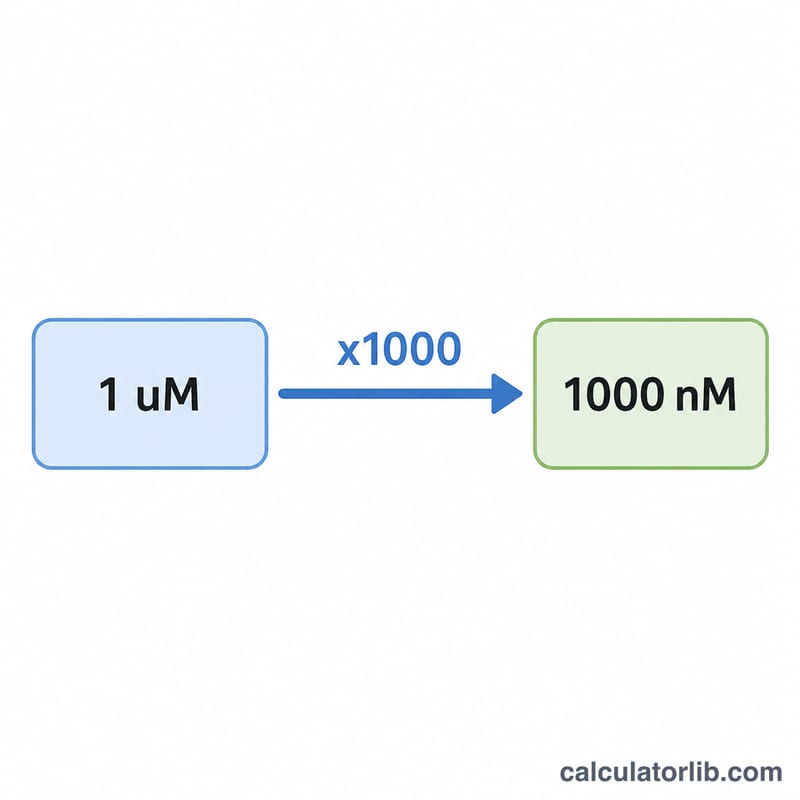
FAQ
How many nM are in 1 µM? Exactly 1000 nM, because micromolar is one thousand times more concentrated than nanomolar.
How do I convert nM back to µM? Divide by 1000 (or multiply by \(10^{-3}\)), so 500 nM = 0.5 µM.
Does this depend on the substance? No. Molarity is moles per litre, so prefix conversions are pure powers of ten and are independent of the compound.